

How Venture Backed Companies Build Repeatable Revenue
Capital gives venture backed companies permission to move faster. It does not automatically make growth repeatable.
After a round closes, the operating question changes. The company is no longer simply proving that customers will buy. It must prove that revenue can be produced again and again through a system that investors, operators, and future buyers can understand.
That system is what separates a promising company from a scalable one. Repeatable revenue means leadership can identify the best-fit customer, explain why they buy, predict how pipeline will convert, support customers after the sale, and show which commercial levers will create the next stage of growth.
For venture backed companies, this is the bridge between product-market fit and durable scale. It is also the foundation for stronger board confidence, cleaner fundraising narratives, and better exit readiness. The challenge is that many companies try to scale before they have made revenue predictable. They hire more sellers, launch more campaigns, and open more markets, but the underlying commercial model is still too dependent on founder charisma, one-off relationships, or a handful of early adopters.
The better path is to design repeatability before adding complexity.
What repeatable revenue really means
Repeatable revenue is not the same as recurring revenue.
Recurring revenue describes how customers pay. Repeatable revenue describes how the company creates, wins, retains, and expands revenue through a known operating model. A subscription business can still have non-repeatable revenue if every deal requires custom positioning, unusual discounting, founder involvement, or unpredictable delivery. A transactional business can be repeatable if it has a clear customer segment, consistent acquisition economics, and reliable purchase behavior.
In venture backed companies, repeatability usually depends on five conditions:
| Condition | What it proves | Evidence leadership should see |
|---|---|---|
| Clear customer pattern | The company knows who buys and why | Segment-level win rates, sales cycles, deal sizes, and retention patterns |
| Consistent acquisition motion | New customers can be generated without heroics | Reliable lead sources, conversion rates, and pipeline creation by channel |
| Defined sales process | Deals move through observable buyer commitments | Stage criteria, qualification standards, and forecast accuracy |
| Healthy economics | Growth does not destroy margin or cash efficiency | CAC discipline, pricing control, payback logic, and expansion potential |
| Durable customer value | Customers stay, expand, or return | Retention, usage, renewals, repeat purchase, referrals, or account growth |
This is why investors do not only look at headline growth. They look for the mechanics underneath it. If you want a deeper investor lens, the same logic appears in what venture investment teams look for in revenue models, especially around revenue quality, pricing power, and customer acquisition repeatability.
Start by turning early wins into a revenue hypothesis
Early revenue is often noisy. Founders sell to their networks. Customers buy because they trust the team. The product may be flexible enough to solve several different problems, which makes the company feel like it has a large market. But a broad set of early wins is not yet a repeatable model.
The first step is to convert those wins into a specific revenue hypothesis. This is a structured answer to a simple question: where can we win repeatedly with attractive economics?
A useful revenue hypothesis should define the target customer, the trigger event that makes the problem urgent, the buying committee, the value proposition, the sales motion, and the expected economics. It should be narrow enough to test, but not so narrow that it limits future expansion.
Leadership should study early customers through a commercial lens, not just a product lens. The best segment is not always the one with the most logos. It may be the segment with the shortest sales cycle, the lowest service burden, the highest expansion potential, or the clearest pain.
Good questions include:
- Which customers bought fastest and required the least persuasion?
- Which customers had the clearest economic reason to act now?
- Which deals closed without excessive customization or discounting?
- Which customers became references, expanded, or renewed?
- Which customer type produced the strongest gross margin after delivery effort?
This exercise often reveals that the company has been chasing revenue volume instead of revenue quality. Venture capital rewards growth, but the strongest growth stories are built on segments where the company can win predictably.
Build one primary go-to-market motion before scaling many
Many venture backed companies dilute their revenue model by trying to scale every go-to-market motion at once. They run founder-led enterprise sales, hire outbound reps, invest in paid acquisition, explore channel partnerships, attend events, test product-led growth, and create content, all before one motion is truly predictable.
Experimentation is healthy. Confusing experimentation with scale is not.
A repeatable company selects a primary motion based on customer behavior, deal complexity, price point, and buying urgency. Other motions can support it, but they should not compete for operational attention before the core motion works.
| Go-to-market motion | Best fit | Repeatability test |
|---|---|---|
| Founder-led strategic sales | Early enterprise validation, complex markets, high trust deals | Can the founder’s message be translated into a teachable sales process? |
| Sales-led outbound | Defined ICP, identifiable buyers, meaningful contract values | Can reps create qualified opportunities without relying on founder access? |
| Inbound or content-led | Educated buyers, active search demand, category awareness | Does content convert into qualified pipeline, not just traffic? |
| Partner or channel-led | Ecosystems with trusted intermediaries or embedded distribution | Can partners source and close without excessive internal support? |
| Product-led growth | Low-friction adoption, measurable product value, broad user base | Do users activate, adopt, and convert at predictable rates? |
The right answer depends on the company’s stage and market. A high-ticket enterprise platform may need a sales-led motion with strong executive selling. A lower-cost product with clear self-serve demand may build around product usage and expansion. A specialist service or regulated solution may need partnerships to access trust and distribution.
The key is alignment. Venture funding changes expectations for the commercial engine, and the GTM must evolve accordingly. That shift is explored further in how venture capital investment shapes GTM strategy, where the operating model moves from proving demand to scaling it with discipline.
Translate the motion into operating math
Repeatable revenue becomes real when the model can be expressed in operating math.
The leadership team should be able to connect revenue targets to pipeline requirements, pipeline requirements to opportunity creation, and opportunity creation to specific channels, people, and activities. This does not mean every forecast will be perfect. It means the company understands the inputs that drive the outcome.
A simple planning chain looks like this:
Target revenue divided by average contract value equals required wins. Required wins divided by win rate equals qualified opportunities needed. Qualified opportunities divided by source conversion equals the channel or activity requirement.
That math should then be adjusted for sales cycle length, ramp time, seasonality, churn, expansion, and capacity. Without those adjustments, companies create plans that look good in a spreadsheet but fail in execution.
The most useful revenue scorecard is not overloaded. It focuses on the few metrics that show whether the system is working.
| Metric | Why it matters | Warning sign |
|---|---|---|
| Qualified pipeline by source | Shows whether demand creation is dependable | Pipeline exists, but most of it is low fit or late stage hope |
| Stage conversion rates | Reveals where buyers lose confidence | Opportunities enter the funnel but stall before proposal or close |
| Sales cycle length | Helps forecast timing and cash needs | Deals slip repeatedly with no clear buyer commitment |
| Average contract value or order value | Shows whether targeting and packaging are working | More customers are added, but deal quality declines |
| Gross retention or repeat purchase | Proves customers continue to value the offer | New logo growth hides post-sale leakage |
| Expansion revenue | Indicates account growth potential | Customers renew but do not broaden usage or spend |
| Rep productivity | Determines whether hiring will scale revenue | New hires add cost before the model is teachable |
Operating math also creates accountability. If pipeline is weak, the company can inspect source performance. If win rates drop, it can inspect qualification, messaging, competition, or pricing. If sales cycles lengthen, it can inspect urgency, authority, procurement, or buyer education.
Without this level of instrumentation, leadership ends up managing anecdotes.
Standardize the sales process without killing judgment
A repeatable sales process does not turn sellers into robots. It gives them a shared operating language.
The most common mistake is defining sales stages around seller activity instead of buyer evidence. “Demo completed” is not a meaningful stage if the buyer has not confirmed a business problem, decision process, budget path, or reason to change. A stronger stage definition identifies what the buyer has done, agreed to, or committed to.
For example, a qualified opportunity should not simply mean that a prospect took a meeting. It should mean the company has verified a real pain, a relevant use case, a plausible economic case, and access to the people who influence the decision.
A teachable sales process typically includes the core customer pains, discovery questions, qualification rules, proof points, objection handling, proposal standards, pricing guardrails, and handoff expectations. It should make good judgment easier, not replace it.
This is especially important when the company hires its first sales leader or expands beyond founder-led selling. Many teams hit a growth ceiling because the founder’s instincts were never converted into a repeatable system. When that happens, the company often appears to have a hiring problem, but the deeper issue is GTM design. That pattern is common when venture capital backed companies outgrow their GTM faster than their commercial infrastructure can support.
Make retention and expansion part of the revenue engine
Many venture backed companies focus heavily on new logo acquisition because it is visible, exciting, and easy to connect to growth targets. But repeatable revenue is incomplete if the post-sale system is weak.
Customer retention proves that the company is solving a problem that remains important after the purchase. Expansion proves that the company can increase value inside an account over time. Both are essential to revenue quality.
For software companies, this may involve activation, adoption, usage depth, renewal process, and expansion triggers. For service-led companies, it may involve account planning, delivery consistency, executive relationships, and measurable client outcomes. For marketplaces or transactional models, it may involve repeat purchase frequency, customer cohorts, supply quality, and reliability.
The principle is the same across models: the company must define what healthy customer value looks like before there is a renewal risk or revenue gap.
A strong post-sale system answers several questions. What must happen in the first 30, 60, or 90 days for the customer to see value? Which behaviors predict renewal or repeat purchase? Which accounts have expansion potential? Which customers are costly to serve relative to their revenue? Which issues should trigger executive attention?
Revenue repeatability improves when customer success, delivery, product, and sales operate from the same customer truth. Otherwise, sales promises one thing, delivery discovers another, and leadership learns about risk too late.
Protect revenue quality as complexity increases
Scale introduces revenue debt. It often appears slowly, then becomes expensive.
Discounting becomes inconsistent. Contracts include too many custom terms. New market segments require different messaging. Sales hires interpret the ICP differently. Customer handoffs break. Forecast categories become subjective. Data quality declines. The company is still growing, but the growth is harder to explain, harder to forecast, and harder to defend in diligence.
This is the point where commercial infrastructure matters. Repeatability requires guardrails around pricing, segmentation, contracts, service commitments, data definitions, and leadership cadence.
Legal and operational review also becomes part of revenue architecture, not a back-office afterthought. For companies expanding into New York or Connecticut with matters involving real estate, landlord-tenant issues, bankruptcy, consumer debt, or civil litigation, experienced counsel such as Clair Gjertsen Weathers PLLC can help reduce friction before it interrupts commercial momentum.
Revenue quality is not only about selling more. It is about making sure the revenue being sold is clean, deliverable, profitable, and transferable. That is what future investors or buyers want to see.
Install a cadence investors can trust
Repeatable revenue needs a management rhythm. Venture backed companies should not wait for board meetings to discover that the plan is off track.
A good cadence separates leading indicators from lagging indicators. Revenue booked is a lagging indicator. Qualified pipeline created, stage movement, customer activation, and renewal risk are leading indicators. Leadership needs both.
| Cadence | Focus | Output |
|---|---|---|
| Weekly revenue meeting | Pipeline movement, deal risk, source performance, near-term blockers | Clear actions, owner accountability, and forecast updates |
| Monthly operating review | Conversion trends, capacity, churn or retention, channel performance | Decisions on resources, messaging, pricing, and process changes |
| Quarterly strategy review | Segment performance, market expansion, hiring plan, board narrative | Updated growth thesis and investment priorities |
The board narrative should connect numbers to decisions. If pipeline is growing but win rates are falling, leadership should explain the cause and the corrective action. If retention is improving, they should explain which customer segments or product changes are driving it. If sales productivity is uneven, they should show whether the issue is hiring, ramp, enablement, territory design, or pipeline quality.
Investors do not expect every plan to be perfect. They do expect the company to understand its commercial system and respond quickly when the data changes.
Use AI and automation after the revenue system is clear
AI can make a strong revenue system faster. It can also make a weak system noisier.
Before automating sales, marketing, or customer success activity, venture backed companies need clear definitions. What is the ICP? What counts as a qualified lead? Which buyer signals matter? What information must be captured after discovery? Which accounts deserve expansion focus? Which churn risks require intervention?
Once those definitions exist, AI-powered automation can support research, segmentation, workflow consistency, call summarization, CRM hygiene, customer risk detection, and reporting. At a portfolio level, common data structures can also help sponsors compare revenue health across companies more consistently.
The caution is simple: do not automate ambiguity. If the commercial process is unclear, automation may increase activity without improving revenue quality. The best use of AI is to reinforce a well-designed revenue architecture, not compensate for the absence of one.
Signs revenue is not yet repeatable
Leadership teams often know something feels fragile before the metrics make it obvious. The warning signs usually show up in patterns like these:
- A small number of founders, executives, or top reps create most of the revenue.
- Forecasts change significantly late in the quarter or month.
- Win rates vary widely by rep, segment, or lead source without a clear explanation.
- Discounting increases whenever the company needs to hit a target.
- New hires take too long to ramp because the sales process is not teachable.
- Customer churn, renewal risk, or delivery strain is explained away as a customer issue.
- Growth comes from many small experiments, but no motion has been proven at scale.
These signals do not mean the company is failing. They mean the revenue system needs design before more capital, headcount, or market expansion is added.
Frequently Asked Questions
What is repeatable revenue for venture backed companies? Repeatable revenue is the ability to generate, win, retain, and expand revenue through a clear operating system rather than one-off effort. It depends on a defined ICP, consistent acquisition motion, measurable sales process, healthy economics, and durable customer value.
When should a venture backed company scale sales headcount? Sales headcount should scale when the company has evidence that a defined motion works. That means clear qualification rules, reliable pipeline sources, consistent stage conversion, teachable messaging, and enough demand to support new sellers after ramp.
Is repeatable revenue only relevant for SaaS companies? No. SaaS companies often discuss repeatability because of recurring revenue models, but the principle applies to services, marketplaces, transactional businesses, and hybrid models. Any venture backed company needs to show that growth can be reproduced with discipline.
Should founders stop selling once a sales team is hired? Founders should not disappear from the commercial process too early. Their role should evolve from being the primary seller to helping codify the message, support strategic deals, coach the team, and transfer market insight into the broader revenue system.
Can AI help create repeatable revenue? AI can support repeatable revenue when the commercial definitions are already clear. It can improve research, workflows, reporting, and customer signals, but it should not be used to scale an undefined ICP, unclear sales process, or weak customer handoff.
The real goal: growth the company can explain
Venture backed companies do not build repeatable revenue by pushing harder. They build it by designing a commercial system that can be measured, taught, improved, and trusted.
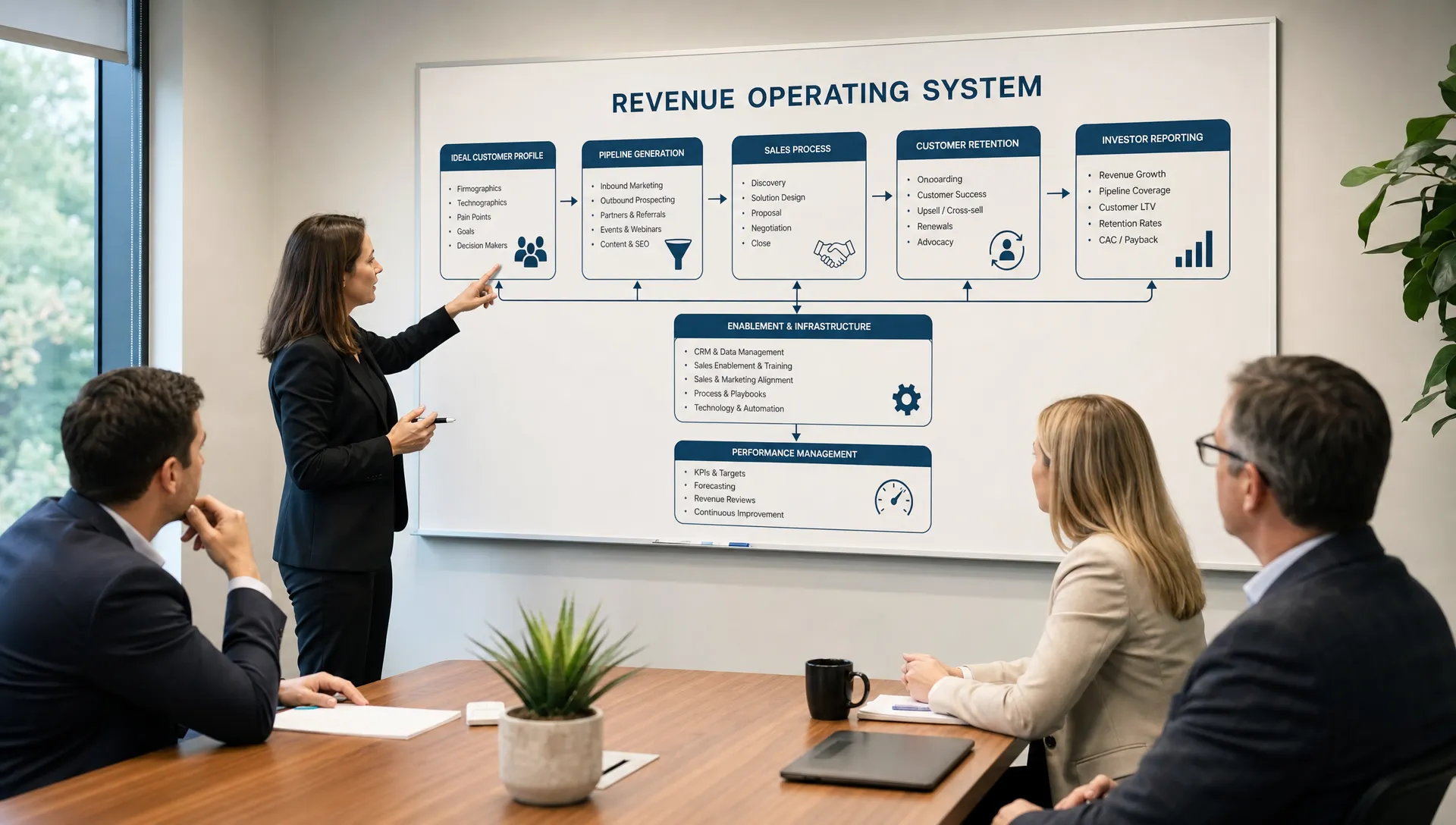
That system starts with a narrow revenue hypothesis, then grows through disciplined GTM design, operating math, sales process, retention infrastructure, revenue quality controls, and investor-grade cadence. Once those pieces are in place, capital can accelerate the model instead of exposing its weaknesses.
If your portfolio company has momentum but inconsistent pipeline, founder-dependent selling, weak forecast confidence, or unclear expansion logic, Phil Pelucha Consulting helps PE, VC, family offices, and portfolio companies assess and install the commercial infrastructure needed for revenue acceleration and exit readiness.