
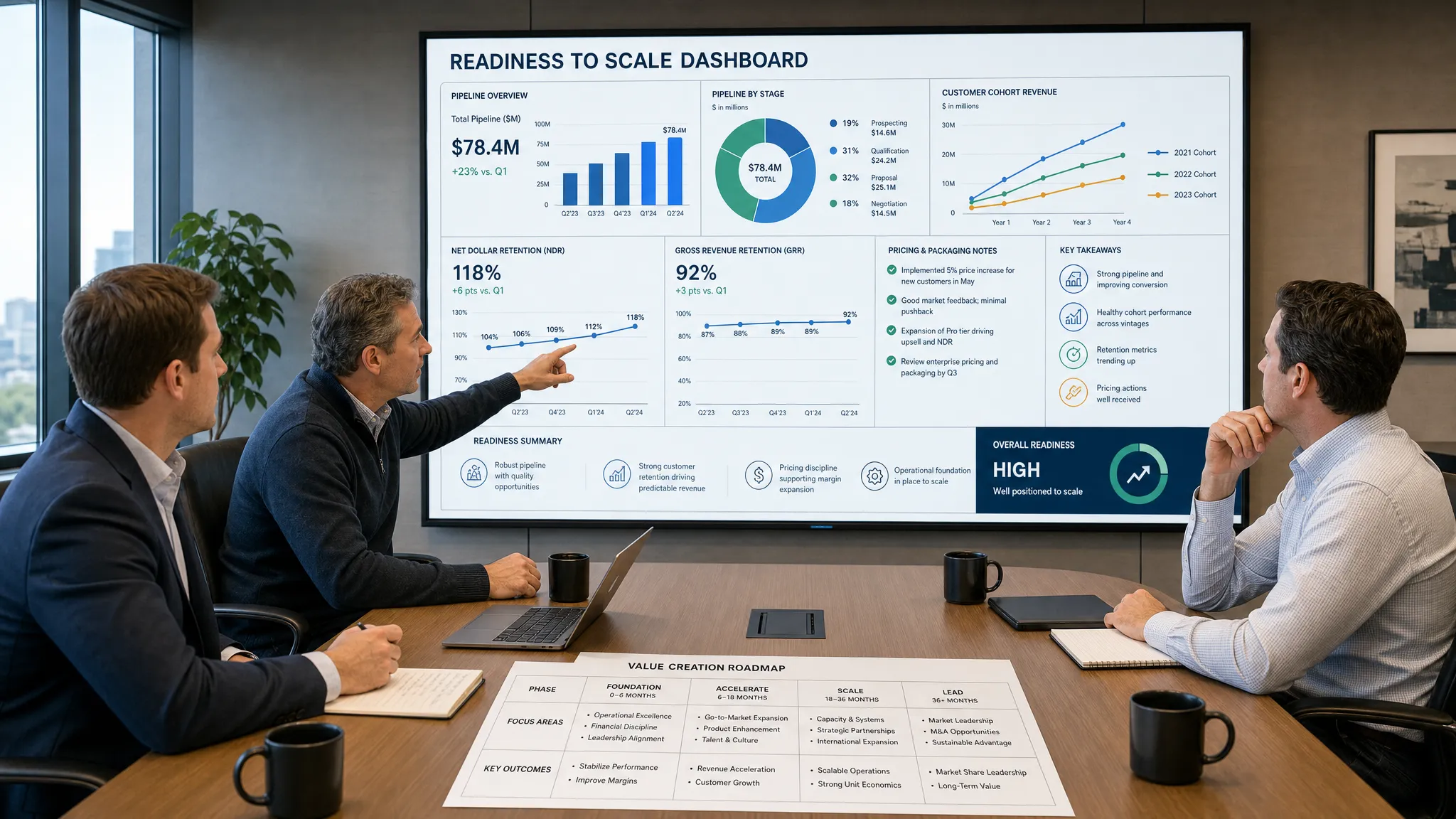
What Every Portfolio Company Needs Before Scaling
Scaling is where a portfolio company proves or breaks its investment thesis. Add salespeople too early, and the company burns cash while exposing weak positioning. Enter a new market before the revenue motion is repeatable, and management learns expensive lessons in public. Automate a broken process, and AI simply makes the mess move faster.
For PE sponsors, VC investors, family offices, and operating teams, the question is not whether to scale. The real question is whether the company is ready to absorb growth capital, headcount, and complexity without sacrificing margin quality or exit value.
A portfolio company needs more than ambition before scaling. It needs commercial proof, operating discipline, clean data, accountable leadership, and a clear view of where growth will actually come from.
Scaling is not the same as growth
Growth can be accidental. A founder lands a few large accounts. A product gets pulled into a hot category. A competitor stumbles. A sales leader overperforms because of personal relationships.
Scaling is different. Scaling means the company can increase revenue in a repeatable way without requiring heroic effort from a few individuals or creating disproportionate cost, churn, service pressure, or management drag.
A scalable portfolio company can answer three questions with evidence:
- Who buys, why they buy, and why now
- Which channels create profitable demand
- Which operating model can support more customers, markets, and revenue without breaking
If those answers are vague, scaling becomes speculation. The company may still grow, but the quality of that growth becomes harder to defend during diligence, harder to forecast in the boardroom, and harder to convert into a premium valuation.
Start with a sponsor-aligned value creation thesis
Before management scales anything, the board and sponsor need alignment on the commercial objective. Revenue for its own sake is not always the right target. A company preparing for exit may need higher-quality recurring revenue. A platform acquisition may need category leadership in a specific segment. A founder-led business may need a sales system that no longer depends on the founder.
The scaling plan should connect directly to the value creation thesis. If the thesis is margin expansion, the company cannot chase growth that requires heavy discounting or excessive implementation support. If the thesis is market expansion, leadership must know which market, which buyer, and which proof points are required before committing capital.
| Alignment area | Decision before scaling | Why it matters |
|---|---|---|
| Growth target | New logo growth, expansion revenue, market entry, or channel growth | Prevents scattered commercial activity |
| Time horizon | 90-day momentum, 12-month transformation, or exit preparation | Sets the right operating cadence |
| Capital intensity | Sales hiring, marketing spend, partnerships, or automation | Helps protect cash and EBITDA quality |
| Value driver | Revenue mix, retention, margin, category position, or strategic buyer appeal | Links scaling to valuation |
| Accountability | CEO, CRO, operating partner, or sponsor advisor | Reduces confusion when tradeoffs appear |
This alignment should be documented in plain language. If the CEO, CFO, CRO, and sponsor each describe the growth plan differently, the company is not ready to scale.
Validate the ideal customer profile before adding fuel
One of the most common scaling mistakes is confusing a large total addressable market with a precise ideal customer profile. A large market tells investors there is room to grow. It does not tell the sales team who to call tomorrow.
A portfolio company should know its highest-probability customer segments before increasing sales and marketing investment. That means understanding the buying trigger, decision process, budget owner, competitive alternatives, implementation constraints, and reasons deals are lost.
This work does not need to be theoretical. Win-loss interviews, CRM analysis, customer cohort reviews, and frontline sales conversations usually reveal patterns quickly. The company may discover that its best customers share the same urgency, compliance requirement, operational pain, geographic footprint, or integration need.
The goal is not to make the market smaller forever. The goal is to scale from a position of focus. A narrow ICP creates better messaging, cleaner pipeline qualification, faster onboarding, more accurate forecasting, and stronger case studies. Once the motion is repeatable, expansion becomes much safer.
Build a repeatable revenue motion
A scalable revenue engine has more than a talented sales team. It has a defined process that ordinary humans can follow and improve.
At minimum, the portfolio company should know how leads are generated, how opportunities are qualified, how discovery is conducted, how proposals are structured, how pricing is approved, and how handoff to delivery or customer success works. Each stage should have exit criteria, not just a label in the CRM.
A repeatable revenue motion should include:
- A clear definition of qualified pipeline and disqualified pipeline
- Stage-by-stage conversion metrics that leadership trusts
- Sales cycle data by segment, deal size, and channel
- Documented discovery, proposal, negotiation, and handoff processes
- A forecast methodology that separates committed deals from hope
- A feedback loop between sales, marketing, product, finance, and delivery
This is where many companies discover the difference between performance and repeatability. A top rep may close deals through intuition and relationships. That is valuable, but it is not yet a system. Scaling requires management to translate individual excellence into process, training, enablement, and measurable standards.
Install a commercial operating system
A portfolio company cannot scale with quarterly updates and scattered spreadsheets. It needs a commercial operating system, meaning the management rhythm, metrics, governance, and decision rights that keep growth under control.
This operating system should be practical, not bureaucratic. The best version gives leadership a weekly view of what is working, what is stuck, and what needs intervention. It should also help the sponsor understand whether the value creation plan is progressing or drifting.
| Operating element | What should be in place | Failure mode if missing |
|---|---|---|
| Weekly revenue meeting | Pipeline movement, forecast changes, blockers, next actions | Forecast surprises and reactive management |
| Monthly performance review | CAC trends, win rates, sales cycle, retention, gross margin | Growth that looks strong but weakens economics |
| Deal review discipline | Qualification, buyer process, business case, competition | Reps chase poor-fit opportunities |
| Customer feedback loop | Churn reasons, implementation friction, expansion signals | Sales promises exceed operational reality |
| Board-level scorecard | Key commercial indicators tied to the thesis | Sponsor and management debate opinions instead of evidence |
For sponsors that need an independent view of commercial readiness, commercial diagnostics and revenue acceleration support can help identify whether the current engine is ready to scale or whether foundational work is needed first.
Make sure leadership can carry the next stage
The leadership team that got the business to its current size may be highly capable, but scaling often requires a different operating muscle. Founder-led selling, informal account management, and relationship-based forecasting can work well in the early stages. They become fragile as the company adds territories, channels, customer segments, and reporting demands.
Before scaling, assess whether the company has the right commercial leadership capacity. This does not always mean hiring a full-time CRO immediately. In some cases, a fractional CRO or sponsor-level commercial advisor can install the cadence, process, and accountability required before a permanent executive is justified.
The key question is simple: who owns revenue architecture? Not just sales results, but the system behind those results. Someone must connect ICP, messaging, pipeline generation, sales process, pricing discipline, customer expansion, data quality, and board reporting into one coherent growth model.
Without that owner, every function optimizes locally. Marketing celebrates leads that sales does not trust. Sales closes customers that delivery struggles to serve. Finance challenges forecasts after it is too late to fix the quarter. The company grows busier, but not necessarily more valuable.
Pressure-test pricing and unit economics
Scaling can hide weak pricing for a while. New bookings look good, but margins compress, implementation costs rise, and the company becomes dependent on discounts or bespoke work.
Before scaling, the portfolio company should understand unit economics by segment, product, channel, and customer cohort. Average numbers are useful, but they can be dangerously misleading. A business may have attractive blended gross margin while certain customer types are quietly destroying delivery capacity.
Pricing and packaging should be reviewed against the value delivered, the buyer's willingness to pay, competitive positioning, and operational cost to serve. The company should also know which concessions are acceptable and which ones undermine the model. If every meaningful deal requires custom pricing, senior approval, or nonstandard terms, scaling will likely amplify complexity.
Strong pricing discipline supports exit readiness. Buyers and investors look for revenue quality, not just revenue volume. Clean pricing logic, defensible gross margin, and low dependency on exceptional discounts make the growth story easier to underwrite.

Fix data hygiene before introducing more automation
AI and automation can create leverage, but only if the underlying process and data are sound. A portfolio company with inconsistent CRM fields, duplicate accounts, unclear pipeline definitions, and poor handoff notes should not expect automation to solve its commercial problems.
In 2026, the best commercial teams are increasingly using AI for research, prospecting support, call analysis, customer segmentation, workflow automation, and reporting. But AI systems depend on governance. The NIST AI Risk Management Framework is a useful reference point for thinking about reliability, accountability, and risk when deploying AI across business processes.
Before scaling AI-enabled revenue operations, confirm that the company has basic data discipline. The CRM should reflect reality. Customer records should be clean. Pipeline stages should mean the same thing to every seller. Marketing source data should be usable. Customer success and finance data should connect to commercial decisions.
AI can accelerate a strong revenue engine. It can also accelerate bad assumptions. The right order is process first, data second, automation third.
Prove retention and expansion before chasing new logos
New customer acquisition gets attention, but retention often determines whether scaling creates enterprise value. A portfolio company that cannot keep and expand its best customers is not ready to push aggressively into new demand generation.
Before scaling, leadership should understand why customers stay, why they leave, what drives expansion, and where onboarding or service delivery creates friction. Net revenue retention, gross revenue retention, cohort performance, time to value, product usage, renewal risk, and support burden can all reveal whether growth is healthy.
This is especially important in service businesses, B2B software, recurring revenue models, and companies with complex implementations. If new sales repeatedly create delivery strain, scaling the front end of the business can damage the back end. That hurts margins, reputation, employee morale, and exit credibility.
A company is more scale-ready when customer success is not merely reactive support. It should be a commercial function that protects revenue, identifies expansion opportunities, and feeds market intelligence back into sales and product decisions.
Clarify market expansion readiness
Many portfolio companies see market expansion as the fastest route to scale. The United States, the UAE, the UK, and other attractive regions can offer larger budgets and strategic buyer interest. But geographic expansion is not just a sales decision.
Before entering a new market, the company needs evidence that the ICP travels well. It should understand local buyer expectations, competitive dynamics, pricing norms, regulatory factors, sales cycles, partner requirements, and proof points required to win trust.
A successful expansion plan typically starts with a beachhead segment, not a broad launch. The company may need a narrow vertical, a specific buyer persona, a strong reference customer, or a partner-led motion before building a larger local presence.
Market expansion should also be tied to the value creation thesis. If the objective is exit readiness, the question is not only whether the company can sell in a new market. The question is whether traction in that market makes the asset more attractive to strategic acquirers or financial buyers.
Use a 30-60-90 day readiness plan
A pre-scale readiness phase does not have to slow the company down. Done well, it prevents wasted motion and helps management move faster with confidence. The following structure can help sponsors and operators turn the concept into action.
| Timeframe | Focus | Outputs |
|---|---|---|
| Days 1-30 | Diagnose commercial reality | ICP analysis, win-loss review, pipeline quality assessment, sales process map, customer cohort review |
| Days 31-60 | Design the scale model | Revenue scorecard, operating cadence, pricing guardrails, channel priorities, data cleanup plan |
| Days 61-90 | Install and test | Weekly revenue rhythm, revised qualification, management reporting, pilot campaigns, expansion playbooks |
The objective is not to create a perfect system before taking action. The objective is to remove the biggest sources of commercial uncertainty before adding more capital and complexity.
Warning signs that a portfolio company is scaling too early
Some companies look ready from a distance because revenue is growing. Up close, the signals can tell a different story.
Watch for these warning signs:
- The company cannot explain its best-fit customer in specific terms
- Pipeline is growing, but conversion rates are declining
- Forecast accuracy depends on a few optimistic leaders
- Sales and delivery disagree about what has been promised
- Discounting is rising faster than win rates
- Customer churn is treated as an account management problem instead of a strategic signal
- New markets are being considered before the core market motion is repeatable
- CRM data is not trusted by the people who are supposed to use it
One or two of these issues may be manageable. Several at once suggest the company needs a commercial reset before scaling.
Frequently Asked Questions
What does a portfolio company need before scaling? A portfolio company needs a clear value creation thesis, validated ICP, repeatable revenue process, commercial operating cadence, strong data hygiene, pricing discipline, retention insight, and leadership accountability before scaling aggressively.
How can PE sponsors tell if a company is ready to scale? Sponsors should look for evidence of repeatability. That includes reliable pipeline definitions, consistent win rates in a defined segment, forecast accuracy, healthy unit economics, manageable churn, and a leadership team that can explain where growth will come from.
Should a portfolio company hire more salespeople to scale faster? Only if the sales motion is already working. Hiring more reps into an unclear ICP, weak process, or poor enablement system usually increases burn without solving the root problem. Prove the motion first, then add capacity.
Where does AI fit into portfolio company scaling? AI can support prospect research, workflow automation, reporting, segmentation, and customer intelligence. It should come after process clarity and data cleanup. Automating unclear workflows often creates more noise, not more leverage.
Is market expansion a good scaling strategy? It can be, but only when the company has evidence that its ICP, value proposition, pricing, and delivery model work in the target market. A focused beachhead strategy is usually safer than a broad launch.
Build the company you can scale
Scaling should not be a leap of faith. For a portfolio company, it should be the result of evidence, operating discipline, and a commercial system that can withstand pressure.
The companies that scale best do not simply spend more. They focus more precisely, measure more honestly, and build infrastructure before volume exposes every weakness. They know which customers they want, which growth levers matter, which data to trust, and which operating rhythm keeps the team accountable.
If your firm is preparing a portfolio company for its next growth phase, Phil Pelucha Consulting helps sponsors and management teams diagnose commercial readiness, optimize revenue systems, and improve exit preparedness. Start the conversation with Phil Pelucha Consulting before adding fuel to the engine.