

Foreign Market Expansion Without Costly False Starts
Foreign market expansion rarely fails because the target country is impossible to understand. It fails because the company commits capital, headcount, and board confidence before it has proven how that market actually buys.
For PE-backed and investor-owned companies, that distinction matters. A false start is not just a failed launch. It can distract management, dilute a strong sales engine, create misleading pipeline, and weaken the exit story. The opportunity cost is often greater than the direct cost of the failed market entry.
The better question is not, should we expand internationally? It is, what must be true before we earn the right to scale in that market?
Foreign market expansion works when leaders treat it as a staged commercial design problem, not a geography project. The goal is to reduce uncertainty before the big spend, validate the revenue path before hiring a full local team, and protect the core business while testing a new growth vector.
Why foreign expansion false starts happen
Most false starts begin with a rational thesis. The market is large. Competitors are present. Customers appear to have the problem. The board wants growth. The company has a proven model at home.
The issue is that these facts do not prove readiness. They prove possibility.
A market can be large and still inaccessible. Buyers can have the problem and still prefer local incumbents. A product can be strong and still require a different sales motion, pricing structure, implementation model, or channel strategy. A company can have a world-class domestic sales team and still lack the operating muscle to support cross-border complexity.
Common false starts usually come from one of four gaps:
| Assumption | What leaders often miss | Costly symptom |
|---|---|---|
| The target market has demand | Demand may exist, but not in the same buyer segment or urgency level | Long sales cycles and weak conversion |
| The current GTM will transfer | Buying committees, procurement norms, and trust signals may differ | Good meetings, poor close rates |
| Local hiring will solve access | Hiring before positioning is proven can create expensive activity without repeatability | High fixed cost and unclear accountability |
| The product only needs light localization | Service expectations, integrations, workflows, and compliance can reshape the offer | Delivery friction and margin leakage |
The most expensive version of this mistake is when a company mistakes activity for validation. Trade shows, partner meetings, distributor conversations, and early enthusiasm are useful signals, but they are not proof of repeatable revenue.
Start with a value-creation thesis, not a country shortlist
A disciplined expansion plan starts with value creation. Geography comes second.
For a sponsor, founder, or portfolio CEO, the thesis should answer a commercial question: how will this market increase enterprise value in a way buyers can believe at exit?
That could mean proving a larger addressable market, reducing revenue concentration, creating a strategic buyer narrative, expanding into higher-margin segments, or building a replicable playbook for multiple territories. Each objective requires a different entry sequence.
If the objective is enterprise value, the market choice should not be based only on GDP, category size, or anecdotal demand. It should be based on the evidence that this company has a right to win there. That means the target market must fit the company’s offer, commercial model, delivery capacity, and management bandwidth.
For a broader sponsor-level lens on this topic, the principles behind international expansion as a value-creation strategy are especially relevant. The point is not simply to enter more markets. The point is to make growth more believable, repeatable, and valuable.
The foreign market expansion readiness filter
Before spending heavily, leadership should run a readiness filter. This is not a theoretical exercise. It should produce a board-ready decision: proceed, pause, narrow the scope, or kill the initiative.
A strong readiness filter tests seven areas.
| Readiness area | Question to answer before scaling | Evidence to look for |
|---|---|---|
| Customer pain | Is the problem urgent enough in this market? | Direct buyer interviews, lost-deal analysis, competitor displacement signals |
| Market access | Can we reach decision-makers efficiently? | Warm channels, partner access, known communities, proven outbound response |
| Differentiation | Why would customers switch from local alternatives? | Clear wedge, measurable value, proof assets that resonate locally |
| Sales motion | Can we sell with a repeatable process? | Defined ICP, messaging, qualification criteria, conversion benchmarks |
| Delivery model | Can we deliver profitably and consistently? | Implementation requirements, local support needs, service-level expectations |
| Operating system | Can the business run the market without chaos? | Reporting cadence, CRM hygiene, playbooks, ownership clarity |
| Leadership capacity | Can management support the launch without weakening the core? | Dedicated sponsor, decision rights, budget discipline, clear escalation path |
The readiness filter should expose the riskiest assumptions early. If the company cannot reach buyers without hiring a large local team, access is the first problem to solve. If prospects like the product but cannot justify the cost, the issue may be pricing or value proof. If deals close but delivery becomes bespoke, the market may be attractive but not scalable yet.
A three-stage system for avoiding false starts
Foreign expansion becomes safer when it is broken into stages. Each stage has a narrow purpose, a defined budget, and a clear decision gate. This prevents the classic pattern where a company announces a market entry, hires quickly, then retrofits the strategy after early momentum fades.
Stage 1: Market truth before market entry
The first stage is not about launching. It is about finding market truth.
Leadership should validate who has the problem, who pays for the solution, what triggers buying urgency, and how customers currently solve the issue. This stage should include direct conversations with buyers, channel partners, local operators, former executives in the category, and potential strategic partners.
The output should be a sharper view of the local ICP. In many cases, the first viable wedge is narrower than expected. A company may discover that enterprise buyers are too slow, mid-market customers are more reachable, or one vertical segment has a more urgent need than the broader category.
Operational context matters here. For example, a route-based field service business entering a new country would need to understand local scheduling expectations, customer communication norms, technician workflows, and billing practices. Vertical operating platforms such as SplashIQ for pool service companies illustrate how category-specific workflows can shape what customers expect from a modern service provider.
Stage 1 should end with a decision, not a report. The company should know whether the market is worth a controlled pilot, which segment to test, and which assumptions remain unresolved.
Stage 2: Controlled pilot with commercial proof
The pilot is where many companies go too broad. They test multiple verticals, messages, channels, and price points at once. That creates noise instead of learning.
A better pilot is intentionally constrained. One ICP. One core offer. One primary route to market. One accountable leader. A small number of success metrics.
The pilot should test whether the company can generate qualified opportunities, move them through a local sales process, win at acceptable economics, and deliver without excessive customization. The point is not to build a large pipeline. The point is to prove that pipeline quality can become revenue.
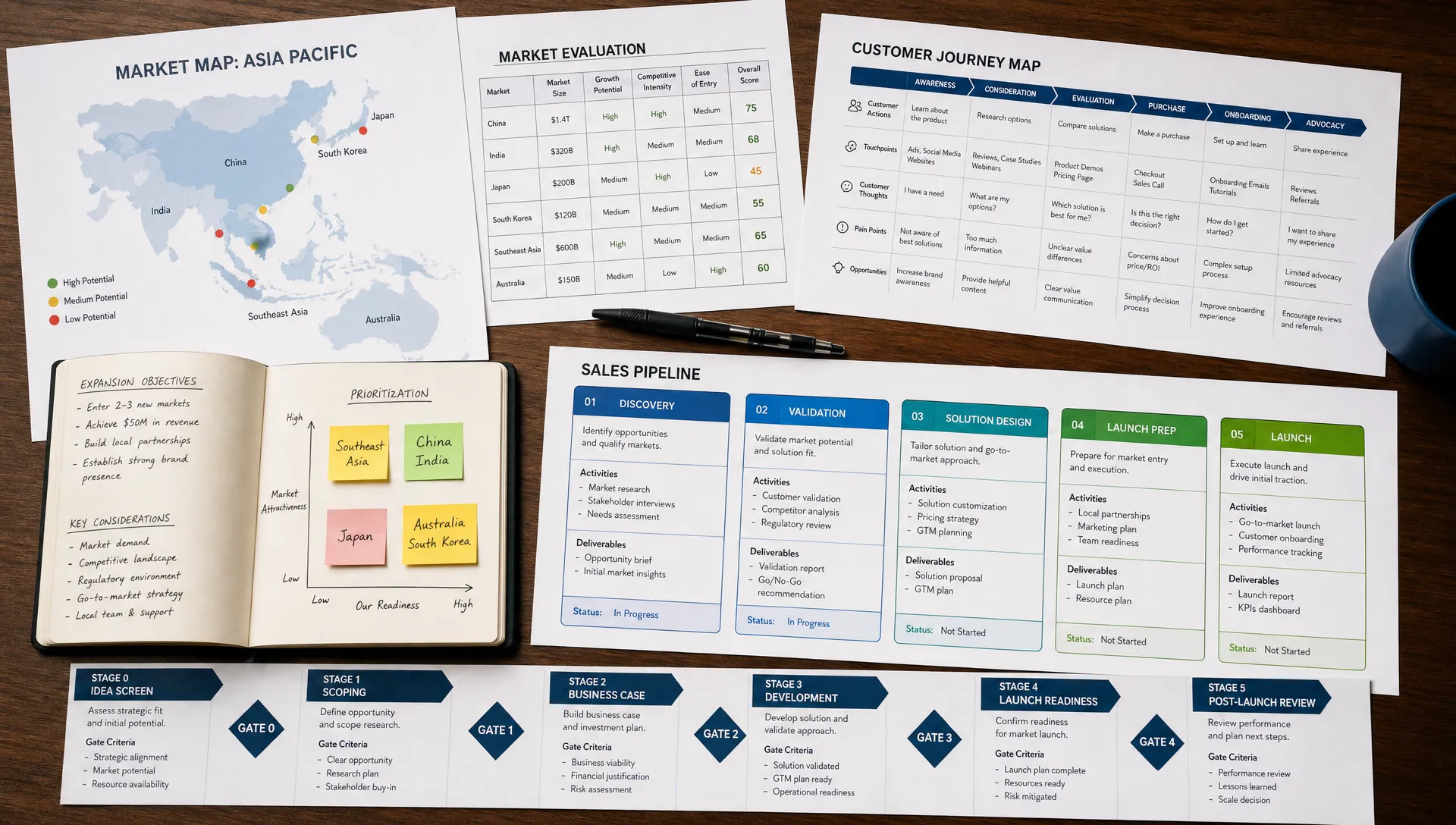
The pilot also needs kill criteria. If the company only defines success, it will rationalize weak signals. Kill criteria create discipline. Examples include inability to access the ICP, low willingness to pay after value proof, delivery requirements that break margin expectations, or sales cycles that are materially longer than the investment case can support.
Stage 3: Scale only after repeatability is visible
Scaling should begin when repeatability is visible, not when optimism is high.
That does not mean every metric must be perfect. It means leadership can explain why deals are won, why deals are lost, how buyers move through the funnel, what delivery requires, and what resources are needed to grow without breaking the model.
At this stage, the company can make larger decisions about local leadership, dedicated sales capacity, partner infrastructure, localization investment, and market-specific customer success. This is also where AI-powered automation and commercial systems become more valuable, because the company has enough verified process knowledge to automate the right things.
Build the assets before building the office
Foreign market expansion does not begin with an office lease or a country manager. It begins with commercial assets that make the market executable.
The most important assets are not glamorous, but they determine whether a market entry becomes repeatable.
| Asset | Why it matters | What good looks like |
|---|---|---|
| Local ICP definition | Prevents scattered selling | Clear segment, buyer roles, triggers, disqualifiers |
| Market-specific messaging | Converts relevance into urgency | Pain language, outcomes, objections, proof points |
| Access map | Reduces wasted prospecting | Priority channels, partners, communities, referral paths |
| Sales process adaptation | Protects forecast quality | Local qualification, procurement steps, decision criteria |
| Delivery playbook | Preserves margin and customer experience | Standard onboarding, support model, escalation rules |
| Governance cadence | Keeps the pilot honest | Weekly operating rhythm, board milestones, decision rights |
These assets help the company avoid two common traps. The first is over-localization, where the business customizes so heavily that the model becomes unscalable. The second is under-localization, where the company assumes its home-market playbook will work unchanged.
The right answer is selective localization. Change what the buyer, channel, or delivery model requires. Protect what makes the company’s economics and differentiation work.
Protect the core sales engine while testing the new market
A foreign launch can damage the core business if it consumes senior attention, pulls the best salespeople away from proven accounts, or creates conflicting priorities in product and operations.
This is especially important for portfolio companies under a value-creation plan. The core engine funds the expansion. Weakening it to chase a new market creates a double risk: the new market may not work, and the existing growth story may soften.
Leadership should separate exploration from execution. The core sales team should not be asked to carry the full burden of a speculative market entry unless the company has deliberately designed for that tradeoff. A small expansion pod, supported by senior commercial oversight, often creates cleaner learning.
The same principle applies to reporting. New-market pipeline should not be blended with core-market pipeline too early. It has different assumptions, different confidence levels, and different conversion dynamics. Keeping it separate makes the board conversation more honest.
If the expansion touches an already productive GTM engine, it is worth reviewing how to protect the existing sales engine while entering new markets. The operational risk is not just market failure. It is losing focus in the business that already works.
How sponsors should govern foreign expansion
Sponsors can add significant value by creating discipline without creating bureaucracy.
A good governance model defines the investment thesis, decision gates, budget tranches, and accountability structure before launch. It also prevents emotional escalation. Once a market entry has a public narrative, leaders can become reluctant to stop it. Governance makes stopping, narrowing, or delaying a rational business decision rather than a political failure.
The sponsor-level dashboard should focus on learning velocity and commercial proof. Early metrics may include qualified buyer conversations, ICP confirmation, channel access, message resonance, conversion by stage, sales cycle evidence, pricing feedback, and delivery complexity. Later metrics can shift toward revenue, margin, retention signals, local team productivity, and forecast accuracy.
The key is sequencing. Do not hold Stage 1 to Stage 3 metrics. Do not fund Stage 3 with Stage 1 evidence.
A practical 90-day validation plan
A 90-day plan will not fully de-risk a foreign market, but it can prevent the most expensive mistakes. The goal is to move from opinion to evidence quickly.
| Timeframe | Primary objective | Leadership decision |
|---|---|---|
| Days 1 to 30 | Validate market truth through buyer, competitor, channel, and delivery research | Is there a narrow ICP worth testing? |
| Days 31 to 60 | Run controlled outreach and message testing with a defined ICP and offer | Can we access buyers and create qualified demand? |
| Days 61 to 90 | Convert qualified opportunities, test economics, and assess delivery requirements | Should we scale, extend the pilot, narrow the wedge, or stop? |
The best 90-day validation plans are uncomfortable because they force choices. They avoid the safety of broad market research and push the company toward testable commercial evidence.
By the end, leadership should be able to say one of four things clearly: the market is ready for scaled investment, the market is promising but the wedge needs refinement, the market is strategically attractive but operationally premature, or the market should be deprioritized.
All four answers create value because all four prevent blind spending.
Warning signs that a false start is forming
False starts usually show up before the board admits there is a problem. The signals are visible if leaders know what to watch.
Watch for vague ICP definitions, enthusiastic meetings without next steps, partners who want exclusivity before proving demand, local hires asking for more resources without clearer conversion, pilots expanding in scope before any motion is repeatable, and revenue forecasts based on pipeline volume rather than stage quality.
Another warning sign is excessive reliance on one local champion. A strong local relationship can open doors, but it should not be mistaken for market access. If the model only works through one individual, it is not yet a scalable market entry strategy.
Finally, watch for internal narrative drift. If the reason for entering the market changes every month, the thesis is not yet stable enough for serious capital.
Frequently Asked Questions
What causes most foreign market expansion false starts? Most false starts happen when companies scale before validating demand, access, sales motion, delivery requirements, and operating readiness. The market may be attractive, but the company has not yet proven that it can win there repeatably.
How should a PE-backed company validate a foreign market before hiring locally? Start with direct buyer research, channel mapping, competitor analysis, and a controlled commercial pilot. Hiring should follow evidence of a narrow ICP, reachable buyers, resonant messaging, and a sales process that can be repeated.
When should leadership stop a foreign market expansion pilot? A pilot should stop or narrow when the company cannot access the ICP, cannot create urgency, cannot win at acceptable economics, or discovers delivery requirements that would break the model. Clear kill criteria should be agreed before the pilot begins.
How much should be localized before launch? Localize what materially affects buyer trust, sales conversion, compliance, delivery, or customer experience. Avoid unnecessary customization that weakens scalability or margin. The goal is selective localization, not reinvention.
Turn foreign expansion into a controlled growth system
Foreign market expansion should not depend on optimism, one local hire, or a large up-front bet. It should be designed as a staged commercial system that proves demand, access, repeatability, and operating readiness before serious capital is committed.
Phil Pelucha Consulting works with PE firms, VC-backed businesses, family offices, and portfolio companies to accelerate revenue, improve exit readiness, and install commercial infrastructure through diagnostics, GTM optimization, fractional CRO support, sponsor advisory, and AI-powered systems.
If your portfolio company is considering foreign expansion and needs a sharper commercial plan before committing capital, start the conversation with Phil Pelucha Consulting.