

Market Expansion Without Breaking Your Sales Engine
Market expansion is attractive because it looks additive: same product, same leadership team, larger addressable market. For PE-backed companies, it can also be one of the fastest ways to strengthen the equity story, diversify revenue, and create a clearer path to exit.
But expansion is rarely just “more selling.” A new geography, segment, channel, or vertical changes the sales motion. It affects who you target, how buyers build consensus, what proof they need, how long deals take, and which internal teams get pulled into the revenue process.
That is why market expansion can quietly break a sales engine that was working well in the core business. The company adds new ambition before it adds the operating system required to absorb complexity. Forecasts become noisy. Top reps get distracted. Managers lose inspection quality. Marketing starts chasing too many messages. Customer success inherits promises the delivery model was not built to support.
The answer is not to avoid expansion. It is to expand with controls. A portfolio company does not need a perfect commercial machine before entering a new market, but it does need enough clarity, instrumentation, and accountability to know whether the new market is genuinely opening or simply consuming resources.
Why market expansion breaks otherwise healthy sales engines
Most sales engines are designed around a known pattern. The best reps understand the customer profile, the buying triggers, the objections, the budget owner, and the proof points that move a deal forward. Managers know what a real opportunity looks like. Marketing knows which messages generate intent. The leadership team has learned how to interpret the pipeline.
Market expansion disrupts that pattern.
In a new market, a familiar title may not own the same problem. A product that feels urgent in one segment may be viewed as optional in another. A 45-day sales cycle may become 120 days because procurement, compliance, partner influence, or board approval enters the deal. Case studies that worked in the core market may not feel relevant to the new buyer.
This creates a dangerous illusion. The CRM may show more pipeline, more meetings, and more activity, but the company may have less reliable revenue. Expansion opportunities often look promising early because buyers are curious. Curiosity is not the same as urgency, and urgency is not the same as budgeted demand.
The sales engine starts to strain when leadership treats early curiosity as proof of repeatability. Hiring accelerates. Quotas get assigned. Marketing launches campaigns. Product leaders are asked for localization or custom features. Delivery teams start making exceptions. Before long, the core business is subsidizing an expansion motion that has not yet earned the right to scale.
Separate the expansion thesis from the expansion motion
A market expansion thesis explains why the company should grow beyond its current market. An expansion motion explains how it will acquire, win, onboard, and retain customers there without damaging the core business.
Both matter, but they are not the same. Many boards approve expansion because the strategic logic is sound, yet the operating motion remains vague. That gap is where sales engines break.
Use a simple distinction:
| Expansion question | What it tests | Failure signal |
|---|---|---|
| Is the problem real in this market? | Demand quality and urgency | Buyers agree in principle but do not act |
| Is the ICP transferable? | Whether the current customer profile still applies | Many meetings, low qualification quality |
| Can we access buyers efficiently? | Channel, referral, outbound, and partner viability | High activity with weak conversion |
| Does the proof translate? | Credibility of case studies and outcomes | Prospects ask for local or segment-specific evidence |
| Can the team sell it repeatably? | Sales process fit and manager inspectability | Deals depend on founders or one exceptional rep |
| Can the business deliver profitably? | Operational and margin impact | Expansion wins create service exceptions |
This table forces the leadership team to define the assumptions behind the expansion. If the assumptions are not explicit, they cannot be tested. If they cannot be tested, the board ends up judging expansion by lagging revenue numbers after significant time and capital have already been spent.
A strong expansion plan starts by turning the thesis into testable commercial assumptions. For example, “we can sell into the US” is not operational enough. A better assumption is: “US-based mid-market companies in this vertical experience the same compliance trigger as our core customers, have budget ownership in the same function, and can be reached through two existing partner channels.”
Now the sales team has something to validate.
Diagnose the core engine before opening a new front
Market expansion amplifies whatever is already happening inside the core revenue system. If ICP definition is loose, expansion makes it looser. If sales stages are subjective, expansion makes the forecast harder to trust. If the company already relies on heroic founder involvement, a new market will usually increase that dependency.
That does not mean the core engine must be flawless. It does mean leadership needs to know which parts are stable and which parts require protection before expansion begins. If those foundations are still unclear, it is worth revisiting what every portfolio company needs before scaling before committing significant resources to a new market.
A core engine is ready for controlled expansion when it has these basics in place:
- Clear ICP definition, with segment-level win rates and disqualification criteria.
- A sales process that managers can inspect consistently.
- Reliable source-to-close visibility, even if the metrics are imperfect.
- Defined handoffs between sales, marketing, customer success, and delivery.
- Evidence of repeatability beyond one founder, one rainmaker, or one channel.
- Capacity awareness, including which leaders and subject matter experts are already stretched.
The most important word here is “controlled.” Expansion is not a referendum on whether the company has a mature enterprise revenue machine. It is a decision about whether the company can run a learning motion without corrupting the operating rhythm that already produces revenue.
If the core business cannot tell the difference between a qualified opportunity and an interesting conversation, the expansion market will not fix that. It will create more interesting conversations.
Build a protected expansion pod
One of the most common mistakes is asking the existing sales team to “also” pursue the new market. That usually creates hidden tradeoffs. Reps chase expansion accounts because they are exciting, leadership asks for updates because the board cares, and core pipeline coverage quietly weakens.
A better model is a protected expansion pod. This is not necessarily a large team. It is a focused group with a clear learning mandate, separate reporting, and defined rules for when opportunities move from exploration to repeatable selling.
The pod should include commercial ownership, sales execution, marketing or demand support, revenue operations, and someone who understands delivery constraints. In smaller portfolio companies, one person may cover several of these roles. The key is not headcount. The key is accountability.
The pod should not be judged only by closed revenue at the start. Early expansion work should be measured by evidence quality. Are the right buyers engaging? Are the same pains appearing repeatedly? Are objections becoming clearer? Are buyers willing to introduce internal stakeholders? Are paid pilots or initial contracts emerging without excessive concessions?
This protects the company from two bad outcomes. The first is over-scaling a market that is not ready. The second is killing a promising market too early because it was evaluated with mature-market expectations.
Build market signal before hiring quota capacity
Expansion should move through a signal ladder. Each step reduces uncertainty before the company commits more sales capacity.
- Problem confirmation: Speak with target buyers, partners, operators, and industry specialists to confirm whether the problem exists in the new market and how buyers describe it in their own language.
- Access validation: Test whether the company can reliably reach the right buyers through warm introductions, outbound, content, communities, partners, or events. AI-assisted lead discovery tools such as Redditor AI can help teams identify relevant buyer conversations at scale, but automation should support judgment rather than replace it.
- Message validation: Test positioning with small campaigns, direct outreach, and executive conversations. The goal is to learn which pain, trigger, and outcome create movement.
- Commercial validation: Seek paid pilots, initial contracts, or structured commitments. Free interest is useful, but paid behavior is more meaningful.
- Repeatability validation: Confirm that more than one person can generate and progress opportunities using the same market-specific playbook.
The signal ladder prevents a classic expansion error: hiring ahead of proof. New sellers do not create market clarity by themselves. If the message is unclear, the channel is unproven, and the buying process is misunderstood, additional reps simply multiply the confusion.
Keep the core sales engine protected
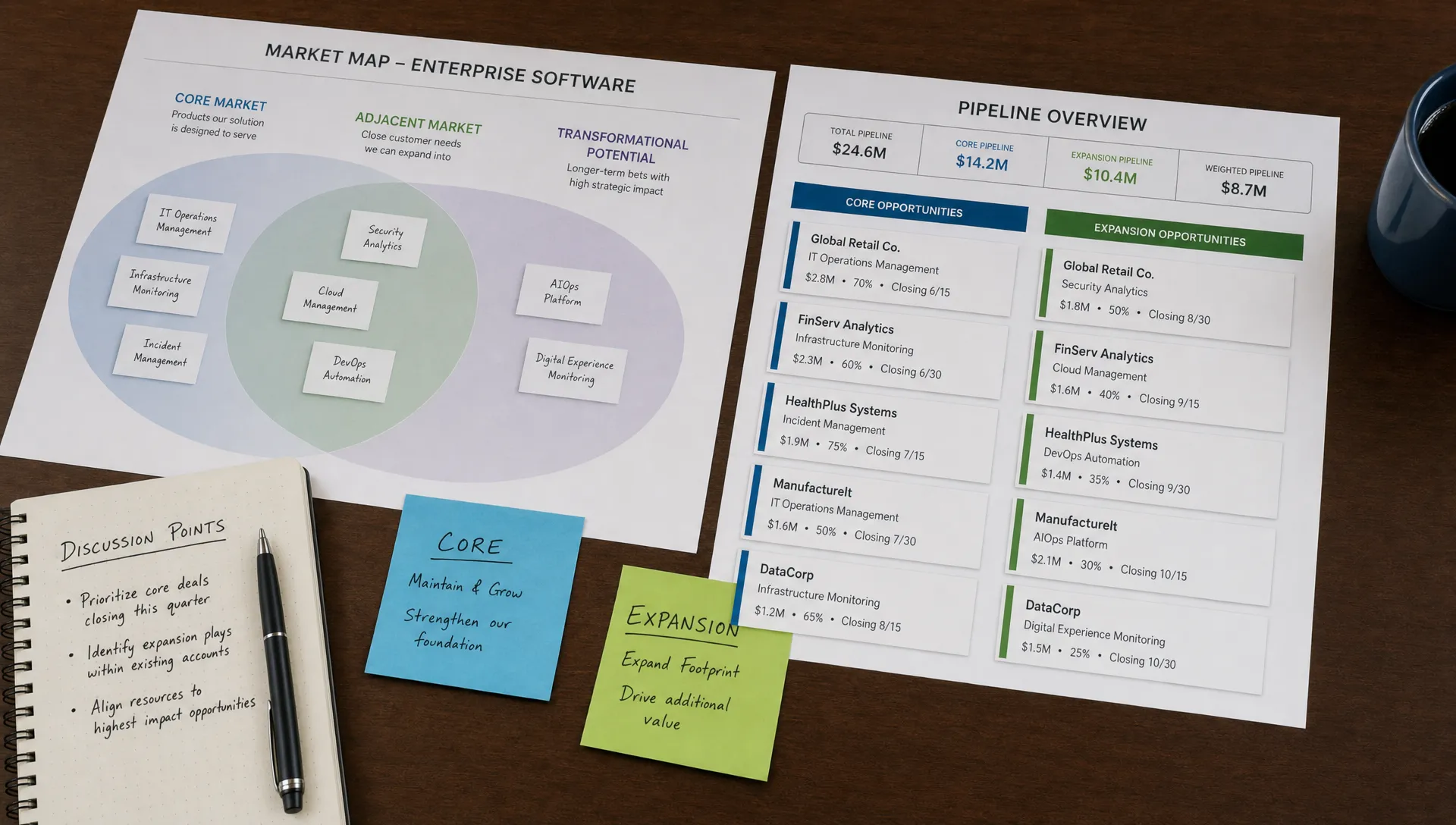
A company can pursue market expansion and still protect the core business, but only if leadership separates learning from production. Core revenue needs stable management cadence, clear pipeline inspection, and consistent execution. Expansion needs discovery, experimentation, and fast feedback.
When those motions are blended too early, both suffer. The core team becomes distracted by exceptions. The expansion team feels constrained by processes designed for a mature market. The board receives blended numbers that make it difficult to see what is actually happening.
Use separate controls for the expansion motion:
| Risk to the sales engine | Practical control | What leadership should watch |
|---|---|---|
| Core reps get distracted | Ring-fence core accounts and quota expectations | Core pipeline coverage and activity quality |
| Forecast becomes unreliable | Separate expansion pipeline stages and forecast categories | Stage conversion by market, not blended totals |
| Discounting increases | Define approval rules for expansion concessions | Margin impact and precedent risk |
| Delivery teams get overloaded | Require delivery review for non-standard commitments | Onboarding complexity and service exceptions |
| Board reporting gets noisy | Report learning metrics separately from revenue metrics | Whether assumptions are being validated or rejected |
This is where operating partners and sponsor teams can add real value. The job is not to demand more activity. It is to turn the value creation plan into a commercial operating rhythm, with clear decisions, owners, and evidence. That is the same principle behind the operating partner playbook for revenue growth, where strategy becomes useful only when it changes weekly execution.
Metrics that matter during market expansion
Expansion metrics should evolve as the market matures. In the earliest phase, the company is not yet proving scale. It is proving that the market deserves more investment.
Early metrics should focus on signal quality:
- Percentage of conversations with the target buyer profile.
- Repetition of the same urgent pain across accounts.
- Conversion from conversation to next step.
- Number of stakeholders engaged per account.
- Objections that can be addressed through positioning, proof, or product changes.
- Evidence that prospects are willing to pay, not merely participate in research.
Once commercial validation begins, the metrics should shift toward sales engine quality. Track sales cycle delta versus the core market, win rate by segment, average contract value, discounting, source-to-opportunity conversion, opportunity-to-close conversion, and delivery burden.
Avoid judging expansion through vanity metrics. Meeting volume, event attendance, social engagement, and top-of-funnel lead counts can all be useful, but none of them prove that the company has a scalable route to revenue. The board should ask, “What did this activity prove?” not simply, “How much activity happened?”
For PE-backed companies, the most important measure is not whether the expansion creates some revenue. It is whether that revenue improves the quality of the equity story. A small amount of repeatable, well-evidenced expansion revenue may be more valuable than a larger amount of messy, founder-led revenue that a buyer cannot underwrite.
Know when to pause, pivot, or scale
A disciplined expansion plan includes decision gates before the work begins. Without gates, teams tend to keep going because effort has already been spent. That is how expansion becomes a slow leak in the sales engine.
Scale when the same ICP shows repeated urgency, the team can access buyers efficiently, initial wins are not dependent on one heroic seller, delivery can support the promise, and unit economics are moving in the right direction.
Pivot when the problem is real but the route to market is wrong. This may mean narrowing the ICP, changing the entry point, using partners instead of direct sales, adjusting the offer, or focusing on a more specific trigger event.
Pause when the market requires too many exceptions, the proof does not translate, sales cycles stretch beyond the investment case, or core revenue performance begins to deteriorate. Pausing is not failure. In a portfolio context, it is capital discipline.
The best expansion decisions are made before politics take over. If the board, CEO, and commercial leader agree on the gates in advance, the company can act on evidence rather than optimism.
Make expansion evidence buyer-ready
Market expansion should not only create revenue during the hold period. It should create evidence that future buyers can trust. That means documenting the logic, the tests, the results, and the operating model as the expansion develops.
A buyer evaluating exit readiness will want to know whether expansion revenue is repeatable. They will look for evidence that the company understands the ICP, can generate pipeline predictably, can win without excessive executive involvement, and can deliver profitably after the sale. This is why market expansion and exit readiness are closely connected.
If expansion is part of the value creation plan, the company should build buyer-ready evidence from the start. That includes segment-level reporting, market-specific win stories, documented playbooks, cohort performance, retention indicators, and clear separation between core and expansion economics. For more on that broader discipline, see how private equity companies improve exit readiness by building evidence throughout the hold period rather than rushing to assemble it before sale.
The goal is simple: make the expansion credible to an acquirer, not just exciting to the current board.
The board questions that keep expansion healthy
Boards and sponsor teams do not need to run the sales process, but they do need to ask questions that protect commercial focus. The most useful questions are specific enough to expose assumptions without pushing management into performative reporting.
Ask questions such as:
- Which expansion assumptions have been validated, and which remain unproven?
- What is the clearest evidence that this market has urgent demand?
- How does the expansion sales cycle compare with the core market?
- Which opportunities required founder or executive involvement, and why?
- What has expansion done to core pipeline coverage and forecast quality?
- Which delivery exceptions are being created by expansion wins?
- What decision gate determines whether we scale, pivot, or pause?
These questions change the tone of the expansion conversation. Instead of debating whether the market is “big,” the leadership team evaluates whether the company has earned the right to invest further.
Frequently Asked Questions
What is market expansion in a PE-backed company? Market expansion is the move into a new geography, customer segment, vertical, channel, or use case to create additional growth. In a PE-backed company, it should be tied to the value creation plan and measured by both revenue potential and evidence quality.
When should a company avoid market expansion? A company should avoid or delay expansion when the core ICP is unclear, sales stages are not inspectable, pipeline data is unreliable, delivery capacity is already strained, or growth depends too heavily on one founder or rainmaker.
How do you expand without distracting the sales team? Create a protected expansion pod, separate expansion reporting from core sales reporting, ring-fence core accounts, and define decision gates. This allows the company to learn in the new market without weakening the current revenue engine.
What is the biggest mistake companies make during market expansion? The biggest mistake is treating early interest as proof of repeatability. Buyers may take meetings because they are curious, but expansion should not scale until the company has evidence of urgency, access, paid demand, and a repeatable sales motion.
Expand with discipline, not distraction
Market expansion can be a powerful lever for PE firms, VC-backed companies, family offices, and portfolio leadership teams. It can also create avoidable revenue risk when ambition runs ahead of commercial infrastructure.
Phil Pelucha Consulting helps sponsors and portfolio companies improve revenue acceleration, sales execution, market expansion, AI-powered commercial systems, and exit readiness. If expansion is on the value creation plan, the first question is not “How fast can we enter?” It is “What must be true for this market to scale without breaking the sales engine we already have?”
Answer that question with evidence, and expansion becomes a disciplined growth system rather than a costly distraction.