
The Operating Partner Playbook for Revenue Growth
Revenue growth in a PE-backed company is rarely a single sales problem. It is usually a system problem: unclear ICP, inconsistent management cadence, weak pipeline inspection, pricing leakage, underdeveloped leadership, and a deal thesis that has not been translated into daily commercial behavior.
That is where the operating partner creates leverage.
A strong operating partner does not simply advise the CEO or pressure the sales team for a bigger number. The role is to convert the investment thesis into a practical revenue operating system, then help the management team run it with discipline. In the current private equity environment, where buyers scrutinize quality of revenue, retention, margin durability, and leadership depth, that commercial infrastructure can be the difference between a good company and a premium exit.
This playbook is built for operating partners, sponsors, CEOs, and portfolio leadership teams that need revenue growth to become more predictable, measurable, and transferable.
What an operating partner actually owns in revenue growth
The operating partner sits between strategy and execution. The sponsor has the investment thesis. The CEO owns the business. The commercial team owns the day-to-day selling motion. The operating partner should not replace any of them.
The best operating partners create alignment, install process, and remove friction. They make sure the company can answer practical questions with evidence, not optimism: Who is the ideal customer? Why do we win? Where does pipeline really come from? Which sales activities predict revenue? Where are margins leaking? Which leaders can scale, and which roles need to change?
In revenue growth, the operating partner usually focuses on outcomes such as:
- Translating the deal thesis into commercial priorities.
- Diagnosing revenue constraints before the fund spends heavily on growth.
- Improving sales process, forecasting, pipeline quality, and conversion.
- Strengthening pricing, packaging, and account expansion discipline.
- Supporting market expansion without creating operational chaos.
- Building leadership capacity so growth is not dependent on one founder or rainmaker.
- Creating the evidence buyers will later inspect during exit diligence.
That last point matters. Revenue acceleration is not just about hitting next quarter's number. In a PE context, growth must become credible enough for a buyer, lender, or investment committee to believe it can continue after ownership changes.
Start by separating thesis risk from execution noise
Most post-acquisition revenue conversations begin with the same question: Why are we behind plan? The common mistake is to answer too quickly.
A missed number can come from execution noise, such as poor follow-up, weak sales management, or low activity levels. It can also come from thesis risk, such as an overestimated market, a less urgent buyer problem, weak differentiation, or a growth channel that does not scale economically.
The operating partner's first job is to separate those two categories. If the thesis is directionally right but execution is uneven, the answer is discipline and enablement. If the thesis itself is under pressure, adding headcount or pushing harder may only increase burn and reduce confidence.
This is why commercial diagnostics should happen before aggressive scaling. Many funds underestimate how often growth gaps appear when spreadsheet assumptions meet legacy behaviors, which is a pattern explored in more detail in why PE firms miss growth targets after acquisition.
A practical operating partner does not ask, How do we sell more? first. They ask, What must be true for this revenue plan to work, and where is the proof weakest?
Phase 1: run a commercial diagnostic in the first 30 days
The first 30 days should produce clarity, not a 60-page report that no one uses. The diagnostic should identify the few constraints that most affect revenue growth, then convert those findings into a prioritized action plan.
The operating partner should inspect the full commercial system, not just sales activity. That includes market positioning, ICP definition, lead sources, sales process, conversion rates, deal cycle length, pricing behavior, customer concentration, retention, expansion, and sales leadership cadence.
A useful diagnostic combines data with field reality. CRM reports may show pipeline coverage, but customer interviews reveal why deals stall. Finance may show margin leakage, but sales calls reveal discounting habits. The CEO may believe the company wins on product quality, while buyers may actually choose the business because of implementation speed, service responsiveness, or reduced risk.
| Diagnostic area | What to examine | Operating partner output |
|---|---|---|
| Market and ICP | Best-fit segments, buyer urgency, win rates by customer type | Priority segments and disqualification rules |
| Pipeline quality | Source, stage accuracy, aging, next steps, deal slippage | Clean pipeline view and inspection cadence |
| Sales process | Conversion by stage, handoffs, qualification, proposal discipline | Standardized sales motion and coaching focus |
| Pricing and margin | Discounting, packaging, approval rules, profitability by segment | Pricing guardrails and margin protection plan |
| Customer base | Retention, expansion, concentration, satisfaction signals | Account growth and risk mitigation plan |
| Leadership capacity | Sales management rhythm, role clarity, hiring gaps | Commercial org plan and talent decisions |
The diagnostic should end with a short list of growth constraints. For example, a company may not have a demand problem at all. It may have a qualification problem that inflates pipeline and hides low conversion. Another company may have enough opportunities but a pricing discipline problem that quietly erodes EBITDA. A third may need a new sales leader before any additional headcount makes sense.
Phase 2: build the revenue growth architecture
Once the diagnostic is complete, the operating partner should help the CEO and leadership team build the revenue architecture. This is the commercial infrastructure that allows growth to scale beyond individual effort.
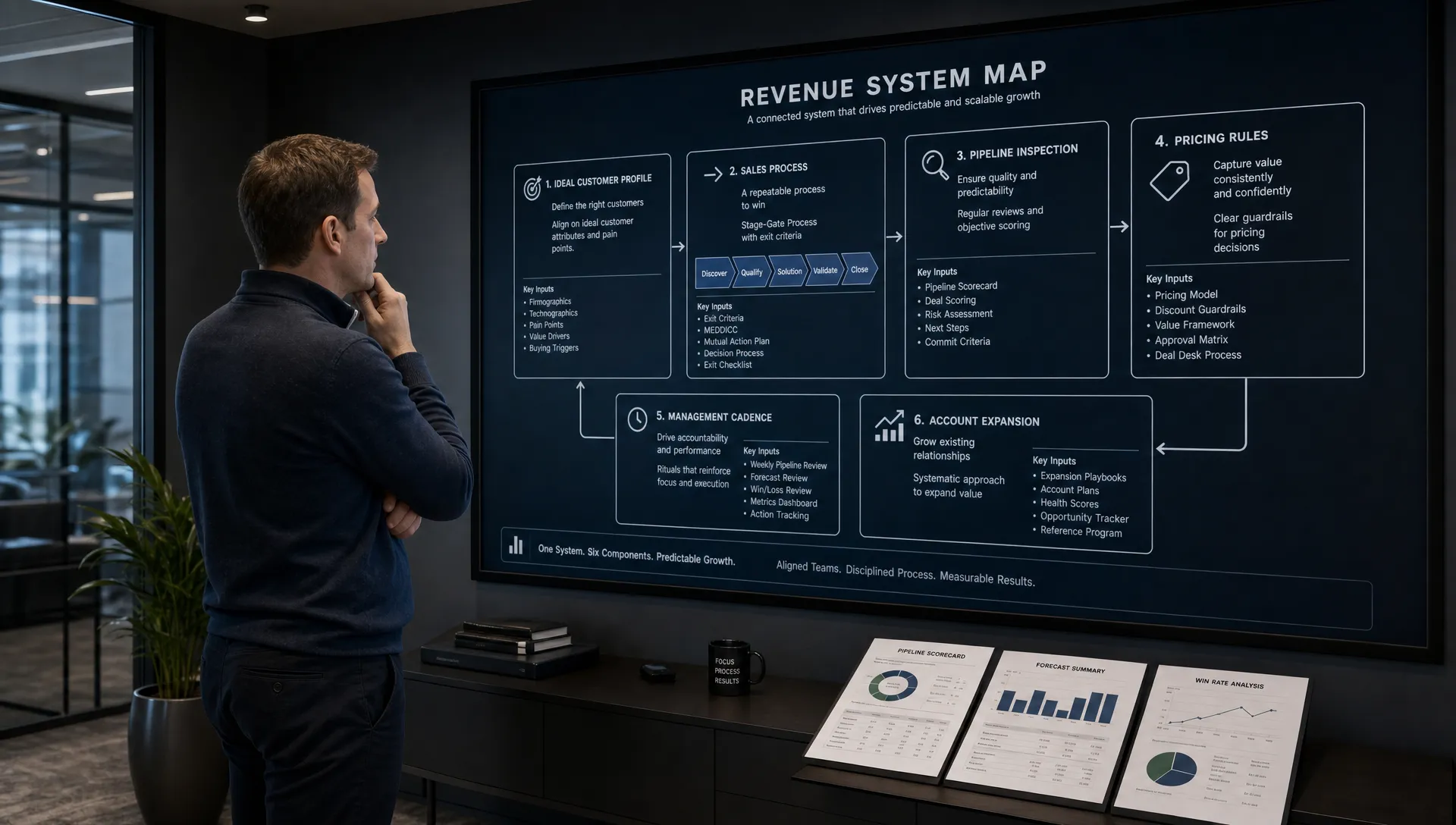
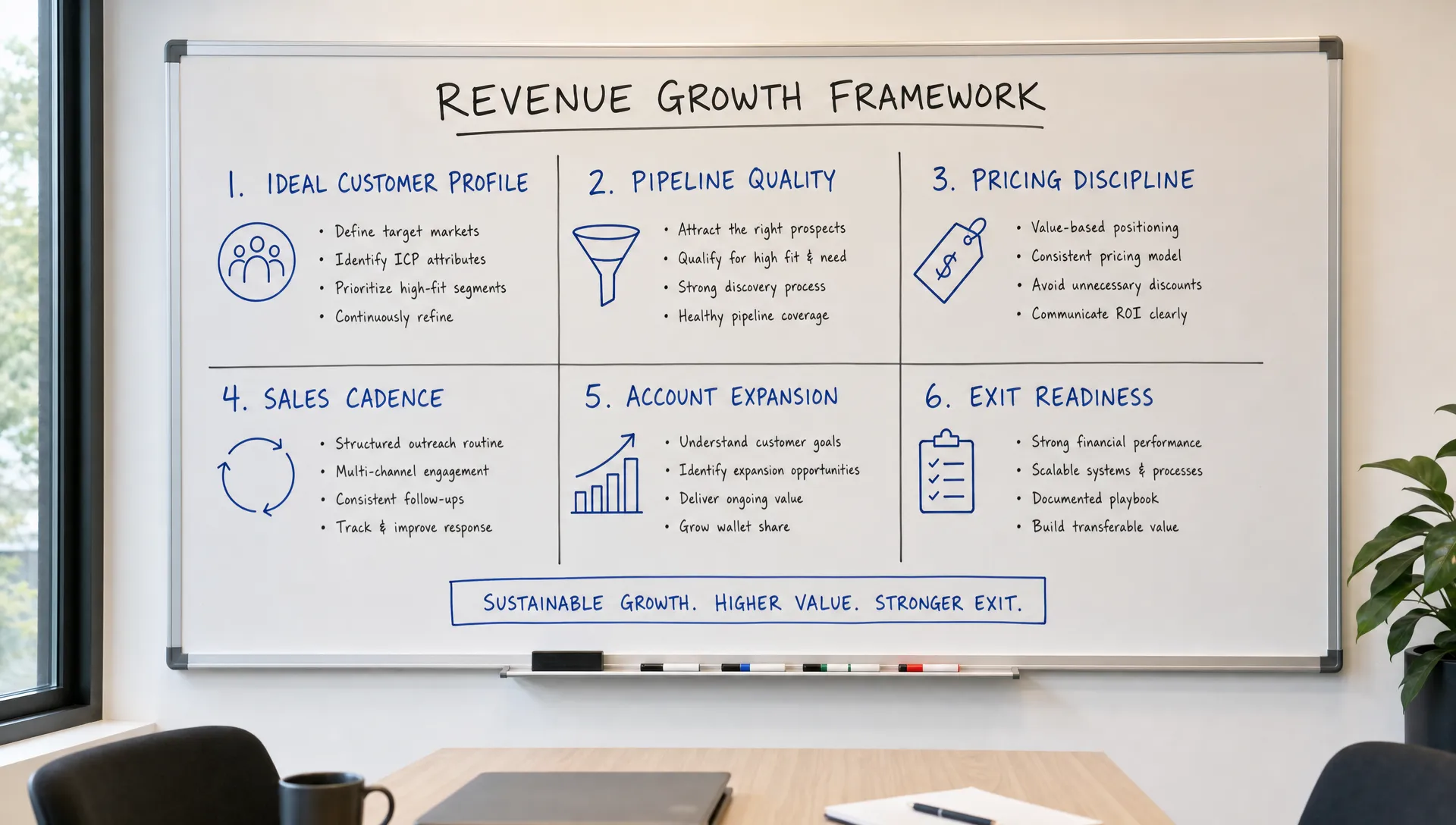
At minimum, that architecture should define the ICP, value proposition, sales stages, qualification standards, pricing rules, forecast process, account expansion model, and weekly management rhythm. It should also clarify what the company will not pursue. Focus is one of the most underused growth levers in portfolio companies.
The operating partner should be especially careful when the board is pushing for more sales headcount. Hiring can accelerate a proven motion, but it can also amplify confusion. If the ICP is vague, messaging is inconsistent, and managers cannot inspect pipeline, more sellers usually create more noise. For a deeper view of the foundations required before expansion, see what every portfolio company needs before scaling.
A strong revenue architecture makes the company easier to manage. It gives the CEO a common language for growth, gives the sales leader a coaching system, gives the sponsor cleaner visibility, and gives the future buyer confidence that performance is not accidental.
Phase 3: install cadence, accountability, and decision rights
The operating partner's impact depends on cadence. A good plan without a management rhythm becomes another board deck. Revenue growth improves when the team knows what gets inspected, how often, by whom, and what decisions follow.
The weekly revenue meeting should not be a storytelling session. It should be a decision forum. The team should review pipeline movement, stage conversion, stuck deals, forecast changes, customer risk, pricing exceptions, and specific actions required before the next meeting. The operating partner can help shape this cadence, but management must own it.
Decision rights should also be explicit. Who approves discounting? Who decides whether to pursue a non-ICP enterprise deal? Who owns expansion revenue? Who has authority to change territory design or channel strategy? Ambiguity slows growth because teams escalate everything or make inconsistent decisions in isolation.
For PE-backed companies, the operating cadence should connect to board reporting without turning every internal meeting into a board performance. The sponsor needs clean visibility. The management team needs room to solve problems. The operating partner helps maintain that balance.
Revenue levers operating partners should prioritize
Not every growth lever deserves equal attention. The right priority depends on the company's stage, deal thesis, and commercial maturity. Still, several levers appear repeatedly across PE-backed businesses.
ICP focus and segment discipline
Many portfolio companies sell too broadly. They chase revenue across too many customer types, deal sizes, geographies, and use cases. That may have worked when founder-led hustle was the main growth engine, but it becomes expensive as the business scales.
The operating partner should help identify the segments with the best combination of win rate, sales cycle, margin, retention, expansion potential, and strategic value. The output should not be a theoretical persona. It should become a set of practical rules that influence targeting, qualification, messaging, hiring, and reporting.
Sales productivity and pipeline integrity
Sales productivity is often the fastest route to revenue improvement because it uses resources the company already has. The operating partner should look for friction in qualification, follow-up, proposal quality, deal reviews, enablement, and manager coaching.
Pipeline integrity is central. A portfolio company can look healthy while carrying a pipeline filled with stale opportunities, poorly qualified deals, or optimistic close dates. The operating partner should push for clear stage definitions, exit criteria, and deal inspection. Forecast confidence improves when the team stops confusing activity with probability.
Pricing and margin protection
Pricing is one of the most powerful revenue levers because it affects both growth and EBITDA. Yet many companies lack pricing governance. Sales teams discount to remove friction, legacy customers sit on old terms, and packaging no longer reflects the value delivered.
An operating partner can help the company review discounting patterns, customer profitability, approval workflows, and packaging opportunities. The goal is not reckless price increases. The goal is disciplined value capture, especially in segments where the company has differentiation and switching costs.
Account expansion and retention
Growth is more credible when it is supported by existing customers. Buyers and sponsors both value revenue that expands through proven relationships. The operating partner should examine whether the company has a real account management model or simply waits for customers to ask for more.
Expansion requires ownership, triggers, playbooks, and customer health signals. It also requires coordination between sales, service, product, and finance. If the company has recurring or repeat revenue, retention and expansion should become central to the growth narrative.
AI and automation, but only after process clarity
AI can improve research, segmentation, sales enablement, reporting, workflow automation, and portfolio-level visibility. But it should not be used to automate a broken process. If the sales stages are unclear, the data is unreliable, and the ICP is vague, AI will often scale the confusion.
The operating partner should identify where automation can reduce manual work, improve decision speed, or create consistency across the portfolio. The best AI systems support the commercial operating model rather than distracting from it.
The operating partner revenue scorecard
A scorecard keeps the operating partner, CEO, and sponsor focused on the same version of reality. It should include leading indicators, lagging indicators, and decision triggers. The purpose is not to track everything. It is to track the few metrics that show whether the growth system is improving.
| Growth area | Leading indicators | Lagging indicators | Decision triggered |
|---|---|---|---|
| Demand generation | Qualified meetings, source quality, conversion by channel | New pipeline value, pipeline cost efficiency | Reallocate spend or refine targeting |
| Sales execution | Stage conversion, deal aging, next-step compliance | Win rate, sales cycle, bookings | Coach, redesign process, or adjust coverage |
| Forecast quality | Slippage, stage accuracy, commit reliability | Revenue attainment, forecast variance | Improve inspection cadence or CRM discipline |
| Pricing | Discount frequency, approval exceptions, quote quality | Gross margin, average selling price | Tighten guardrails or adjust packaging |
| Customer growth | Health signals, renewal risk, expansion opportunities | Retention, expansion revenue, churn | Prioritize account plans and executive outreach |
| Leadership | Manager coaching rhythm, hiring progress, role clarity | Seller productivity, team retention | Upgrade talent or redesign roles |
The scorecard should be reviewed consistently, but it should not become a compliance exercise. Metrics are useful only when they lead to decisions. If a number changes and nothing happens, the operating partner should challenge whether that metric belongs on the scorecard.
Talent is the multiplier, or the bottleneck
Revenue growth often depends on whether the commercial leadership team can scale with the business. A founder-led sales culture may need a professional sales leader. A relationship-driven model may need account management discipline. A business entering the US may need leaders who understand regional buyer expectations, channel dynamics, and enterprise procurement.
The operating partner should assess talent with a clear lens: what does the next phase of growth require, and who has already proven they can operate at that level? This is not only about replacing people. It is about role clarity, coaching, incentives, and leadership design.
When the company does need to hire or upgrade senior commercial talent, the operating partner should help define success before engaging the market. A vague brief produces vague candidates. The role specification should connect directly to the revenue architecture: target segments, sales motion, growth levers, leadership cadence, and measurable outcomes.
For senior commercial leaders moving between PE-backed roles, recruiter-led profile optimization for senior professionals can also clarify how achievements should be framed for UK, European, and North American hiring standards, which helps candidates and hiring teams speak a more precise performance language.
Turning revenue growth into exit-ready evidence
Operating partners should think about exit readiness from the beginning, not in the final quarter before sale. A buyer will not simply ask whether revenue grew. They will ask how it grew, whether it can continue, what risks remain, and whether the management team can sustain performance without the sponsor's intervention.
That means the operating partner should help the company build evidence as growth improves. Evidence may include cleaner cohort performance, stronger retention, reduced customer concentration, improved forecast reliability, disciplined pricing, documented sales process, diversified pipeline sources, and a leadership team with clear accountability.
This documentation should not be created only for a future data room. It should be the natural byproduct of running the business well. The more predictable the commercial engine becomes, the easier it is to defend the growth story during diligence.
Common mistakes operating partners should avoid
The first mistake is trying to solve every commercial problem at once. Portfolio companies have limited management bandwidth. A focused 90-day plan with three priorities usually beats a comprehensive transformation plan that overwhelms the team.
The second mistake is pushing growth before readiness. If the company lacks ICP clarity, sales management discipline, and pricing guardrails, more demand or headcount may create lower-quality revenue.
The third mistake is becoming the shadow CRO. The operating partner can coach, challenge, and install cadence, but the management team must own execution. If the operating partner becomes the only person who understands the revenue system, the business has not become more valuable.
The fourth mistake is measuring activity instead of progress. More calls, meetings, and proposals matter only if they improve conversion, quality, cycle time, margin, or retention.
A practical 90-day operating partner playbook
The following 90-day structure gives the operating partner a practical way to move from diagnosis to execution without losing momentum.
| Timeframe | Primary objective | Key actions | Expected output |
|---|---|---|---|
| Days 1 to 30 | Diagnose the revenue system | Review data, interview customers, inspect pipeline, assess leadership, test thesis assumptions | Growth constraints and priority action plan |
| Days 31 to 60 | Design the commercial operating model | Define ICP, sales stages, forecast cadence, pricing guardrails, account expansion model | Revenue architecture and scorecard |
| Days 61 to 90 | Install discipline and prove traction | Run cadence, coach leaders, clean pipeline, execute priority growth plays | Improved visibility, faster decisions, early performance evidence |
The 90-day plan should be specific enough to create momentum, but flexible enough to adapt as evidence emerges. The operating partner's value comes from disciplined iteration, not rigid adherence to the original plan.
Frequently Asked Questions
What does an operating partner do for revenue growth? An operating partner helps translate the investment thesis into a commercial operating system. That usually includes diagnostics, sales process improvement, pipeline inspection, pricing discipline, leadership assessment, and growth cadence.
Is an operating partner the same as a fractional CRO? Not necessarily. A fractional CRO often owns commercial execution directly. An operating partner usually works across sponsor, CEO, and management team to improve the system, although some engagements may include hands-on revenue leadership support depending on the company's needs.
When should a PE firm bring in an operating partner? The best time is before aggressive growth spend begins. An operating partner is especially valuable after acquisition, before market expansion, during sales leadership change, when growth is behind plan, or when the company needs to improve exit readiness.
What is the biggest revenue mistake PE-backed companies make? One of the biggest mistakes is scaling before the commercial foundation is ready. Adding sellers, campaigns, or new markets without clear ICP, process, pricing, and management cadence can increase cost without improving quality of revenue.
How should an operating partner measure success? Success should be measured through both performance and operating evidence. Revenue, margin, win rate, retention, and bookings matter, but so do forecast accuracy, pipeline quality, leadership cadence, pricing discipline, and reduced dependency on individual rainmakers.
Build a revenue system buyers can believe in
Revenue growth is not created by pressure alone. It comes from clarity, cadence, leadership, and a commercial model that can scale beyond individual effort.
Phil Pelucha Consulting works with PE firms, VC firms, family offices, and portfolio companies on revenue acceleration, commercial diagnostics, fractional CRO support, market expansion, AI-powered automation, and exit readiness improvement. If your portfolio company needs to convert its growth thesis into an executable commercial system, start the conversation with Phil Pelucha.