

How Private Equity Companies Improve Exit Readiness
Exit readiness is not a final-quarter exercise. It is the accumulated proof that a portfolio company can grow predictably, operate without founder dependency, defend margins, and give a buyer confidence that the next owner can keep compounding value.
For private equity companies, that changes the job. A strong acquisition thesis is only the starting point. The real work is converting the thesis into measurable operating evidence before a sale process begins. That evidence has to survive diligence, management meetings, lender scrutiny, and the buyer’s internal investment committee.
In 2026, this matters more than ever. Higher financing costs, more selective buyers, and longer hold periods have raised the standard for exits. A company that looks attractive on adjusted EBITDA alone may still struggle if its revenue engine is opaque, its management team is thin, or its growth story depends on heroic assumptions.
The firms that improve exit readiness consistently tend to treat it as a value creation discipline, not a transaction checklist. As explored in more detail in this guide to how private equity and venture capital create value, capital alone rarely drives the return. The return comes from better systems, sharper execution, and cleaner proof.
What exit readiness really means
Exit readiness means a portfolio company is prepared to be evaluated by a sophisticated buyer at any time, not just when the sponsor decides to launch a process.
That does not mean the company must be perfect. Buyers expect some whitespace. In fact, they often want a credible next chapter to underwrite. But they need to believe the current owner has reduced ambiguity around the core business.
A buyer-ready company can answer questions such as:
- Where is growth really coming from?
- How repeatable is the sales motion?
- Which customer segments are most profitable?
- What happens if the founder or top salesperson leaves?
- Can the company expand into new markets without breaking the model?
- Are the systems, reporting, and leadership team strong enough for the next stage?
The difference between “interesting asset” and “high-conviction acquisition” is usually proof. Private equity companies improve exit readiness by building that proof across the hold period.
The exit readiness scorecard buyers care about
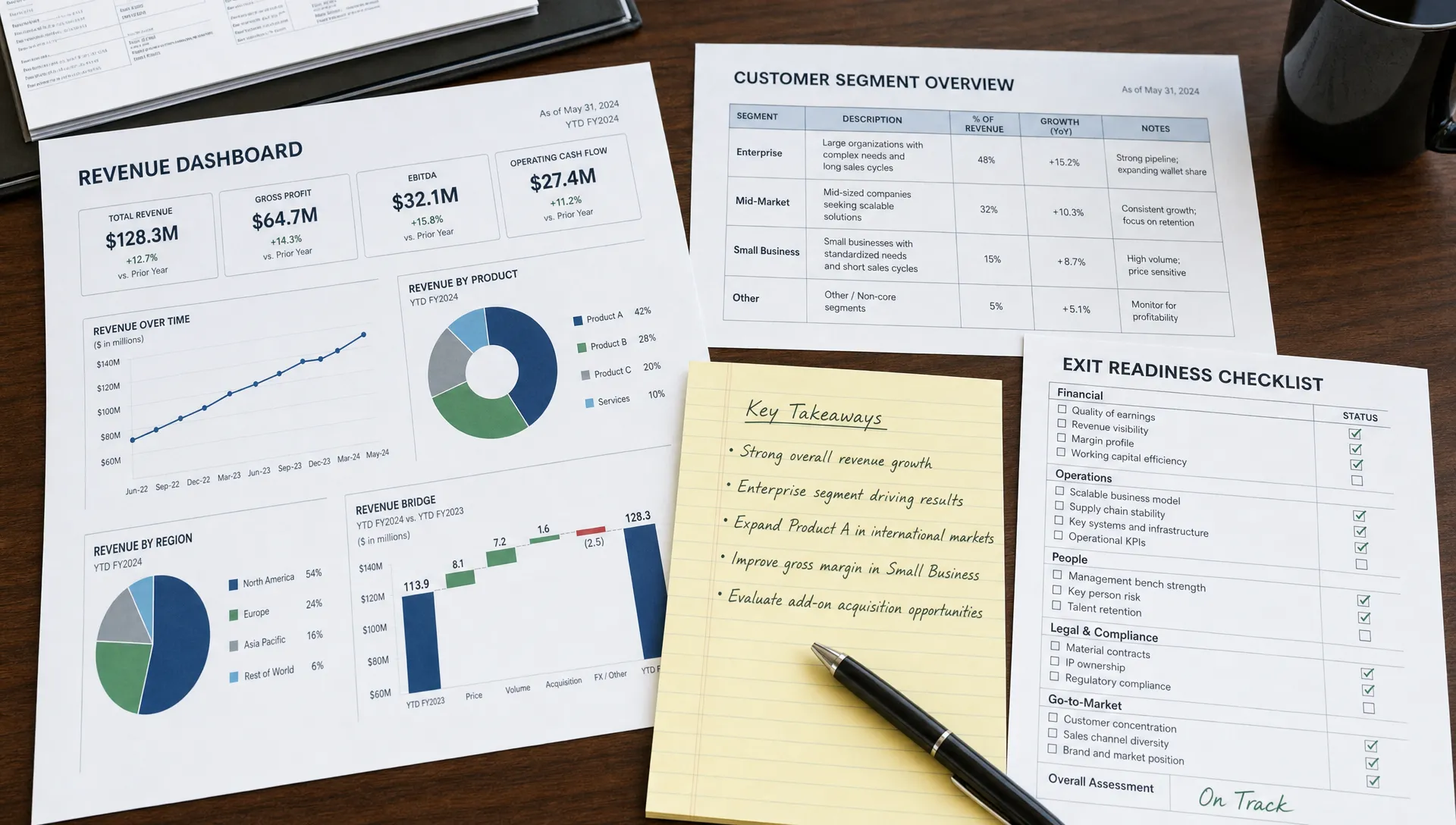
Financial performance matters, but buyers rarely stop at the income statement. They want to know whether the business can repeat and expand its performance under new ownership. The table below summarizes the commercial evidence that often drives buyer confidence.
| Readiness area | Buyer question | Evidence that strengthens the story |
|---|---|---|
| Revenue quality | Is growth predictable and defensible? | Cohort trends, retention, pricing history, pipeline conversion, customer concentration analysis |
| GTM repeatability | Can the company scale sales without guesswork? | Defined ICP, documented sales process, CRM hygiene, conversion benchmarks, sales productivity by channel |
| Margin durability | Will EBITDA hold as the company grows? | Gross margin by segment, CAC payback, pricing discipline, service delivery efficiency |
| Management depth | Can the business operate beyond the founder or sponsor team? | Clear leadership roles, second-line managers, decision cadence, succession planning |
| Market expansion | Is the next growth vector proven? | Pilot results, regional traction, partner validation, localized demand data |
| Data and systems | Can diligence be completed efficiently? | Clean reporting, integrated KPIs, documented processes, reliable dashboards |
| Brand and demand generation | Does the market understand the company’s value? | Strong positioning, channel performance, content assets, measurable lead sources |
The earlier these areas are addressed, the less a sponsor has to rely on narrative during exit. Narrative still matters, but it works best when it explains evidence rather than compensates for missing evidence.
1. Start with a commercial diagnostic, not a cosmetic cleanup
Many sponsors wait too long to ask whether the company’s growth engine is actually working. By the time exit preparation begins, weak pipeline quality, inconsistent pricing, and customer concentration may already be embedded in the numbers.
A commercial diagnostic should happen early in the hold period and be refreshed regularly. It evaluates the company’s revenue model, sales organization, market positioning, channel performance, and customer economics. The goal is not to create a presentation. The goal is to identify the constraints that could reduce valuation or slow diligence later.
This is where many growth plans fail. The model assumes sales capacity can be added, new markets can be entered, and pricing can improve. But the operating company may lack the infrastructure to execute. That gap is a common reason sponsors miss growth targets after acquisition, even when the investment thesis was sound.
A useful diagnostic should separate symptoms from root causes. For example, a missed revenue target may not be a demand issue. It may reflect unclear ICP definition, weak sales management, poor handoff between marketing and sales, or a CRM that cannot distinguish real opportunities from wishful pipeline.
2. Build a revenue story that is easy to underwrite
At exit, buyers are not only buying historical revenue. They are underwriting future revenue. That means the sponsor must make the revenue story clear, segmented, and defensible.
A vague claim like “we have a large addressable market” is not enough. Buyers want to see which segments are growing, where margins are strongest, which channels convert, and how customer behavior changes over time. They also want to know whether growth depends on a few large accounts or a repeatable acquisition motion.
The best revenue stories usually include several layers of evidence: customer retention, win rates, average contract value trends, cross-sell performance, pricing actions, and sales cycle consistency. For subscription or recurring revenue businesses, net revenue retention and cohort behavior are especially important. For services, distribution, manufacturing, and project-based businesses, buyers may focus more on backlog quality, repeat purchase behavior, account expansion, and margin by customer type.
Private equity companies improve exit readiness when they force management teams to explain revenue in buyer language. That means moving beyond “sales are up” and toward “this segment is growing because this repeatable motion is producing this measurable result.”
3. Standardize the GTM engine before scaling it
Adding headcount to an inconsistent sales motion creates noise. A larger team can produce more activity, but not necessarily more quality revenue. Before a portfolio company scales, it needs clear positioning, defined customer segments, a documented sales process, clean reporting, and management routines that make performance visible.
This is especially important for companies entering the next stage of growth. A founder-led sales culture may work well up to a point, but buyers will discount a company if growth depends on undocumented relationships or individual heroics. They want to see that new hires can be onboarded, coached, measured, and made productive within a predictable system.
The same principle applies to marketing. Demand generation should connect to the commercial model, not operate as a separate activity. If paid media, content, events, referrals, outbound, and partner channels all exist, the company should know which ones generate qualified pipeline and which ones simply create activity.
If your portfolio company is approaching a scale inflection point, it is worth revisiting the core foundations described in what every portfolio company needs before scaling. Exit readiness improves when scale looks repeatable rather than improvised.
4. Reduce key-person dependency
A company may be profitable and growing, yet still feel risky if too much institutional knowledge sits inside one or two people. Buyers notice this quickly. They listen for phrases like “only the founder handles that,” “our top salesperson owns those relationships,” or “finance pulls that manually when needed.”
Key-person dependency creates uncertainty. It raises questions about customer retention, employee stability, process continuity, and post-close execution. Even if the risk never materializes, the perception can affect valuation, deal structure, or earnout terms.
Improving this area requires more than an org chart. It requires management depth, documented processes, performance cadence, and decision rights. The company should know who owns revenue, pricing, customer success, operations, finance, and market expansion. It should also have a rhythm for reviewing KPIs and making decisions without sponsor intervention every time a problem appears.
This is where fractional executive support, operating partners, and targeted leadership hiring can create real exit value. The aim is not bureaucracy. It is confidence that the business can keep performing when ownership changes.
5. Prove the next growth vector before the sale process
Buyers pay for current performance, but they get excited by a credible next chapter. The challenge is that an untested growth idea can feel like speculation. A tested growth vector can feel like upside.
Market expansion is a common example. A portfolio company may believe it can enter the US, expand across the Gulf, launch a new vertical, or move upmarket. Those ideas can support a stronger exit story, but only if the sponsor can show evidence. Even small pilots can matter if they demonstrate customer demand, channel fit, unit economics, and operational requirements.
The same applies to product expansion, pricing changes, partnerships, and new sales channels. A buyer does not need every initiative to be fully mature. But they do need enough signal to believe the next owner can invest behind the opportunity with confidence.
A practical rule is to avoid presenting unvalidated expansion as certain upside. Instead, present it as a staged growth path with proof from controlled experiments. That makes the opportunity more credible and reduces the risk that diligence exposes the plan as wishful thinking.
6. Upgrade data, systems, and automation before diligence pressure arrives
Exit processes punish messy data. If the company cannot produce reliable sales, customer, margin, and operational reporting, buyers may assume the business is less mature than the headline numbers suggest.
Data readiness starts with definitions. What counts as pipeline? What counts as a qualified opportunity? How is churn calculated? How are margins allocated by customer, region, or product line? If leadership cannot answer consistently, diligence becomes slower and less flattering.
Automation can also improve exit readiness when it removes manual bottlenecks and increases consistency. AI-enabled systems can support reporting, sales enablement, customer segmentation, workflow automation, and knowledge management. The key is to focus on business outcomes, not technology theater. Buyers care less about whether a company “uses AI” and more about whether the company operates faster, cleaner, and with less dependency on manual work.
For private equity companies managing multiple portfolio businesses, portfolio-scale systems can also create leverage. Common reporting structures, shared commercial playbooks, and repeatable automation patterns make it easier to compare performance and intervene early.
7. Strengthen brand, positioning, and demand generation
A strong exit story is not only financial. It is also commercial. Buyers want to understand why customers choose the company, how the market perceives it, and whether demand generation can support future growth.
Positioning is often underdeveloped in founder-led and lower-middle-market companies. The business may have strong customer relationships, but an unclear market narrative. That becomes a problem during exit because buyers need to explain the acquisition internally, lenders need to understand the growth case, and management needs to present a compelling future.
Improving this does not always require a full rebrand. Often, the highest-impact work is clarifying the ideal customer, tightening the value proposition, improving proof points, and aligning marketing assets with the sales process. If paid acquisition or campaign execution is part of the thesis, specialist partners that provide managed digital marketing campaign support can help supplement internal teams while performance is being tested and optimized.
The goal is to make demand visible and measurable. Brand should support trust. Marketing should support pipeline. Sales should convert the right opportunities. When those elements reinforce each other, the exit narrative becomes easier to believe.
The exit readiness timeline
Exit readiness is strongest when the work starts early. A late push can improve presentation quality, but it rarely fixes structural weaknesses. The timeline below is a practical way to think about sequencing.
| Timing before exit | Primary focus | What should be true by the end of this phase |
|---|---|---|
| 24 to 36 months | Diagnose and build | Commercial constraints are identified, GTM foundations are installed, management gaps are visible |
| 18 to 24 months | Prove and refine | Growth initiatives are tested, reporting improves, revenue quality becomes easier to explain |
| 12 to 18 months | Institutionalize | Processes are documented, leadership cadence is strong, expansion story has evidence |
| 6 to 12 months | Prepare for scrutiny | Data room inputs are clean, buyer questions are anticipated, management can defend the plan |
| 0 to 6 months | Execute the process | Narrative, numbers, and management presentation align around buyer-ready evidence |
This timeline is not rigid. Some assets need more time, especially if the company requires leadership upgrades, system changes, pricing work, or market expansion proof. But the principle is consistent: the earlier the sponsor builds evidence, the stronger the exit.
Common exit readiness mistakes
The most common mistake is treating exit readiness as a banker-led packaging exercise. Bankers can position a company well, but they cannot manufacture operating proof that does not exist.
Another mistake is over-adjusting the story. Buyers understand normalization, but they become skeptical when too much of the investment case depends on add-backs, one-time explanations, or future initiatives that have not been tested.
Sponsors also underestimate the importance of management presentation. A strong deck cannot compensate for a leadership team that gives inconsistent answers, lacks command of the numbers, or cannot explain how growth will be delivered.
Finally, some firms wait until performance softens to focus on exit readiness. At that point, the work becomes defensive. The better approach is to build readiness while momentum is strong, so the company has options if market windows open unexpectedly.
How private equity companies can make exit readiness repeatable
The strongest sponsors do not reinvent exit preparation for every portfolio company. They build a repeatable operating model that can be adapted by sector, size, and growth thesis.
That model usually includes a commercial diagnostic early in the hold period, quarterly reviews of value creation progress, standardized revenue reporting, clear ownership of GTM initiatives, and a buyer-readiness review well before the formal sale process.
It also requires alignment between the deal team, operating team, management team, and external advisors. Exit readiness fails when every stakeholder has a different version of the growth story. It improves when the company’s data, operating cadence, and market narrative all point in the same direction.
Private equity companies that do this well create more than a smoother exit process. They often create better companies. A business with clearer revenue quality, stronger management, cleaner systems, and validated growth levers is more valuable whether the sponsor exits this year or holds longer.
Frequently Asked Questions
When should private equity companies start preparing a portfolio company for exit? Ideally, exit readiness starts during the first year of ownership. The most important work, including GTM standardization, management depth, reporting, and growth proof, usually takes longer than the final sale preparation window.
What is the biggest driver of exit readiness? Revenue quality is often the most important driver because buyers need confidence that growth is predictable and repeatable. Management depth, margin durability, and clean reporting are also critical.
Is exit readiness only relevant when a sale process is planned? No. A buyer-ready company gives sponsors more strategic flexibility. If market conditions improve, an unsolicited offer appears, or fund timing changes, the company is better prepared to act.
How does AI improve exit readiness? AI can improve exit readiness when it creates cleaner workflows, better reporting, faster sales enablement, stronger customer segmentation, or reduced manual dependency. It should be tied to measurable operating improvements rather than used as a buzzword.
Can a company improve exit readiness in six months? Yes, but usually only in targeted areas such as reporting, narrative, data room preparation, and management presentation. Structural issues like sales productivity, leadership gaps, or market expansion proof typically require more time.
Improve exit readiness before buyers test the story
Exit readiness is the result of disciplined commercial execution. The earlier a sponsor identifies the gaps, installs the right revenue infrastructure, and builds buyer-ready evidence, the more control it has over timing, valuation, and process quality.
Phil Pelucha Consulting supports PE firms, investors, and portfolio companies with revenue acceleration, commercial diagnostics, fractional CRO support, AI systems, market expansion, and exit readiness improvement. If your portfolio company needs a stronger commercial engine before the next transaction window, now is the time to build it.