
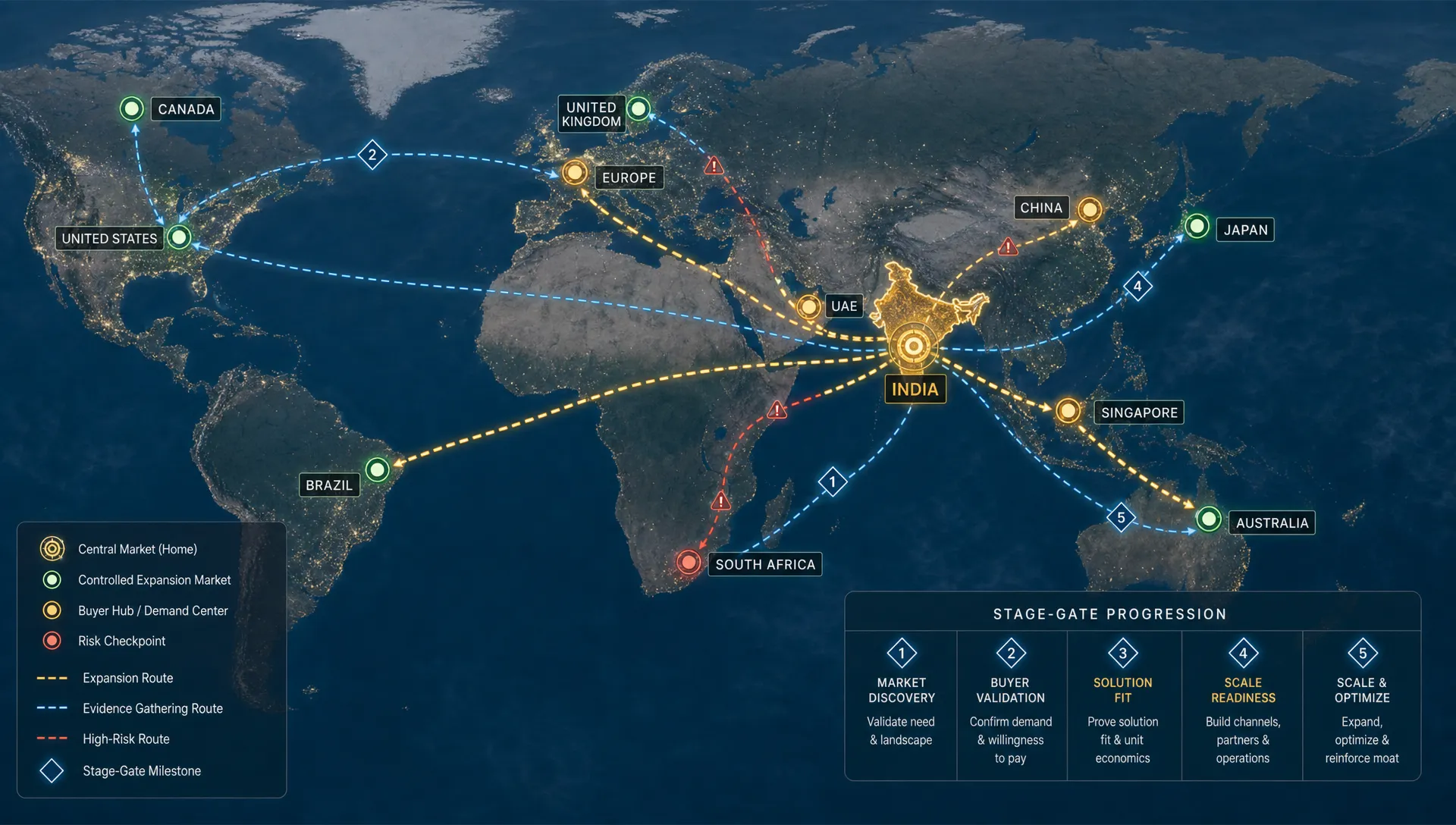
Global Market Expansion With Less Risk and More Control
Global market expansion is attractive for a simple reason: the right new market can change the growth curve of a company without requiring a new product, a full rebrand, or a major acquisition. For PE-backed and sponsor-owned companies, it can also create a stronger equity story before exit by proving that the business has repeatable growth beyond its original geography.
The problem is that international growth often looks cleaner in the board deck than it feels in the operating cadence. A large addressable market, a few promising conversations, and a competitor presence abroad do not automatically translate into a controllable expansion motion.
The companies that expand well do not treat global market expansion as a leap of faith. They treat it as a controlled commercial experiment, with defined risk, staged investment, and clear evidence thresholds before each next move.
Control Is the Real Expansion Advantage
Most expansion risk is not created by the foreign market itself. It is created by weak assumptions that go untested for too long.
A company may assume its existing ICP will buy the same way in another country. It may assume the current sales motion can be copied, the same messaging will resonate, the same channel economics will hold, or the same implementation model will scale. Each assumption may be reasonable on its own. Together, they create operational drag.
For investors and leadership teams, the goal is not to remove all risk. That is impossible. The goal is to separate smart risk from uncontrolled exposure. Smart risk has a hypothesis, an owner, a budget, a timeframe, and a decision rule. Uncontrolled exposure has momentum, optimism, and no clear moment when the company can stop, adjust, or double down.
This is why expansion should be governed like a capital allocation decision, not just a sales initiative. The question is not simply whether the new market is attractive. The better question is whether the company can prove a path to repeatable revenue before it commits fixed cost, leadership bandwidth, and brand reputation.
If you are still shaping the broader thesis, it helps to anchor the work in a disciplined market expansion strategy that works, rather than starting with country selection alone.
The Six Risks That Need Active Management
Global expansion becomes more manageable when leaders stop treating risk as one broad category. Different risks require different controls. A legal risk is not solved by more sales calls. A messaging risk is not solved by hiring a country manager. A channel risk is not solved by translating the website.
The table below summarizes the most common risk categories and the controls that reduce downside without slowing the entire initiative.
| Expansion risk | What it looks like | Practical control |
|---|---|---|
| Market truth risk | TAM looks large, but reachable demand is unclear | Validate with target account interviews, local buyer research, and early paid demand signals |
| Access risk | The company knows who should buy, but cannot reach them efficiently | Test direct outreach, referral paths, partners, and sponsor networks before hiring a full local team |
| Positioning risk | The offer is strong at home, but does not land locally | Run message tests with buyers, partners, and industry advisors before launching campaigns |
| Sales execution risk | The home market playbook does not convert in the new market | Build a narrow pilot motion with defined stages, CRM discipline, and weekly review |
| Operating risk | Delivery, compliance, support, or localization strain the business | Map what must be local, what can stay centralized, and what needs specialist support |
| Capital allocation risk | Investment keeps increasing without proof of repeatability | Use stage gates with pre-agreed scale, pause, or exit criteria |
This level of control matters especially in private equity environments because time is not neutral. Every quarter spent chasing unclear demand is a quarter that could have strengthened the core business, improved margins, or built a more credible exit narrative.
Start With a Narrow Expansion Thesis
A common mistake is defining the expansion target too broadly. The company says it is expanding into the United States, the GCC, the UK, or Europe. But countries and regions are not markets. A market is a specific buyer segment with a specific problem, budget, urgency, buying process, and viable route to access.
A better expansion thesis is narrow enough to test. Instead of asking whether Germany is attractive, ask whether mid-market manufacturers in a specific vertical have enough urgency, budget, and access points to justify a controlled pilot. Instead of asking whether the UAE is a growth market, ask whether enterprise buyers in one segment will respond to the offer, accept the price, and move through procurement within a realistic sales cycle.
A useful thesis answers five questions:
- Which buyer segment will we target first?
- What problem will we lead with?
- Why should this market buy now?
- How will we reach decision-makers predictably?
- What evidence will justify the next investment stage?
This forces management teams to avoid vague opportunity language. It also creates a cleaner board conversation. The debate shifts from whether everyone feels confident about a country to whether the evidence supports the next tranche of spend.
Use Stage Gates Instead of Big-Bang Expansion
The safest global expansion plans rarely feel dramatic at the beginning. They start small, collect evidence, and earn the right to scale. This is not a conservative posture. It is a faster way to find truth.
Stage-gated expansion works because it limits irreversible decisions. The company does not open a large office before proving access. It does not hire a full team before proving sales motion. It does not localize every asset before proving message-market fit. It does not commit leadership attention indefinitely without a defined review cadence.
| Phase | Purpose | What to validate | Decision control |
|---|---|---|---|
| Thesis | Define the opportunity and assumptions | ICP, pain point, route to market, expected economics | Approve or reject pilot design |
| Market proof | Test whether demand is real and reachable | Buyer conversations, local objections, willingness to engage | Continue, narrow, or stop |
| Controlled pilot | Prove a repeatable path to revenue | Pipeline quality, conversion rates, sales cycle behavior, delivery friction | Scale, redesign, or pause |
| Local engine | Add capacity around a proven motion | Hiring profile, partner model, enablement, reporting | Invest with operating discipline |
| Scale | Expand segments, regions, or channels | Unit economics, management capacity, customer success | Accelerate or optimize |
This structure is especially important when the existing business is already performing. Expansion should not break what is working. Leadership should protect core-market revenue, customer success, and sales management bandwidth while the new market is being tested. If the new initiative starts pulling the best people away from the core engine without enough evidence, the company may create more value leakage than value creation.
For that reason, expansion planning should include an explicit GTM protection plan. If your company is scaling into new geographies while trying to preserve existing performance, the principles in market expansion without breaking your sales engine are directly relevant.
Build the Operating Model Before You Hire the Market
Hiring a local leader can be valuable, but it should not be the first control mechanism. Too many companies hire a country head and expect that person to solve strategy, access, positioning, hiring, partnerships, and execution at the same time.
Before hiring for scale, define the operating model. Decide what stays central and what becomes local. Pricing strategy, brand governance, revenue reporting, enablement, and performance management often need central oversight. Local execution, partner relationships, buyer nuance, and certain delivery requirements may need local adaptation.
The right answer depends on the business model. A software company, a technical services firm, a specialist manufacturer, and a compliance-heavy B2B provider will not need the same structure. In technical markets, local credibility can matter as much as product capability. For example, a company selling into built environments, offices, factories, studios, or industrial facilities in South Africa would need to understand how local buyers evaluate site expertise and solution proof. Studying specialist providers such as Genesis Acoustics can help leaders see how acoustic and soundproofing solutions are positioned around practical buyer problems, site inspections, and expert diagnosis in that market.
The lesson is broader than acoustics. Market entry is not just about finding demand. It is about understanding how buyers trust providers, how procurement evaluates risk, how proof is demonstrated, and how local competitors frame the problem.

Create a Board-Level Expansion Control System
A global expansion initiative should have a control system that is visible to the board and useful to operators. If reporting is too high-level, the board sees activity but not truth. If reporting is too detailed, the leadership team drowns in noise.
The best control systems combine a few leading indicators with disciplined review. Leaders should be able to see whether the initiative is moving from assumptions to evidence. They should also be able to detect whether the effort is consuming more resources than planned.
Practical controls include:
- A single accountable executive for the expansion motion
- A written thesis with assumptions, risks, and decision gates
- Weekly operating reviews during pilot phases
- Monthly sponsor or board updates focused on evidence, not activity
- Clear criteria for scaling, redesigning, pausing, or exiting the market
The key is to make decisions before emotions take over. If a pilot has weak access, unclear messaging, and poor conversion after a fair test, the company should not continue simply because the market looked attractive in the original deck. Conversely, if the evidence is strong, the company should be ready to invest decisively rather than keeping the initiative underpowered.
Control does not mean moving slowly. It means knowing when to move fast.
Do Not Confuse Localization With Translation
Localization is often underestimated. Translating sales collateral is only a small part of the work. Real localization may affect pricing, packaging, buyer education, channel strategy, proof points, implementation, contracting, and customer success.
In some markets, buyers may expect more consultative selling. In others, partner credibility may matter more than direct outreach. Some regions require more executive relationship-building before formal procurement begins. Others demand detailed technical proof before a commercial conversation advances.
This is where early customer discovery pays for itself. Interviews with target buyers, former buyers, channel operators, and local industry specialists can reveal issues that do not appear in desk research. Public sources such as the U.S. International Trade Administration’s country guides can provide useful context, but they cannot replace direct market conversations with the exact buyers you need to win.
The goal is not to reinvent the company for every market. The goal is to identify the few adaptations that materially improve conversion, trust, and delivery quality.
Use AI to Improve Visibility, Not Replace Judgment
AI can make global market expansion more controlled when it is applied to the right problems. It can accelerate market research, cluster buyer feedback, monitor competitor messaging, support account prioritization, and improve reporting consistency across regions.
For portfolio companies, AI can also reduce the manual burden of sponsor reporting. A shared data structure across CRM, pipeline reviews, customer notes, and expansion dashboards can help leaders detect patterns faster. That matters when a sponsor is comparing multiple portfolio companies or multiple market-entry options at once.
However, AI should not be used to skip market truth. It can summarize signals, but it cannot create demand. It can identify target accounts, but it cannot prove that those accounts will buy. It can improve cadence, but it cannot repair a weak value proposition.
The best use of AI is to make the expansion system more observable. Leaders should see more clearly where the initiative is working, where it is stuck, and which assumptions need attention.
What PE Sponsors Should Expect From a Controlled Expansion Plan
For PE sponsors, global expansion should connect directly to the value creation plan. It should not be a side project or a vanity initiative. The expansion thesis should explain how the move improves revenue quality, market headroom, resilience, margin potential, or exit optionality.
A strong sponsor-level plan will also define how much risk is acceptable at each stage. A founder-led company may be comfortable experimenting informally, but a PE-backed company needs sharper governance. That does not mean bureaucracy. It means every material investment should be tied to a proof point.
Sponsors should expect management to answer three questions with clarity. First, what is the smallest credible test that can validate the opportunity? Second, what must be true before additional capital is released? Third, how will the company protect the core business while the expansion is underway?
When those answers are clear, global market expansion becomes less of a gamble and more of a managed growth option.
Frequently Asked Questions
What is the biggest risk in global market expansion? The biggest risk is usually not choosing the wrong country. It is scaling before the company has proven demand, access, messaging, and repeatable sales execution in that market.
How can a PE-backed company reduce expansion risk? A PE-backed company can reduce risk by using a staged investment model, validating assumptions through buyer conversations and pilot activity, protecting the core sales engine, and setting clear scale or stop criteria before committing major fixed costs.
When should a company hire a local team for a new market? A local team is most valuable after the company has evidence of reachable demand and a defined go-to-market motion. Hiring too early can add cost and complexity before the strategy is proven.
Is global expansion only suitable for large companies? No. Mid-market and portfolio companies can expand globally if they keep the initial scope narrow, test carefully, and avoid overbuilding infrastructure before market proof exists.
How should sponsors evaluate whether expansion is working? Sponsors should look beyond activity metrics. Useful signals include qualified pipeline quality, buyer feedback, conversion behavior, sales cycle realism, delivery friction, and whether the initiative is meeting agreed stage-gate criteria.
Bring More Discipline to Your Next Expansion Move
Global expansion should create leverage, not uncontrolled complexity. The right approach gives leadership teams the confidence to test new markets, protect existing revenue, and invest only when the evidence supports it.
Phil Pelucha Consulting supports PE firms, portfolio companies, and growth-stage leadership teams with revenue acceleration, commercial diagnostics, GTM optimization, market expansion, and sponsor-level advisory. If your firm is evaluating a new market move, start a conversation with Phil Pelucha about building a more controlled path to growth.