
Growth Capital Private Equity Strategies That Scale
Growth capital private equity works when capital is paired with a repeatable system for turning market demand into durable revenue. Too many businesses treat a growth round as permission to hire faster, open markets, buy software and increase marketing spend at the same time. That creates motion, but not always enterprise value.
For PE sponsors, family offices and portfolio leadership teams, the more valuable question is not how much capital can we deploy? It is where can capital remove the constraint that is already limiting profitable scale? A strong growth capital strategy concentrates resources behind validated markets, clear ICPs, revenue operations, sales productivity, retention and exit-grade reporting.
This article lays out a practical operating model for growth capital private equity strategies that scale without building a heavier, slower organization.
What growth capital private equity should actually fund
Growth capital sits between early venture risk and mature control-buyout discipline. The company usually has revenue traction, customer proof and a reason to believe the market can absorb more capacity. The risk is less about whether anyone wants the product and more about whether the business can scale acquisition, delivery and management without eroding margins.
That distinction matters. Capital should not fund every possible idea. It should fund the few constraints that, once removed, increase the value of the whole platform. In some companies, that means building a real sales management layer. In others, it means improving demand capture, entering a new geography or installing the revenue systems needed to make forecasting reliable.
If the financing question is still open, it is worth comparing growth capital or debt as strategic paths before locking the company into a plan. Growth capital is most powerful when the upside requires risk sharing, strategic support and operating change rather than simply borrowing against existing cash flow.
The core rule: fund repeatability before scale
The most common mistake in growth capital investing is mistaking momentum for repeatability. A founder-led company may have strong growth because the founder is still close to every major customer, every strategic partnership and every sales hire. That does not mean the revenue engine can support institutional scale.
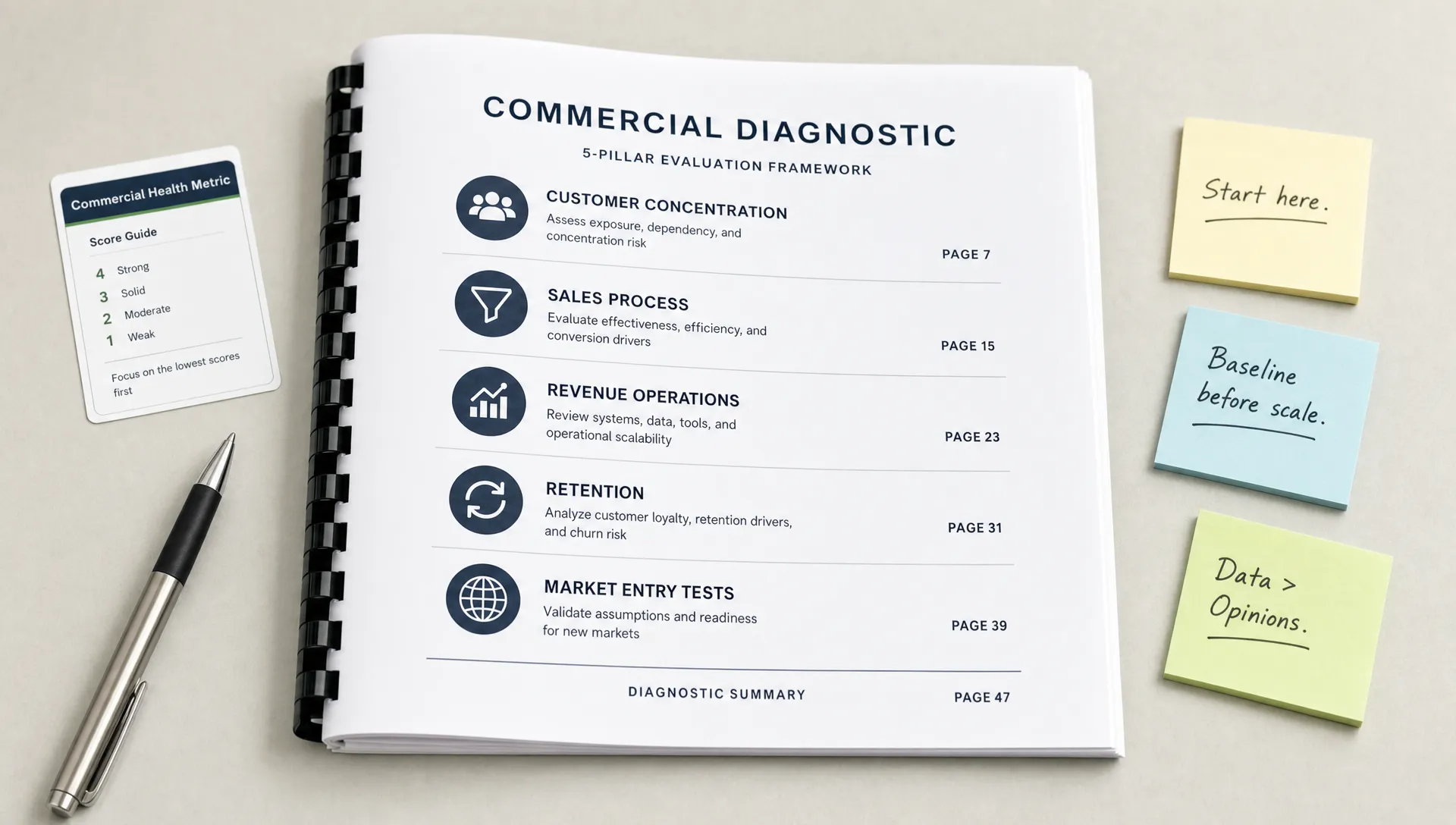
Before adding more spend, investors should ask whether the company can explain, measure and reproduce its best wins. If the answer is no, capital may amplify inconsistency. This is why a pre-scale commercial diagnostic is often more valuable than a larger sales budget. It reveals which parts of the growth engine are ready for capital and which parts need to be repaired first.
For a deeper view on this sequencing problem, see what PE funds should fix before pushing growth. The same logic applies to growth capital: speed only compounds value when the underlying operating model is ready.
| Scaling area | What must be true before adding capital | What capital should fund |
|---|---|---|
| Sales capacity | Win rates, ramp times and ICP are measurable | Hiring, enablement and management systems |
| Marketing | Demand sources are attributable and conversion is understood | Content, paid acquisition, SEO and conversion assets |
| Market expansion | Current market economics are proven | Local partnerships, leadership and controlled entry tests |
| Customer success | Retention drivers and churn causes are visible | Onboarding, adoption programs and account expansion |
| Revenue operations | Data is clean enough for decisions | CRM architecture, forecasting and automation |
Strategy 1: Concentrate around the best customers
A scalable growth capital strategy starts with customer concentration in the strategic sense, not dependency on one or two accounts. The company should know which segments deliver the best combination of acquisition efficiency, margin, retention, expansion potential and reference value.
This is not a branding exercise. It is an economic decision. Many portfolio companies claim to serve mid-market, enterprise and strategic buyers at the same time. In practice, each segment may require different messaging, sales cycles, pricing structures, implementation models and support coverage. Spreading growth capital across too many segments creates complexity faster than revenue.
The work is to identify the highest-quality demand and then design the commercial machine around it. That means narrowing the ideal customer profile, clarifying disqualifiers and linking sales effort to segment-level contribution margin. The best growth strategies often look more focused before they look bigger.
Strategy 2: Turn founder-led selling into institutional revenue
Founder-led sales can be a strength during diligence and a weakness after the deal. Founders often carry credibility, product knowledge and customer trust that the sales team has not yet learned to reproduce. If growth capital is deployed into headcount before this knowledge is captured, new hires may struggle to convert interest into revenue.
The transition requires a structured revenue engine. This includes a clear sales process, qualification standards, account planning, sales playbooks, objection handling, pricing guidance and management cadence. None of this needs to be over-engineered. It does need to be explicit enough that a talented commercial leader can train, coach and forecast against it.
For sponsors, this is one of the highest-leverage uses of operating support. A fractional CRO or commercial operating partner can bridge the gap between entrepreneurial selling and institutional sales management, especially when the company is not ready for a full executive hire.
Strategy 3: Build a revenue operating system, not just a bigger team
Growth capital often goes into hiring because hiring is visible. Board packs can show new reps, new territories and increased quota capacity. But without the operating system behind the team, the result can be inflated payroll and a less reliable forecast.
A revenue operating system gives management visibility into the mechanics of growth. It connects lead sources to pipeline, pipeline to win rates, win rates to onboarding capacity and onboarding to retention. It also creates shared definitions so the board and management team are not debating what qualified pipeline means every month.
The basics are simple: clean CRM data, stage discipline, conversion tracking, activity quality, forecast categories, customer segmentation and accountability rhythms. The benefit is not administrative tidiness. The benefit is that capital allocation gets smarter because leaders can see what is working and where the constraint has moved.
Strategy 4: Upgrade demand capture before expanding demand generation
Many growth-stage companies invest in outbound campaigns, events or paid media while their demand capture assets remain weak. The website is unclear, the offer is difficult to understand, search visibility is thin and conversion paths are not aligned with the buyer journey. In that case, marketing spend leaks value.
For growth capital private equity, digital infrastructure should be treated as part of the commercial system. A portfolio company does not need a bloated brand project, but it does need a credible, conversion-oriented presence that supports sales and captures existing demand. When local market visibility or technical execution is the bottleneck, a specialist such as a custom web design and SEO partner can help strengthen the assets that turn buyer interest into measurable opportunities.
The right sequence is usually to sharpen positioning, clarify the commercial offer, improve conversion paths and then scale acquisition. Demand generation works better when the market can quickly understand why the company matters.
Strategy 5: Use AI to remove commercial friction
AI can accelerate growth, but it does not rescue a weak strategy. The most useful applications are usually practical: cleaning data, summarizing sales calls, enriching accounts, prioritizing outreach, generating proposal drafts, monitoring churn signals and automating repetitive revenue operations tasks.
The sponsor-level opportunity is bigger than isolated tools. PE and family office investors can create shared AI systems across a portfolio, especially where companies have similar commercial motions. That can reduce duplicated effort, improve reporting and help smaller management teams access capabilities they could not build alone.
The right test is whether AI improves speed, quality or consistency in a specific revenue workflow. If it does not, it is probably theater. Growth capital should fund AI where it increases sales productivity, improves customer experience or gives leadership cleaner visibility into the business.
Strategy 6: Expand markets through staged entry, not executive optimism
Market expansion is one of the most attractive growth capital uses because it can dramatically change the exit narrative. It is also one of the easiest ways to waste capital. New geographies and verticals introduce hidden costs: local buyer behavior, channel economics, compliance, talent availability, support coverage, competition and brand trust.
A scalable expansion plan starts with evidence. Sponsors should define the market selection logic, entry model, investment gates and kill criteria before committing serious capital. The first phase should test whether the company can win repeatably in the new market, not just whether a few friendly prospects will take meetings.
For companies considering cross-border growth, international expansion strategies for PE-backed growth offers a more detailed framework for market selection and entry discipline. The broader point is the same: growth capital should buy learning before it buys scale.

Strategy 7: Improve pricing and packaging before adding volume
Pricing is often underused in growth capital plans because it feels sensitive. Yet better pricing architecture can create meaningful value without adding proportional cost. The opportunity may include clearer packages, reduced discounting, value-based price increases, better renewal structures or more disciplined approval rules.
The key is to connect pricing work to customer value. A company that raises prices without improving packaging, communication or customer success may create churn risk. A company that understands willingness to pay by segment can often improve margins and sales clarity at the same time.
For PE sponsors, pricing work also strengthens the exit story. Buyers want to see that revenue growth is not dependent only on more salespeople. They want evidence that the company has pricing power, disciplined commercial governance and a customer base that accepts the value proposition.
Strategy 8: Build retention and expansion into the growth thesis
Growth capital strategies often overweight new logo acquisition. New logos matter, but the quality of growth depends on what happens after the contract is signed. If onboarding is inconsistent, adoption is weak or customer success is reactive, the business may need to replace too much revenue each year before it can grow.
Retention is not only a customer success metric. It is a commercial design issue. The company needs clear handoffs from sales to delivery, measurable adoption milestones, account health indicators, expansion triggers and renewal ownership. This is especially important in services, SaaS, distribution and B2B platforms where customer trust compounds over time.
Expansion revenue deserves its own operating rhythm. Account plans, executive sponsorship, usage signals and customer outcomes should feed a structured review cadence. When retention and expansion are built into the revenue system, growth capital works harder because every acquired customer has a larger lifetime value.
Strategy 9: Align the board around a few scaling metrics
Growth capital creates pressure to move quickly, but board alignment matters more as the plan becomes more ambitious. Too many companies report lagging indicators such as revenue and EBITDA without enough visibility into the leading indicators that explain whether growth is becoming more repeatable.
The board should agree on a small set of metrics that connect the investment thesis to operating reality. This keeps the management team focused and helps sponsors distinguish temporary execution noise from a broken assumption.
| Metric | Why it matters | What a scaling company should learn from it |
|---|---|---|
| Net revenue retention | Shows durability and expansion in the existing base | Whether customer value compounds after acquisition |
| Sales ramp time | Shows how repeatable the sales model is | Whether hiring more reps will increase capacity predictably |
| CAC payback | Connects acquisition spend to capital efficiency | Whether growth is becoming more or less expensive |
| Pipeline conversion by source | Reveals demand quality | Which channels deserve more capital |
| Gross margin by segment | Shows quality of revenue | Which customers improve enterprise value |
| Forecast accuracy | Tests management control | Whether the revenue engine is board-ready |
The right metrics will vary by sector and business model. The discipline is to measure what changes the next capital allocation decision, not everything that can be measured.
Strategy 10: Design the exit narrative from the start
Exit readiness is not a project for the final six months. In growth capital private equity, every scaling choice should contribute to a future buyer's confidence. The buyer will want to understand why the company grew, how repeatable that growth is and what remains available for the next owner.
That means the company should document the commercial model as it scales. Which segments drove growth? Which channels improved? How did sales productivity change? What happened to retention, margin and pricing discipline? A strong exit narrative is built from operating evidence, not a polished CIM alone.
The best sponsors keep this narrative visible from the beginning. It helps management understand why certain investments matter and prevents the company from chasing revenue that looks good in the short term but weakens the eventual valuation story.
A 90-day plan for deploying growth capital with discipline
The first 90 days after a growth capital investment should create clarity before acceleration. This does not mean slowing the company down. It means making sure the next dollar goes where it can produce the highest-quality growth.
A practical 90-day plan can follow this sequence:
- Days 1 to 30, diagnose the commercial system: Review customer economics, pipeline quality, sales process, pricing, retention, marketing conversion, data integrity and management capacity.
- Days 31 to 60, select the constraints to remove: Choose the two or three bottlenecks that most limit profitable scale, then define owners, resources, milestones and success metrics.
- Days 61 to 90, launch controlled scaling initiatives: Start targeted hiring, demand capture upgrades, pricing tests, AI workflow pilots or market entry experiments with clear reporting back to the board.
The outcome should be a growth plan that management can execute and investors can govern. If the first 90 days only produce a longer list of initiatives, the company has probably confused ambition with strategy.
Where growth capital strategies fail
Most failed growth strategies do not fail because the thesis was irrational. They fail because the operating model was not ready for the level of complexity introduced by the capital.
Common failure patterns include hiring ahead of sales management, entering too many markets at once, measuring activity instead of conversion, adding software without process ownership, treating AI as a shortcut, pushing price increases without customer insight and allowing board reporting to lag behind the business.
The antidote is focus. Growth capital should create a narrower, stronger path to scale. When every initiative has a clear constraint, owner, metric and decision gate, the company can move fast without losing control.
Frequently Asked Questions
What is growth capital private equity? Growth capital private equity provides capital to companies that already have market traction and need funding, operating support or strategic guidance to scale. It often focuses on revenue growth, market expansion, sales infrastructure and exit readiness rather than financial engineering alone.
How is growth capital different from venture capital? Venture capital usually accepts higher product and market risk at earlier stages. Growth capital typically backs companies with more proven revenue, clearer customer demand and a stronger expectation that capital can accelerate an existing model.
What should PE sponsors fix before deploying growth capital? Sponsors should clarify the ideal customer profile, revenue quality, sales process, pricing discipline, retention drivers, data integrity and management capacity. These foundations make additional capital more productive.
Is AI a reliable growth capital strategy? AI is reliable when it improves a specific commercial workflow, such as data hygiene, account prioritization, call analysis or forecasting. It is not reliable as a substitute for positioning, customer insight or commercial leadership.
When should a portfolio company expand into a new market? A company should expand when its core market economics are proven, the new market has clear strategic logic and the entry plan includes investment gates. Early tests should prove repeatability before full-scale commitment.
Turn growth capital into a scalable commercial system
Growth capital private equity rewards discipline. The firms that outperform are not simply spending more aggressively. They are installing the commercial infrastructure that turns capital into repeatable revenue, better margins and a stronger exit narrative.
Phil Pelucha Consulting helps PE, VC, family office and portfolio company leaders identify growth constraints, optimize sales and GTM systems, support market expansion, build AI-powered revenue workflows and improve exit readiness. If your growth plan needs to move from ambition to execution, start with a commercial diagnostic and build the scaling system around the evidence.