
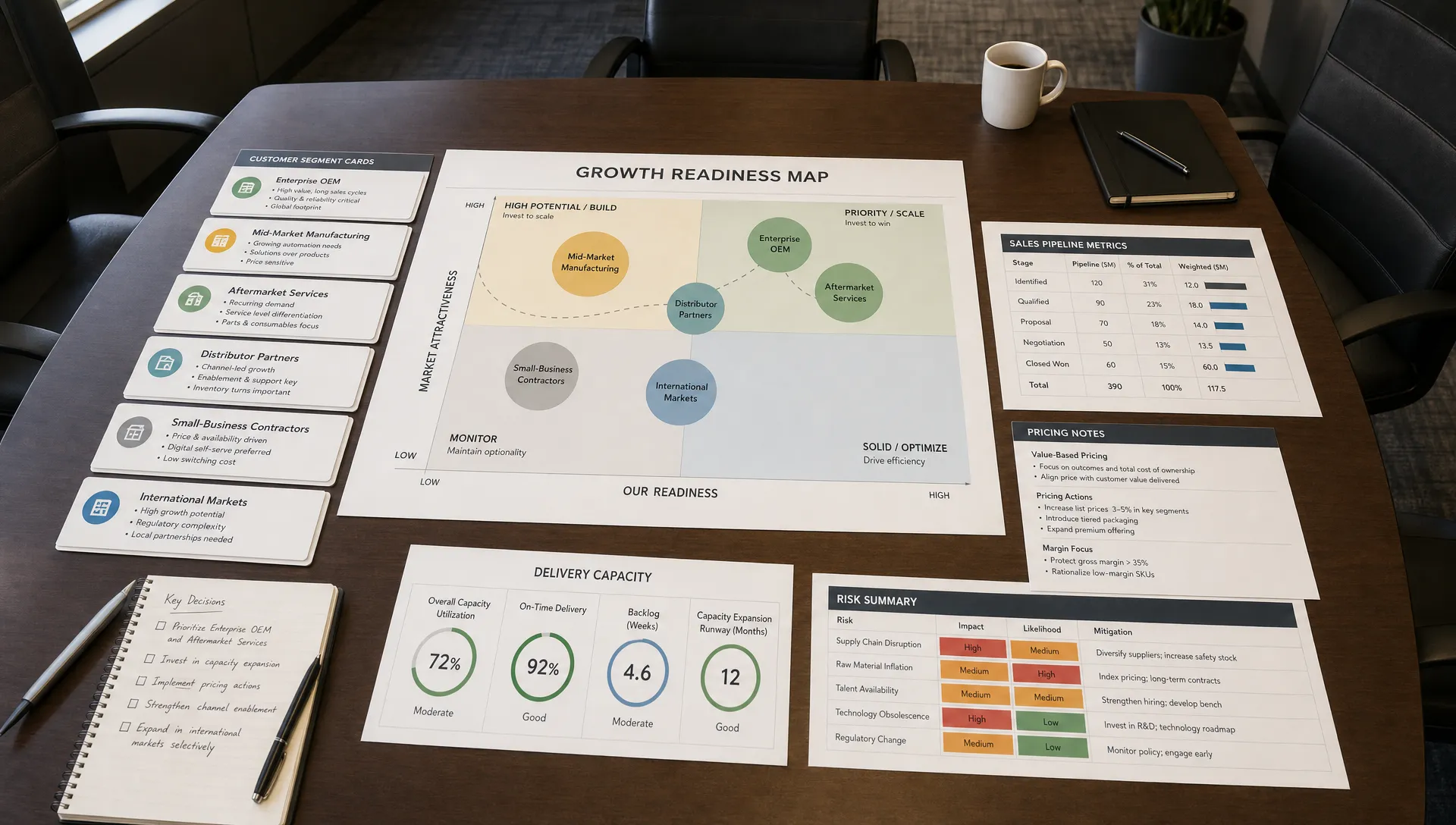
What PE Funds Should Fix Before Pushing Growth
Growth is the most expensive place to discover that a portfolio company is not ready to scale.
For PE funds, the instinct to push growth after acquisition is understandable. The investment committee approved a plan. The model has a revenue case. The hold period is already moving. Management wants momentum, and sponsors want evidence that the value creation plan is alive.
But pressure does not create readiness. If the commercial engine is unclear, the data is unreliable, delivery capacity is thin, or pricing leaks margin, growth can amplify exactly the weaknesses that reduce enterprise value. More sales activity can create more churn. More customers can expose service fragility. More revenue can arrive with worse margins. More pipeline can make forecasting less trustworthy.
The better question is not how hard can we push growth? It is what must be fixed first so growth is accretive, repeatable, and credible to a future buyer?
Growth amplifies the weakest part of the business
A portfolio company rarely fails to grow because the board did not ask for enough growth. It fails because the system underneath the target cannot consistently convert demand into profitable, retained revenue.
That system includes positioning, lead generation, sales process, customer success, pricing, delivery, working capital, leadership cadence, and data quality. If any one of those is materially weak, pushing harder may only create a larger version of the same problem.
This is one reason post-close plans miss even when the deal model was thoughtful. As explored in why PE firms miss growth targets after acquisition, the spreadsheet starts operating inside a real company with legacy habits, uneven execution, and constraints that were not fully visible during diligence.
Growth, therefore, should be treated as a system test. If the company grows 20 percent, what breaks first? The answer tells the sponsor where value creation must begin.
Fix the translation from thesis to operating reality
The first fix is not a new campaign, a larger sales team, or an international launch. It is translating the investment thesis into an operating scorecard that management can actually run.
A deal thesis often uses clean assumptions. The market is fragmented. Cross-sell is available. The sales team can be professionalized. Pricing can improve. Churn can fall. A new geography is attractive. Those statements may be directionally true, but they are not yet executable.
Before pushing growth, PE funds should force each growth assumption to become observable operating proof.
| Growth assumption in the deal model | Operating proof to validate before scaling | Risk if ignored |
|---|---|---|
| Sales headcount can increase revenue | Clear ICP, repeatable sales process, reliable conversion data, defined ramp expectations | Hiring creates cost without predictable productivity |
| New markets can accelerate growth | Segment demand, local buying triggers, competitive map, delivery capacity, compliance needs | Expansion distracts management and dilutes focus |
| Pricing can improve margins | Value drivers, discount patterns, customer willingness to pay, approval controls | Revenue grows while margin leakage continues |
| Cross-sell is available | Customer segmentation, product fit, usage data, account ownership, customer success process | Sellers push irrelevant offers and damage relationships |
| AI or automation can improve productivity | Clean data, consistent workflows, process owners, adoption plan | Tools automate confusion rather than performance |
The board should not accept a growth plan that only says what will be done. It should require proof of why the company is ready, who owns each lever, which constraint is being removed, and how progress will be measured.
Fix ICP and offer discipline before increasing demand
Many portfolio companies have revenue, but not enough commercial clarity. They know who bought historically, but they do not know which customers are most profitable, easiest to retain, fastest to close, and most likely to expand.
That distinction matters. Growth from the wrong customers can look positive in the board deck while damaging the business underneath. Poor-fit customers demand more customization, require heavier support, negotiate harder, churn faster, or prevent the team from building repeatable motions.
Before pushing growth, the company should define its ideal customer profile with practical specificity. That means more than industry and company size. It should include the buyer problem, trigger events, urgency, economic owner, buying committee, disqualifiers, average sales complexity, implementation burden, margin profile, and expansion potential.
The offer also needs discipline. If every customer receives a custom version of the product, service, implementation, contract, or pricing model, scaling will be operationally expensive. Standardization does not mean inflexibility. It means the company knows which variations create value and which ones only create complexity.
This is closely connected to understanding what every portfolio company needs before scaling, because scaling should compound clarity, not compensate for its absence.
Fix revenue quality, not just revenue volume
A company can hit its revenue target and still reduce exit readiness. That happens when growth is built on low-margin contracts, excessive discounting, weak retention, customer concentration, long cash cycles, or heavy founder involvement.
Revenue quality is what buyers underwrite when they decide whether growth deserves a premium multiple. A future buyer wants to see that revenue is durable, profitable, transferable, and supported by repeatable systems.
The pre-growth diagnostic should examine gross margin by customer and product line, retention by cohort, expansion by segment, discounting by salesperson, implementation cost by deal type, receivables patterns, and customer concentration. The goal is to identify where the company should grow faster, where it should grow differently, and where it should stop growing altogether.
Not all revenue deserves the same level of sponsor support. A large customer that drains delivery resources, pays slowly, and blocks product standardization may be less valuable than a smaller account that expands predictably and fits the operating model.
Fix the sales process before adding salespeople
Sales headcount is often the most visible growth lever, but it is also one of the easiest to waste. If a portfolio company does not have a defined sales process, consistent qualification, useful CRM data, and a disciplined management cadence, more reps usually create more noise.
The sponsor should ask whether the company can answer basic commercial questions without a manual fire drill. What is the real pipeline coverage? Which stages have the highest drop-off? Which lead sources convert into profitable customers? Which reps are winning because of skill, territory, founder support, or luck? What does a qualified opportunity actually mean?
A strong pre-growth sales fix includes stage definitions, exit criteria, deal review standards, forecast categories, follow-up expectations, and a recurring operating rhythm. The CRM should become a management instrument, not a storage locker.
This is where many founder-led companies need help. The founder may be excellent at closing, but that does not mean the business has a transferable sales system. If the growth plan depends on the founder continuing to rescue key deals, the company has not yet created scalable value.
Fix delivery capacity and customer experience before demand spikes
Growth is not only a sales problem. It is also an operations problem.
If delivery, onboarding, engineering, implementation, procurement, or customer support cannot handle new demand, commercial success can quickly become customer dissatisfaction. The result is longer time to value, increased refunds or credits, employee burnout, margin pressure, and churn.
For service businesses, the constraint may be senior talent, project management, knowledge transfer, or utilization. For software businesses, it may be implementation complexity, customer success capacity, product reliability, or support response times. For industrial, manufacturing, or hardware businesses, it may include engineering throughput, design-for-manufacture readiness, prototyping speed, component availability, or lifecycle support.
In electronics and hardware-heavy portfolio companies, for example, sponsors may need to validate whether engineering and prototyping partners can keep pace with commercial commitments. A specialist embedded systems and electronics design partner can be relevant when growth depends on PCB design, power electronics, rapid prototyping, or broader product development capacity.
The point is simple: do not create demand the company cannot fulfill well. Growth that damages customer experience becomes a tax on future enterprise value.

Fix data quality before adding AI and automation
AI can accelerate portfolio company growth, but only if the underlying process is stable enough to improve. If the CRM is inconsistent, customer data is fragmented, sales stages are subjective, and no one owns the workflow, automation will simply accelerate bad inputs.
Before PE funds invest in AI systems, they should clarify the operating questions the technology is meant to answer. Is the goal to reduce manual reporting? Improve lead scoring? Shorten sales cycles? Identify churn risk? Standardize account research? Support board reporting? Each use case requires different data, ownership, and adoption behavior.
The pre-growth fix is usually less glamorous than the AI headline. It involves common definitions, clean ownership, workflow discipline, data hygiene, and management accountability. Once those foundations are in place, AI can support productivity and decision-making at both the portfolio company and sponsor level.
Without those foundations, AI becomes another tool layered onto a weak operating model.
Fix pricing governance and margin leakage
Pricing is one of the fastest ways to improve value, but it is often neglected because it requires commercial courage and cross-functional alignment.
Before pushing growth, PE funds should understand where price is actually being set. Is it controlled by leadership, sales, legacy contracts, procurement pressure, channel partners, or informal discount habits? Are discounts tied to deal quality, volume, strategic value, or rep anxiety? Is the company selling value, or simply matching the last concession a buyer requested?
Pricing governance does not always mean an immediate price increase. It may mean establishing discount floors, approval thresholds, clearer packaging, annual review mechanisms, implementation fees, minimum order values, or more disciplined renewal conversations.
The danger is pushing growth while margin leakage remains invisible. In that scenario, every new customer expands the revenue line while weakening cash generation and valuation quality.
Fix leadership accountability and decision cadence
Many portfolio companies have capable people but unclear accountability. Growth initiatives are discussed in meetings, but ownership is diffuse. Marketing blames sales quality. Sales blames lead volume. Operations blames unrealistic promises. Finance sees the results too late.
PE funds should fix the cadence before raising expectations. A growth plan needs a small number of owners, a small number of metrics, and a regular forum where decisions are made quickly. The goal is not more reporting. It is faster truth.
A useful cadence separates leading indicators from lagging indicators. Revenue is a lagging indicator. Pipeline quality, sales cycle movement, customer onboarding time, renewal risk, margin by deal, and activity against named accounts are closer to the operating truth.
If the business lacks senior commercial leadership, a fractional CRO model can sometimes bridge the gap while the company matures. The sponsor should be careful, however, not to treat outside support as a substitute for internal accountability. The most valuable advisors install operating muscle that the company can continue using.
A practical pre-growth checklist for PE funds
The right checklist should be simple enough for a board conversation and specific enough to expose constraints. Before approving a more aggressive growth push, sponsors should test the company against these areas.
| Area to fix | Sponsor question | Ready-to-scale indicator |
|---|---|---|
| ICP and positioning | Do we know which customers create the most valuable growth? | Clear segments, disqualifiers, and value proposition by buyer type |
| Sales process | Can we predict conversion without founder intervention? | Defined stages, accurate CRM, reliable forecast cadence |
| Revenue quality | Are we growing durable, profitable revenue? | Margin, retention, expansion, and cash metrics reviewed by cohort |
| Pricing | Do we control discounting and value capture? | Approval rules, packaging discipline, and regular price reviews |
| Delivery capacity | Can operations absorb demand without degrading experience? | Capacity model, onboarding metrics, and customer satisfaction signals |
| Data and AI readiness | Are workflows and data clean enough to automate? | Common definitions, ownership, and trusted reporting sources |
| Leadership cadence | Are decisions made with speed and accountability? | Named owners, weekly operating rhythm, and board-level visibility |
This checklist is not designed to slow growth. It is designed to prevent false acceleration. The faster a sponsor identifies the binding constraint, the faster the company can remove it and scale with confidence.
The right sequence: diagnose, simplify, install, then accelerate
The strongest PE funds do not treat growth as a blunt instruction. They sequence it.
First, they diagnose the real constraint. They do not assume the issue is sales just because revenue is behind plan. They examine the customer journey from demand generation through renewal, then look for the point where value is leaking.
Second, they simplify. They reduce low-quality initiatives, unclear offers, weak segments, and reporting clutter. Many companies do not need more activity at first. They need fewer distractions and sharper choices.
Third, they install the operating infrastructure. That can include sales process, pipeline governance, pricing controls, customer success routines, management cadence, data definitions, and AI-enabled workflows where appropriate.
Only then do they accelerate. At that point, growth capital, headcount, market expansion, M&A integration, and automation have a stronger chance of producing value that lasts beyond the next board meeting.
This is also how growth becomes exit readiness. A buyer does not only want to see that revenue increased under sponsor ownership. They want to understand why it increased, whether it can continue, and whether the system is independent of heroic effort.
Frequently Asked Questions
Should PE funds push growth immediately after acquisition? Not always. Early momentum matters, but sponsors should first identify the constraints that could make growth inefficient or low quality. The best first move is often a commercial diagnostic that tests ICP, sales process, margins, delivery capacity, and data quality.
What is the biggest mistake PE funds make before scaling a portfolio company? The biggest mistake is adding pressure or headcount before the company has a repeatable commercial system. If the ICP is unclear, pricing is inconsistent, and sales data is unreliable, more activity can increase cost faster than value.
How do PE funds know a portfolio company is ready for growth? A company is closer to ready when it can show repeatable conversion in the right customer segments, reliable revenue quality, controlled discounting, delivery capacity, clean data, and a management cadence that surfaces issues early.
Can AI help PE funds accelerate growth across portfolio companies? Yes, but AI works best when workflows and data are already disciplined. It can support reporting, research, sales productivity, customer insights, and portfolio-level visibility, but it should not be layered onto broken processes without cleanup.
Why does fixing these issues improve exit readiness? Buyers pay more for growth they can trust. When a portfolio company can prove that revenue is durable, profitable, systemized, and not dependent on a few individuals, the growth story becomes easier to underwrite.
Build growth that buyers can believe
Pushing growth is easy. Building growth that improves valuation is harder.
For PE funds, the opportunity is to move from pressure to precision. Fix the commercial infrastructure first, then scale the parts of the business that are already proving they can generate high-quality revenue.
If your fund is preparing to accelerate a portfolio company, enter a new market, professionalize sales, or improve exit readiness, Phil Pelucha Consulting helps sponsors and management teams diagnose constraints, install commercial operating systems, and turn growth ambition into investable execution.