
How to Manage a Venture Capital Portfolio for Growth
Managing a venture capital portfolio for growth is not the same as being helpful to founders.
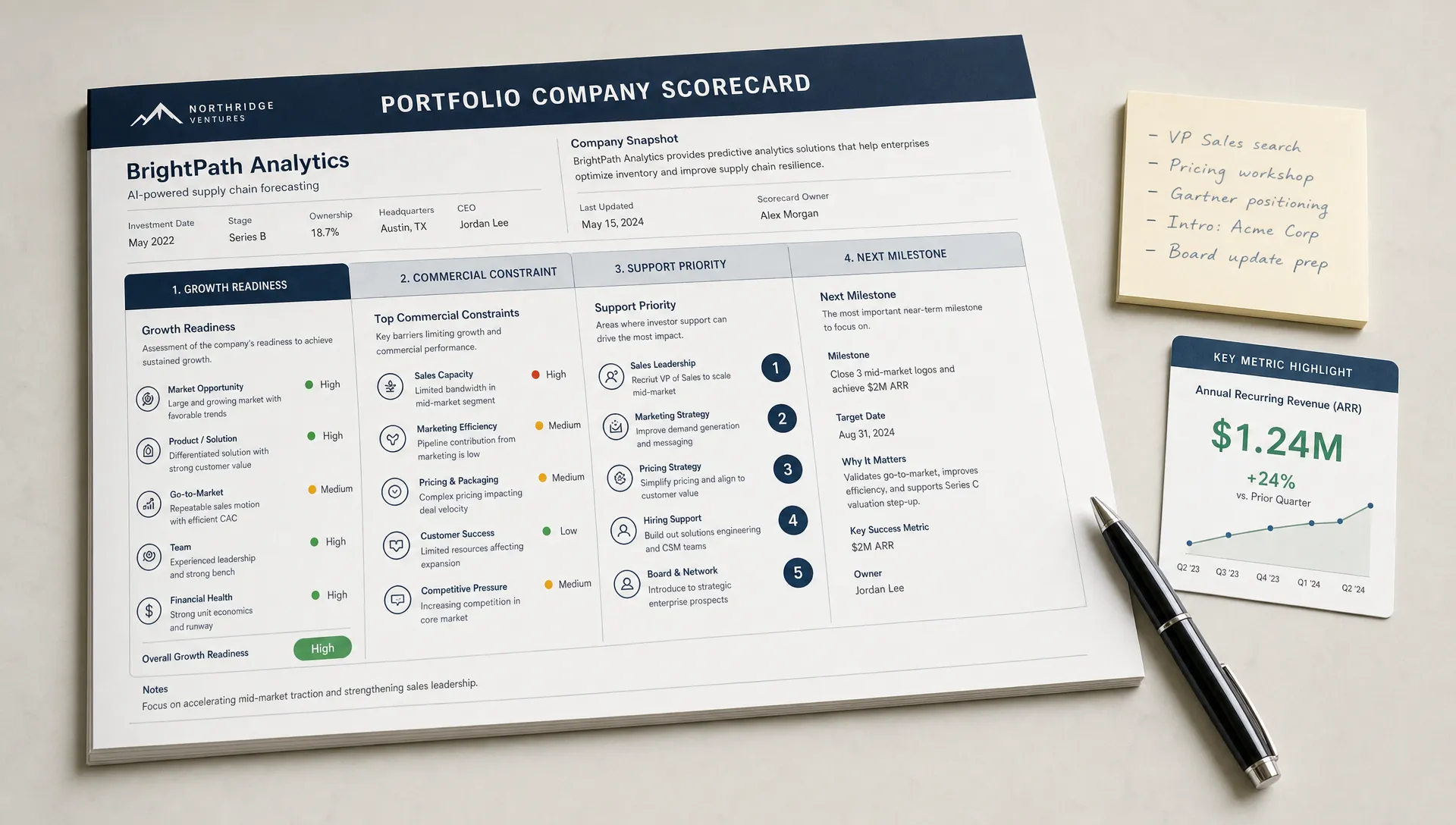
Introductions, board advice and occasional recruiting support matter, but they are not a portfolio growth system. A strong system helps investors decide where to focus attention, which companies deserve more operating resources, what commercial constraints need fixing and how each company should become more valuable before the next financing event or exit.
For VC firms, family offices and growth investors, the challenge is usually not a lack of intelligence inside the portfolio. It is a lack of operating rhythm. Founders are moving fast, markets change, reporting quality varies and partner time is scarce. Without a clear structure, portfolio support becomes reactive. The loudest company gets help, the most charismatic founder gets airtime and the real value creation work starts too late.
A better approach treats the venture capital portfolio as a managed growth engine. Each company still needs an individual plan, but the firm also needs a repeatable way to diagnose growth, allocate support and compound learning across the whole portfolio.
Start With a Portfolio Growth Thesis
Every VC fund has an investment thesis. Fewer have a clear portfolio growth thesis.
An investment thesis explains why the firm believes certain companies can create outsized returns. A portfolio growth thesis explains how the firm will help those companies convert potential into measurable enterprise value. That distinction matters because capital alone rarely turns a promising company into a category winner.
A practical growth thesis should define three things:
- Where growth is expected to come from: New customer acquisition, enterprise expansion, pricing power, channel partnerships, geographic expansion, product-led adoption or strategic positioning.
- What the firm is uniquely able to support: Commercial strategy, talent, customer access, AI automation, fundraising preparation, M&A readiness or governance.
- How support will be prioritized: By company stage, upside potential, urgency, founder receptivity and the specific constraint limiting growth.
This keeps the firm from offering generic help. A seed-stage infrastructure company does not need the same operating support as a Series B vertical SaaS company preparing for US expansion. A founder-led sales motion with strong demand but weak conversion needs a different intervention than a product with high usage but poor monetization.
The best portfolio managers ask a direct question: if this company is going to become materially more valuable in the next 12 to 24 months, what must change commercially?
That question pushes the conversation away from activity and toward value creation.
Segment the Portfolio by Growth Readiness
Stage labels are useful, but they are not enough. Two Series A companies can have completely different growth realities. One may have a repeatable ICP, improving sales conversion and a clear path to efficient scaling. The other may still be testing pricing, struggling with churn and relying on founder charisma to close deals.
Portfolio growth management improves when companies are segmented by readiness rather than round name alone.
| Portfolio segment | Typical signal | Primary investor role | Growth focus |
|---|---|---|---|
| Breakout candidates | Strong demand, improving retention and clear market pull | Increase operating support and protect momentum | Sales capacity, expansion, leadership depth and capital strategy |
| System builders | Product-market fit exists, but GTM is inconsistent | Install repeatable commercial infrastructure | ICP clarity, pipeline quality, sales process and management cadence |
| Constraint cases | Growth has slowed or unit economics are unclear | Diagnose the bottleneck before adding resources | Pricing, churn, conversion, product gaps or market focus |
| Strategic optionality plays | Growth may be moderate, but the asset has buyer relevance | Improve positioning and exit readiness | Revenue quality, strategic narrative and diligence preparation |
This segmentation should be reviewed quarterly, not once a year. A company can move from system builder to breakout candidate quickly after tightening ICP and improving sales execution. Another can fall from breakout status if growth becomes dependent on discounting, one-off enterprise deals or unsustainable burn.
The point is not to label companies permanently. The point is to make resource allocation more rational.
Build a Portfolio Growth Cadence
A venture capital portfolio needs a rhythm that is stronger than ad hoc board updates but lighter than corporate bureaucracy. The cadence should help partners and operating teams see problems early, compare patterns across companies and intervene before growth issues become valuation issues.
A useful cadence has three layers.
Quarterly Commercial Reviews
Quarterly reviews should go deeper than headline revenue. The goal is to understand the quality and repeatability of growth.
For each company, review the commercial story behind the numbers. What customer segment is working? Which channel is producing the best pipeline? Is sales productivity improving? Are expansion revenues becoming more predictable? Are customers renewing because the product is critical, or because contracts have not come up yet?
This type of review is especially important after a company raises capital. Funding usually increases expectations, hiring pace and go-to-market complexity. If your team wants a deeper view on that transition, this breakdown of how venture capital investment reshapes GTM strategy is a useful companion piece.
Monthly Constraint Checks
Monthly checks should be short and focused. Ask each company to identify the single constraint most likely to limit growth over the next 30 to 90 days.
That constraint might be pipeline volume, low win rate, weak onboarding, slow hiring, poor activation, insufficient customer proof, pricing confusion or cash collection delays. The discipline is forcing prioritization. When every issue is treated as urgent, portfolio support becomes noise.
Event-Based Interventions
Some moments deserve immediate investor attention. These include a planned fundraise, a missed revenue quarter, a major enterprise contract, entry into a new market, a senior commercial hire, a strategic partnership, a churn spike or inbound acquisition interest.
The VC role is not to micromanage these events. It is to help the company make better decisions when the cost of delay or misjudgment is high.
Diagnose Growth Quality, Not Just Growth Rate
High growth can hide fragile mechanics. A company may be growing because it is underpricing, over-customizing, selling to the wrong customer segment or relying on a few heroic salespeople. Those patterns can look impressive in a monthly update but break under diligence.
Managing a venture capital portfolio for growth means looking at the quality of revenue as much as the pace of revenue.
| Growth layer | Questions to ask | Red flags | Better operating response |
|---|---|---|---|
| Market focus | Which customer segment converts fastest and retains best? | Broad ICP, inconsistent use cases and scattered messaging | Narrow the ICP and align GTM around the strongest segment |
| Sales motion | Is the sales process repeatable without the founder? | Founder closes most deals, poor CRM hygiene and long cycle variance | Build sales stages, qualification rules and manager inspection |
| Revenue quality | Is revenue recurring, expandable and defensible? | Heavy discounting, services-heavy deals and weak renewal visibility | Improve packaging, onboarding and customer success accountability |
| Capital efficiency | Does growth justify the spend behind it? | Rising burn with unclear conversion improvement | Tie hiring and spend to specific growth milestones |
| Leadership depth | Can the team scale the next phase? | Founder bottlenecks and unclear ownership | Clarify roles, upgrade key seats and add fractional expertise where needed |
The most important word in the table is repeatable. Venture outcomes depend on scale, but scale only works when the growth motion can be repeated with less founder dependency and better managerial control.
Prioritize the Highest-Leverage Operating Support
VC firms do not have unlimited operating bandwidth. Even firms with platform teams, venture partners or operating partners must make choices. The support that creates the most value usually sits close to revenue, market access and leadership capability.
Commercial diagnostics are often the best starting point. A strong diagnostic identifies whether the company has a demand problem, conversion problem, retention problem, pricing problem, sales capacity problem or management system problem. Those issues can look similar in board reporting, but they require different fixes.
For example, a company missing plan may not need more leads. It may need a tighter ICP, better qualification, cleaner discovery or a more credible enterprise sales process. Another company may have plenty of signed customers but weak activation, meaning the real growth constraint is onboarding and customer success.
Operational infrastructure can also become a growth constraint, especially in vertical markets where payments, compliance or cash flow affect the customer experience. For instance, a travel technology or tourism portfolio company may need specialized financial operations support, where an all-in-one payment platform for travel agencies can help streamline payment management, reconciliation, fraud prevention and cash-flow control.
That kind of tool selection should never be treated as a random software recommendation. It should connect to a clear operating bottleneck.

Manage Capital Allocation Around Milestones
Capital allocation is not only about deciding whether to follow on. It is also about shaping the milestones that make follow-on capital rational.
A portfolio company should know what evidence is required before the next internal or external financing decision. That evidence might include a specific revenue run rate, improved retention, a proven enterprise sales motion, reduced payback period, expansion into a new customer segment or a stronger leadership bench.
The mistake is funding motion without defining proof. More hiring, more marketing spend and more market expansion can accelerate growth, but only if the underlying system works. If the GTM engine is weak, capital often amplifies confusion.
VC portfolio managers should separate three conversations:
- Milestone design: What must be true before more capital should be deployed?
- Resource alignment: Which hires, systems or advisory support are needed to reach those milestones?
- Risk visibility: What would tell us early that the plan is not working?
This makes follow-on decisions less emotional. It also helps founders understand the commercial logic behind investor support.
Help Founders Move From Heroics to Systems
Many venture-backed companies grow early through founder intensity. The founder sells the vision, handles strategic customers, recruits early talent, manages product direction and carries the company through ambiguity.
That is normal. It is also unsustainable.
As companies mature, investors should help founders replace heroics with systems. This does not mean stripping founders away from customers or strategy. It means making growth less dependent on one person.
The transition usually includes clearer sales stages, stronger management reporting, documented qualification rules, better customer segmentation, consistent onboarding, formal customer success ownership and a realistic hiring plan. It may also require a fractional CRO or senior commercial operator before the company is ready for a permanent executive hire.
Founders often resist process because they associate it with corporate drag. The right process should do the opposite. It should reduce confusion, help good people perform and make the company easier to scale.
Before increasing spend, every company should have the basic foundations in place. This includes a defined ICP, a credible revenue model, clean ownership of the funnel and enough reporting discipline to see what is working. For a more detailed foundation checklist, see what every portfolio company needs before scaling.
Create Portfolio-Level Learning Loops
One of the advantages of managing a venture capital portfolio is pattern recognition. A VC firm sees multiple companies tackling similar problems across hiring, sales, pricing, partnerships, retention and market entry. That learning becomes valuable only if it is captured and reused.
Portfolio-level learning does not require turning every company into the same company. It requires identifying patterns that can help each founder make faster, better decisions.
Useful learning loops include comparing what types of VP Sales profiles work at different stages, which channels produce reliable pipeline in specific markets, how enterprise buyers respond to pricing changes, what onboarding structures reduce churn and which metrics actually predict fundraising readiness.
The key is to avoid false benchmarking. A deeptech company, consumer marketplace and B2B SaaS platform should not be judged by the same operating model. The learning loop should highlight relevant patterns, not force uniformity.
A simple portfolio knowledge base can include commercial playbooks, hiring scorecards, market entry notes, diligence lessons, buyer feedback, sales process templates and board reporting examples. Over time, this becomes a compounding asset for the firm.
Use AI and Automation With Commercial Discipline
AI can help VC firms and portfolio companies reduce manual reporting, analyze customer data, speed up research, surface pipeline risks and automate parts of outreach or operations. It can also create noise if deployed without a clear commercial purpose.
The right question is not whether a portfolio company is using AI. The right question is which constraint AI is supposed to remove.
For a sales-led company, AI might support call analysis, account research, lead scoring or CRM hygiene. For a customer success team, it might help identify renewal risk or summarize product feedback. For a sponsor or investor, it might help standardize portfolio reporting and identify companies that need intervention earlier.
Still, AI will not fix a vague ICP, weak offer, poor sales leadership or unclear ownership. Automation should sit on top of a sound revenue design, not replace it.
Make Exit Readiness Part of Growth Management
Exit readiness should not begin when the banker is appointed. Strategic buyers and later-stage investors look for evidence that growth is durable, explainable and transferable.
That means portfolio growth management should improve the quality of the business long before a transaction process. The company should be able to explain where revenue comes from, why customers buy, how the sales motion scales, what drives retention and why future growth is credible.
Clean reporting, defensible positioning, customer concentration visibility, leadership depth and a coherent market narrative all matter. They also make board discussions more useful in the years before exit.
Growth and exit preparation should reinforce each other. The same systems that help a company grow predictably also help it stand up to diligence. If this is a priority for your fund, this article on what drives stronger venture capital exits explores the topic in more depth.
Common Mistakes in Venture Capital Portfolio Management
Even strong investors fall into predictable traps when managing portfolio growth.
One common mistake is over-supporting the wrong companies. Time flows to founders who ask for help, not necessarily to the companies where support can produce the greatest return. A structured segmentation model helps correct that.
Another mistake is confusing reporting with management. A dashboard may show performance, but it does not create action. Growth management requires diagnosis, prioritization and follow-through.
A third mistake is pushing scale before the revenue system is ready. Hiring more salespeople into an unclear ICP or weak sales process rarely solves the problem. It usually makes the problem more expensive.
The final mistake is waiting too long to address commercial leadership. Many founders can sell the first version of the company. Far fewer can design the sales organization, management cadence and expansion model required for the next stage. Investors add real value when they help founders make that transition before growth stalls.
A Practical Portfolio Growth Checklist
Use this checklist as a working tool during partner meetings, portfolio reviews or operating team planning.
| Question | What good looks like |
|---|---|
| Do we know the top growth constraint for each active company? | Each company has one clearly named constraint with an owner and time frame |
| Are companies segmented by readiness and upside? | Support is prioritized by opportunity, urgency and probability of impact |
| Are follow-on decisions tied to commercial milestones? | Capital is linked to evidence, not momentum alone |
| Is GTM quality improving? | ICP clarity, conversion, retention and sales repeatability are getting stronger |
| Are founders building systems beyond themselves? | Commercial ownership, process and reporting are becoming less founder-dependent |
| Are we capturing portfolio-level learning? | Lessons from one company improve decisions across the portfolio |
| Is exit readiness improving as the company scales? | Revenue quality, leadership depth and strategic narrative are becoming clearer |
The checklist is simple by design. Complexity is not the goal. The goal is to force better conversations about where growth will come from and what must change to unlock it.
Frequently Asked Questions
What is venture capital portfolio management? Venture capital portfolio management is the process of supporting, monitoring and allocating resources across a group of VC-backed companies. For growth-focused investors, it includes commercial diagnostics, capital planning, founder support, GTM improvement and exit readiness.
How often should a VC firm review portfolio growth? Most firms benefit from quarterly commercial reviews, supported by shorter monthly checks for priority companies. Major events such as fundraising, missed revenue targets, strategic partnerships or senior hires may require immediate support.
What metrics matter most in a venture capital portfolio? The right metrics depend on business model and stage, but common signals include revenue growth, retention, sales conversion, pipeline quality, customer acquisition efficiency, gross margin, burn multiple, expansion revenue and leadership capacity.
How can VC firms decide which companies get operating support? Support should be allocated based on upside, urgency, readiness and founder receptivity. The best use of investor time is usually where a specific intervention can remove a clear growth constraint.
When should exit readiness become part of portfolio management? Exit readiness should begin well before a transaction process. Clean revenue reporting, stronger GTM systems, leadership depth and a credible growth narrative all improve both operating performance and eventual buyer confidence.
Turn Portfolio Support Into a Growth System
Managing a venture capital portfolio for growth requires more than good intentions. It takes a clear thesis, disciplined segmentation, stronger commercial diagnostics and an operating cadence that helps founders remove the constraints that matter most.
For PE firms, VC firms, family offices and portfolio companies, Phil Pelucha Consulting helps design and install the commercial infrastructure required for revenue acceleration, market expansion, AI-enabled operating systems and exit readiness. If your portfolio needs sharper growth visibility and more consistent execution, start a conversation with Phil Pelucha Consulting.