
How to Prepare for a PE Exit Years Before the Sale
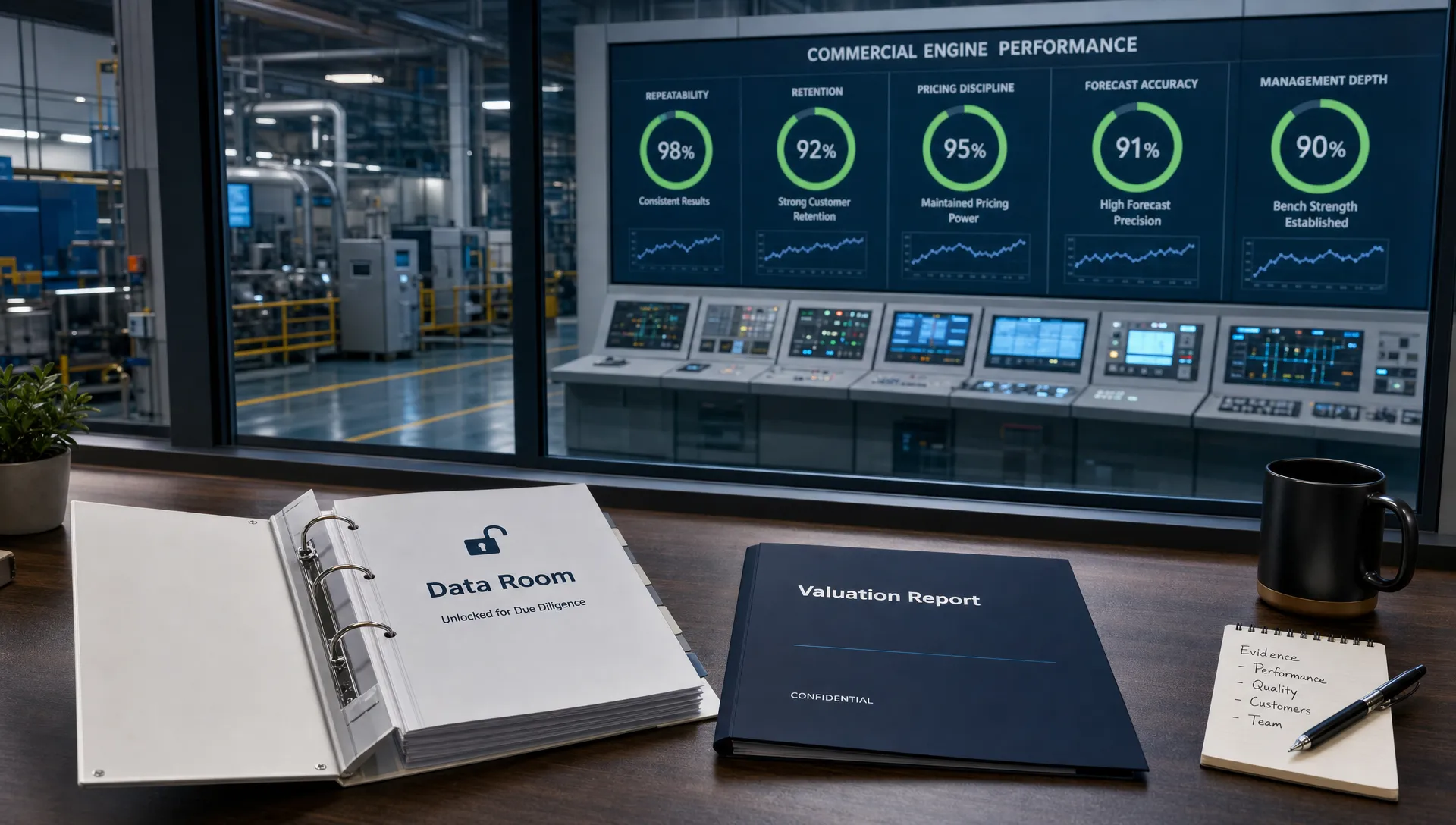
A successful PE exit is rarely created in the final six months of ownership. By the time bankers are drafting the CIM, most of the value has already been earned, protected, or lost. Buyers are not only underwriting EBITDA and headline growth. They are underwriting the quality, repeatability, and transferability of the commercial engine that produced those numbers.
That is why preparing for a PE exit years before the sale is a value-creation discipline, not a transaction workstream. The goal is to build a company that can withstand buyer diligence long before buyers arrive.
The best preparation starts with a simple premise: every strategic initiative should eventually become evidence. A new market entry, pricing change, sales process redesign, AI automation project, or account expansion program should all produce artifacts that prove the business can keep growing without extraordinary intervention from the sponsor or founder.
If your firm already has an exit-readiness program, the question is not whether to prepare. It is whether the preparation is happening early enough, and whether it is focused on the commercial evidence buyers actually reward.
Why PE Exit Preparation Should Start Years Before the Sale
Exit preparation often gets confused with transaction readiness. Transaction readiness asks, “Can we run a process?” Exit preparation asks, “Will buyers believe this company deserves a premium?”
Those are very different questions.
A company can have clean financials, a polished data room, and a strong banker deck, yet still lose value if buyers identify weak revenue quality, poor forecast discipline, founder-led sales, customer concentration, or unclear growth levers. These issues are difficult to fix under deal pressure because buyers can see whether improvements have been embedded over time or manufactured for diligence.
A strong PE exit plan should therefore begin 24 to 36 months before the likely sale window. That gives the sponsor and management team time to diagnose the commercial engine, redesign the revenue architecture, test expansion levers, strengthen the management bench, and create a track record of measurable improvement.
For a broader operating view, Phil Pelucha has also covered how private equity firms can strengthen exit readiness before a sale process. This article focuses specifically on sequencing: what to build, when to build it, and how to convert operating change into buyer-grade proof.
Start With the Exit Thesis, Not the Exit Date
The mistake many portfolio companies make is treating the exit date as the planning anchor. A better anchor is the exit thesis.
The exit thesis defines why the next buyer will pay more for the business than the current owner did. It should be specific enough to guide operating priorities years before market outreach begins.
A practical exit thesis answers five questions:
- What type of buyer is most likely to pay a premium?
- What growth story will that buyer find credible?
- Which risks could cause that buyer to discount value?
- What evidence must exist before diligence begins?
- Which initiatives must be proven over multiple quarters, not simply described?
For example, a strategic acquirer may care deeply about customer overlap, product adjacency, channel leverage, and integration fit. A financial sponsor may focus more heavily on recurring revenue quality, margin expansion potential, management depth, and the next phase of scalable growth. The commercial plan should be designed around the likely buyer lens, not around a generic definition of “growth.”
This does not mean choosing one buyer years in advance. It means building the company so that multiple buyer types can understand the growth logic quickly, test it in diligence, and believe it can survive ownership transition.
Build a Three-Year PE Exit Preparation Timeline
The most effective exit plans convert the holding period into a staged evidence-building program. Each stage has a different purpose. Early work should identify and repair value leakage. Mid-stage work should prove repeatability. Final-stage work should package evidence without overcorrecting the business for optics.
| Timing before exit | Primary objective | Commercial focus | Evidence buyers should see |
|---|---|---|---|
| 36 to 30 months | Define the exit thesis | Buyer profile, value drivers, risk map | Clear value-creation narrative and prioritized initiatives |
| 30 to 24 months | Diagnose revenue quality | ICP, segmentation, pipeline, pricing, retention | Baseline metrics and a credible improvement plan |
| 24 to 18 months | Redesign the commercial engine | Sales process, GTM roles, management cadence | Repeatable operating model and early performance lift |
| 18 to 12 months | Prove growth levers | Account expansion, new markets, channel strategy | Multi-quarter performance evidence and stronger forecasting |
| 12 to 6 months | Harden the diligence story | Data room, management narrative, risk remediation | Clean documentation and buyer-ready proof points |
| Final 6 months | Run the process without disruption | Process support, Q&A, commercial confidence | Consistent execution during diligence |
The earlier stages are where most value is created. The final stage should be about confidence, not chaos.
Years 3 to 2: Diagnose Revenue Quality Before Scaling
The first major workstream should be a commercial diagnostic. This is not a sales performance review. It is a fact-based assessment of where the company’s revenue is strong, where it is fragile, and where growth depends on conditions that may not transfer to the next owner.
Buyers will look beyond revenue growth and ask how that revenue was produced. Was it concentrated in a small number of large accounts? Was it driven by discounting? Did growth come from one exceptional salesperson? Are customers expanding because the product is mission-critical, or because the company temporarily over-serviced them? Is the pipeline a reliable indicator of future bookings, or a collection of optimistic CRM entries?
A useful diagnostic should examine:
- Revenue by customer segment, product, geography, channel, and cohort
- Gross and net retention, where relevant to the business model
- Customer concentration and dependency risk
- Sales cycle consistency and stage conversion rates
- Pricing discipline, discount patterns, and margin leakage
- Win-loss patterns by buyer type and use case
- Forecast accuracy over multiple quarters
This work often reveals a common PE problem: the company is growing, but the growth is not yet institutionalized. The sponsor sees momentum, but a buyer may see dependence on founder relationships, a narrow customer base, or a sales process that is difficult to scale.
The fix is not always to push harder for more revenue. In many cases, the better move is to repair the underlying commercial architecture first. That distinction matters because growth can amplify weaknesses when ICP, pricing, forecasting, and sales management are unclear.
Years 2 to 1.5: Make the GTM Engine Transferable
A premium PE exit depends on a buyer believing the growth engine will keep working after the transaction. That means the go-to-market model must be transferable.
Transferability is not the same as having talented sellers. It means the company has a system that can recruit, train, manage, and improve commercial performance without relying on individual heroics. The sales motion should be documented, measured, and coached. Marketing should support defined demand creation priorities. Customer success or account management should have a clear expansion and retention mandate. Leadership should manage the business through a consistent commercial cadence.
This is where many portfolio companies need to move from founder-led or relationship-led selling to process-led growth. Buyers do not need the company to be perfect, but they need to see that the system is mature enough to scale.
A transferable GTM engine usually includes clear ICP definitions, buyer personas, qualification standards, pipeline governance, sales playbooks, role clarity, and performance dashboards. More importantly, management should be able to explain why the system works. A dashboard without operational discipline does not increase confidence. A CRM full of activity data does not prove commercial quality unless the data informs decisions.
This is also the right stage to strengthen the relationship between revenue strategy and valuation. A business with predictable growth, clear operating rhythm, and measurable revenue levers will usually be easier for buyers to underwrite than one that relies on broad market optimism. Phil Pelucha’s piece on how exit valuation improves with revenue architecture explores this connection in more depth.
Year 1.5: Prove the Growth Levers Buyers Will Underwrite
Once the core commercial engine is stronger, the company can begin proving the growth levers that will support the exit narrative.
This is where sponsors should be selective. Not every growth idea deserves equal investment before exit. The strongest initiatives are those that can produce buyer-relevant proof within the remaining hold period.
Examples may include expanding into a new customer segment, improving enterprise sales productivity, launching a channel partnership model, increasing wallet share in strategic accounts, improving pricing realization, or entering a new geography. The key is to run these initiatives with enough discipline that buyers can evaluate the results.
For market expansion, the evidence should go beyond “large TAM.” Buyers will want proof of access, conversion, economics, and repeatability. If international or US expansion is part of the value creation plan, the company should be able to show why the market was selected, what assumptions were tested, and whether early traction supports further investment. For a deeper framework, see this guide to building a market expansion growth strategy that holds up.

The strongest growth levers have three characteristics. They are strategically relevant to likely buyers, measurable across multiple quarters, and connected to operating capabilities the company can continue after the sale.
If the company cannot prove a growth lever before exit, it should be positioned carefully. Overstating unproven upside can damage credibility during diligence. It is better to present a tested growth wedge with clear early evidence than a large but speculative opportunity.
Year 1: Clean Up the Risks That Create Buyer Discounts
In the final 12 to 18 months, risk reduction becomes increasingly important. Buyers often use diligence findings to renegotiate value, expand holdbacks, delay processes, or walk away. The earlier these risks are addressed, the less leverage buyers have.
Commercial risks are only part of the picture. Sponsors and management teams should also assess compliance, contracting, data quality, customer obligations, cybersecurity, AI usage, employment practices, and operational dependencies.
Regulated businesses need particular discipline here. If compliance workflows are manual, fragmented, or dependent on a small number of people, buyers may worry about scalability and regulatory exposure. For organizations with significant compliance requirements, platforms offering AI-powered compliance workflow automation can help teams streamline risk assessment, remediation actions, policy development, and data collection before those gaps become diligence issues.
The point is not to chase every possible risk. The point is to identify the risks most likely to affect buyer confidence and address them before they appear in a diligence request list.
A practical risk cleanup program should prioritize issues based on value impact. Contractual risks tied to major customers may matter more than minor policy inconsistencies. Inconsistent revenue recognition may matter more than cosmetic reporting gaps. Weak data governance may matter more in a software or healthcare business than in a simpler services model.
The sponsor’s role is to ensure these issues are not left until the banker asks for documents. By then, remediation may look reactive. Early remediation looks like disciplined ownership.
Build the Evidence Room Before the Data Room
A data room stores documents. An evidence room tells the story of value creation.
The distinction is important. Many companies only build a data room when the transaction process begins. They gather contracts, financial statements, employee lists, customer data, and board materials. That is necessary, but it is not enough.
An evidence room is built over time. It captures the proof that operating improvements were real, sustained, and measurable. It should show how the company diagnosed issues, implemented changes, tracked results, and adjusted intelligently.
| Buyer question | Evidence to build early | Why it matters |
|---|---|---|
| Is growth repeatable? | Pipeline conversion, cohort performance, sales productivity trends | Supports forward revenue confidence |
| Is revenue high quality? | Retention, concentration, pricing, margin, customer segmentation | Reduces perceived downside risk |
| Can management execute? | Operating cadence, scorecards, initiative tracking | Shows the business is professionally managed |
| Is the GTM model scalable? | Playbooks, role clarity, hiring ramp data, channel performance | Demonstrates transferability |
| Are risks controlled? | Remediation logs, compliance records, contract reviews | Limits diligence surprises |
This evidence should be reviewed at board level well before exit. If a key proof point is missing, the company still has time to create it. If a metric is weak, the company still has time to improve it or adjust the narrative.
Prepare Management for Buyer Scrutiny
In many PE exits, management presentations are decisive. Buyers are not only assessing the business. They are assessing whether the leadership team can deliver the next plan.
Preparation should begin long before formal management presentation rehearsals. The leadership team should already be operating with the metrics, language, and discipline that buyers expect. They should understand the growth thesis, know the commercial drivers, explain performance variation, and speak credibly about risks.
This matters because buyers can detect when a story is overly sponsor-led. If management cannot explain the revenue engine without leaning on advisors, confidence falls. If leaders disagree on ICP, pipeline quality, pricing strategy, or market priorities, diligence becomes harder.
A strong management team does not need to pretend the business has no issues. In fact, credible self-awareness often increases buyer confidence. The best teams can say what has improved, what remains to be done, why the next phase is achievable, and what resources are required.
Avoid the Common Mistakes That Weaken a PE Exit
Exit preparation fails when the company optimizes for presentation rather than performance. Buyers are sophisticated. They will test the story through data, customer calls, market work, management meetings, and quality of earnings analysis.
The most common mistakes include starting too late, confusing activity with evidence, overinvesting in unproven growth stories, ignoring revenue quality, and allowing the sponsor to carry too much of the commercial narrative. Another frequent mistake is pushing growth before fixing the operating system. That may create short-term momentum, but it can also increase churn, discounting, forecast misses, and operational strain.
The better approach is to build the commercial foundation first, then scale the initiatives most likely to increase exit value. That may feel slower in the early stages, but it usually creates a stronger diligence position later.
What to Do 24 to 36 Months Before a Likely Sale
If the exit is still years away, now is the time to make the plan practical. The sponsor and management team should align on the likely buyer universe, define the value creation evidence required, and prioritize the commercial changes that need multiple quarters to prove.
A useful starting point is a commercial readiness review that asks three questions. First, where is growth genuinely repeatable today? Second, where does the business depend on people, relationships, or market conditions that may not transfer? Third, which improvements would most increase buyer confidence if they were visible for the next six to eight quarters?
From there, the team can build a sequenced roadmap. The roadmap should not be a generic transformation plan. It should connect each initiative to exit value, diligence evidence, and management accountability.
Frequently Asked Questions
When should a portfolio company start preparing for a PE exit? Ideally, 24 to 36 months before a likely sale window. This gives the company time to diagnose commercial weaknesses, strengthen the GTM engine, prove growth levers, and build evidence buyers can trust.
What is the difference between exit readiness and transaction readiness? Transaction readiness focuses on running a sale process, including bankers, data rooms, and diligence responses. Exit readiness focuses on building a stronger, more valuable company before the process begins.
What do buyers look for in a PE exit? Buyers typically look for durable growth, revenue quality, management depth, scalable systems, clean data, controlled risks, and credible upside. The exact weighting depends on whether the buyer is strategic or financial.
Can exit preparation improve valuation? Yes, when it increases buyer confidence in future performance. Strong revenue architecture, predictable forecasting, repeatable sales processes, and documented growth evidence can reduce perceived risk and support a stronger valuation case.
Is it too late to improve exit readiness in the final year? It is not too late, but the options are narrower. The final year is best used to harden the narrative, clean up risks, and document evidence. Major commercial redesign is more powerful when started earlier.
Build the Exit Before You Sell the Company
A PE exit is not won in the CIM. It is won in the operating decisions made years earlier.
The companies that command stronger buyer attention are usually the ones that can prove how they grow, why that growth is durable, and what the next owner can scale. That proof takes time. It requires commercial discipline, management alignment, and a clear connection between value creation work and exit evidence.
If your portfolio company is 12 to 36 months from a potential sale, Phil Pelucha Consulting can support commercial diagnostics, revenue acceleration, GTM optimization, sponsor advisory, and exit-readiness work designed around buyer confidence.