
Operating Partner Venture Capital Roles Explained
In venture capital, capital is only the beginning. Once a company has money in the bank, the harder question becomes operational: how does it turn that capital into repeatable revenue, stronger leadership, better systems, and a credible path to the next round or exit?
That is where the operating partner venture capital role becomes important.
An operating partner is not just a mentor, consultant, or friendly advisor. At its best, the role gives a VC firm practical operating leverage across the portfolio. The operating partner helps founders remove growth constraints, sharpen go-to-market execution, improve management discipline, and translate the investment thesis into measurable progress.
For founders, this can be the difference between helpful boardroom advice and hands-on support that changes the trajectory of the business. For funds, it can be the difference between hoping a company scales and actively building the conditions for scale.
What is an operating partner in venture capital?
An operating partner in venture capital is an experienced operator who works with a VC firm and its portfolio companies to improve business performance. The role usually focuses on practical value creation after the investment has been made.
Unlike an investment partner, whose primary work is sourcing deals, evaluating companies, negotiating terms, and managing fund economics, an operating partner focuses on execution. They help portfolio companies solve specific problems in areas such as revenue growth, hiring, pricing, product commercialization, sales process, expansion, data infrastructure, or executive leadership.
The role can be structured in several ways. Some VC firms employ full-time operating partners as part of their platform or portfolio support team. Others bring in part-time operating partners, functional specialists, fractional executives, or trusted advisors who work with selected companies when a specific need arises.
The key distinction is this: an operating partner does not usually run the portfolio company day to day. The founder and management team still own execution. The operating partner improves the company’s ability to execute.
That distinction matters. In venture capital, investors typically have minority positions and founder-led companies need to preserve speed, ownership, and autonomy. A strong operating partner adds force without taking control.
Why VC firms use operating partners
The venture environment has changed. In a low-interest, growth-at-all-costs market, many companies could raise again on momentum, top-line growth, or category excitement. In today’s more disciplined capital environment, investors expect clearer evidence of efficient growth, strong retention, accountable leadership, and durable commercial infrastructure.
Operating partners help VC firms protect and expand value by closing the gap between strategy and execution. They are especially valuable when a company has raised capital but has not yet built the operating muscle required for the next stage.
Common reasons VC firms use operating partners include:
- A portfolio company has strong product-market fit but weak sales execution.
- The founder is excellent at vision and product, but needs support building the leadership bench.
- Growth is happening, but forecasting, CRM hygiene, and revenue operations are unreliable.
- The company needs to enter a new market but lacks a disciplined expansion plan.
- A fund wants more consistent value creation across the portfolio, not just ad hoc advice.
In short, the operating partner exists because advice alone is not enough. Venture-backed companies need operating systems, decision cadence, management discipline, and focused intervention at the points where growth is most constrained.
Operating partner vs venture partner vs platform lead
These roles often overlap, especially in smaller funds, but they are not the same. Confusing them can lead to vague mandates and disappointing results.
| Role | Primary focus | Typical involvement | Success is measured by |
|---|---|---|---|
| Operating partner | Improving portfolio company performance | Hands-on support, diagnostics, functional intervention, leadership enablement | Better growth, stronger execution, improved readiness for next round or exit |
| Venture partner | Deal sourcing, sector credibility, founder relationships, selective portfolio support | Often part-time or network-based | Quality of deal flow, portfolio access, strategic introductions, founder influence |
| Platform lead | Scalable portfolio services and community | Programs, events, content, talent networks, shared resources | Portfolio engagement, founder satisfaction, repeatable support infrastructure |
| Board partner | Governance and investor oversight | Board meetings, strategic guidance, capital planning | Strong governance, risk management, strategic alignment, investor returns |
A venture partner may help a company with introductions or strategic advice. A platform lead may build founder programs and shared resources. An operating partner is usually closer to the work of diagnosing and fixing operational constraints.
If you want a deeper comparison, this breakdown of what a venture partner really does in portfolio growth explains where that role fits alongside operating support.
Core responsibilities of a VC operating partner
The exact scope depends on the fund, stage, sector, and portfolio needs. Still, most effective operating partners create value in five major ways.
Commercial diagnosis
Before fixing anything, the operating partner needs to understand what is actually constraining growth. Many portfolio companies misdiagnose their own problems. A team may think it has a lead generation issue when the real problem is poor qualification. Another may blame sales performance when the deeper issue is unclear positioning or a weak ideal customer profile.
A useful operating partner asks better questions:
- Where does the funnel actually break?
- Which customer segments convert fastest and retain longest?
- Is the sales motion aligned with deal size, buying complexity, and product maturity?
- Are growth targets supported by pipeline math?
- Does the leadership team have the operating cadence to hit the plan?
This diagnostic discipline prevents portfolio companies from wasting time on cosmetic fixes. For a more focused view of prioritization, see this guide on what a venture capital operating partner should fix.
Go-to-market and revenue architecture
Many operating partners are brought in because revenue is not scaling predictably. The company may have founder-led sales, a few strong early customers, and promising market demand, but no repeatable commercial system.
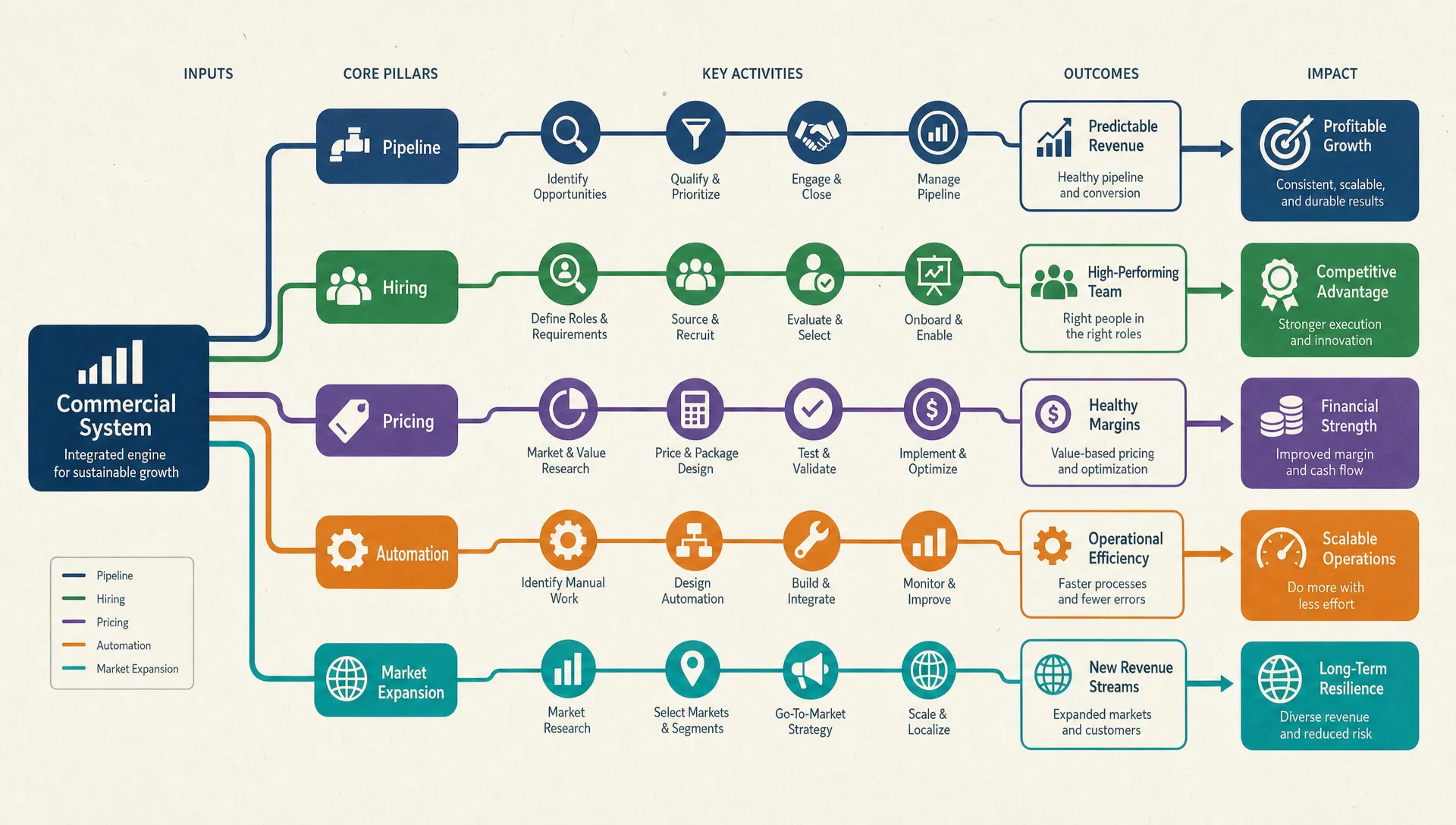
In that setting, the operating partner may help refine the ideal customer profile, clarify positioning, redesign pipeline stages, improve qualification, assess sales leadership, introduce revenue operating rhythms, and define the metrics that matter.
The goal is not to create bureaucracy. The goal is to make growth more visible, repeatable, and manageable. That becomes especially important as a company moves from founder-driven selling to a dedicated commercial team.
Leadership enablement
Venture-backed companies often outgrow their original management habits before they outgrow their market. What worked at 10 employees can break at 40. What worked at 40 can fail at 150.
A strong operating partner helps founders and executives adapt to the next stage. That can include coaching a founder CEO, evaluating whether the company needs a VP Sales or CRO, helping design leadership scorecards, preparing executives for board meetings, or improving cross-functional accountability.
The best operating partners do this without undermining management. They strengthen the team’s decision-making capacity rather than becoming a shadow CEO.
Portfolio-wide playbooks and systems
At the fund level, operating partners can turn repeated lessons into reusable assets. If several portfolio companies struggle with pipeline forecasting, the fund can create a better diagnostic template. If multiple companies are exploring AI adoption, the operating partner can help define safe, practical use cases for sales, marketing, customer success, and internal operations.
This is where the role shifts from company-by-company support to portfolio leverage. A single intervention helps one company. A well-designed playbook can improve the performance of many.
Useful playbooks may cover revenue diagnostics, sales hiring, pricing reviews, customer segmentation, market expansion, RevOps maturity, AI automation, board reporting, or exit readiness.
Specialist activation
No operating partner can be world-class at everything. The best ones know when to bring in functional specialists rather than pretending to have every answer.
For example, a Dutch industrial or regional services portfolio company dealing with energy reduction, subsidies, regulation, or grid congestion may need local expertise from a provider of independent energy and sustainability advice for businesses in Arnhem Nijmegen. In that scenario, the operating partner’s value is not doing the technical work directly. It is identifying the operational risk, framing the commercial impact, and connecting the company with the right specialist support.
This skill is underappreciated. Great operating partners do not just solve problems. They build the right problem-solving network around the company.
Exit and next-round readiness
Even when a company is years away from exit, the foundations of value are built early. Buyers and later-stage investors care about more than growth rate. They evaluate revenue quality, retention, customer concentration, leadership depth, reporting discipline, margin profile, and evidence that growth can continue after the transaction.
An operating partner can help founders build toward those expectations before diligence begins. That means improving commercial documentation, making revenue metrics more reliable, reducing dependency on the founder, and ensuring the growth story is supported by evidence.
How the operating partner role changes by company stage
Operating support should not look the same at every stage. A seed-stage startup does not need the same operating cadence as a growth-stage company preparing for a major financing or strategic exit.
| Company stage | Main operating need | What the operating partner usually does |
|---|---|---|
| Seed and pre-Series A | Learning velocity and focus | Helps validate ICP, sharpen messaging, identify early sales patterns, and avoid premature process |
| Series A and B | Repeatable growth | Builds GTM structure, improves funnel discipline, supports sales hiring, and strengthens metrics |
| Growth stage | Scale and management depth | Improves leadership systems, market expansion, forecasting, RevOps, customer success, and performance management |
| Pre-exit or late stage | Evidence and durability | Strengthens revenue quality, reduces key-person dependency, prepares diligence materials, and improves buyer readiness |
The biggest mistake is applying late-stage process too early or leaving later-stage companies with early-stage habits for too long. The operating partner must calibrate support to the company’s stage, not to a generic template.

What makes a great VC operating partner?
The best operating partners combine pattern recognition with humility. They have seen enough companies to spot common failure modes, but they do not assume every company needs the same answer.
Great operating partners usually share several traits.
| Trait | Why it matters |
|---|---|
| Real operating experience | Founders can quickly tell whether advice comes from experience or theory |
| Commercial fluency | Revenue is often the clearest path to value creation and future financing |
| Founder empathy | Venture-backed teams need support that respects speed, ambiguity, and ownership |
| Diagnostic discipline | Fixing the wrong problem wastes time and damages trust |
| Ability to ship | The role must produce practical outputs, not just interesting conversations |
| Network judgment | Good partners know which experts, customers, hires, and advisors are worth introducing |
| Stage awareness | Early-stage and growth-stage companies need different operating systems |
A great operating partner also knows when to step back. The role is not to win every debate, create dependency, or overload the company with templates. It is to make the founder and leadership team more effective.
Common mistakes VC funds make with operating partners
Many VC firms like the idea of operating support, but struggle to define it clearly. That creates frustration for partners, founders, and the operating partner themselves.
Common mistakes include:
- Giving the operating partner a vague mandate to help the portfolio without clear priorities.
- Measuring activity instead of business outcomes.
- Treating all portfolio companies as if they need the same support.
- Using generic playbooks when the real constraint is company-specific.
- Involving the operating partner too late, after major commercial problems are already visible.
- Letting the operating partner become an unpaid consultant with no authority, scope, or follow-through.
- Acting like a control investor in a founder-led venture environment.
The fix is to define the operating partner’s mandate around the fund’s value creation thesis. If the fund invests in B2B SaaS, the operating partner may focus heavily on GTM, retention, pricing, and revenue operations. If the fund invests in healthcare, the role may require deeper regulatory, enterprise sales, and reimbursement expertise. If the fund invests across sectors, the operating partner may need to act more like a diagnostic leader and specialist orchestrator.
Clarity matters more than breadth. A narrow mandate with measurable impact beats a broad mandate that sounds impressive but changes little.
How founders should work with an operating partner
Founders sometimes worry that an operating partner is being sent in because the board lacks confidence. That can happen, but in healthy VC relationships, operating support is a resource, not a punishment.
Founders get the most value when they treat the operating partner as an extension of their growth capacity. The relationship works best when expectations are explicit.
A productive engagement should define:
- The specific business problem being addressed.
- The owner inside the company.
- The operating partner’s role and decision rights.
- The data required to diagnose the issue.
- The time horizon for the intervention.
- The expected outputs, such as a hiring scorecard, GTM plan, forecast model, pricing review, or board-ready growth narrative.
The founder should not outsource ownership. If a sales process is broken, the operating partner can help redesign it, but the leadership team must run it. If market expansion is under consideration, the operating partner can pressure-test assumptions, but management must make the strategic commitment.
The best founder-operating partner relationships are candid, focused, and practical. They avoid theater. They create movement.
Metrics that prove operating partner impact
Operating partner impact can be difficult to attribute perfectly because many variables shape company performance. Still, funds should measure whether the role is improving the quality of execution.
| Area | Leading indicators | Lagging indicators |
|---|---|---|
| Revenue execution | Better pipeline hygiene, clearer ICP, improved qualification, stronger sales cadence | Higher conversion, shorter sales cycles, better win rates, more predictable bookings |
| Customer quality | Stronger segmentation, clearer success metrics, better onboarding discipline | Higher retention, improved expansion revenue, lower churn |
| Leadership | Defined roles, better scorecards, stronger meeting cadence, improved hiring process | Better executive performance, fewer missed commitments, stronger management depth |
| Capital efficiency | Better budget discipline, clearer growth assumptions, improved forecasting | Longer runway, improved CAC payback, stronger margin profile |
| Exit readiness | Cleaner data room inputs, clearer growth story, reduced founder dependency | Better investor confidence, smoother diligence, stronger valuation support |
The operating partner should not be judged only by meetings held or introductions made. Those may be useful inputs, but the real question is whether the company becomes stronger, faster, more disciplined, and more valuable.
Should every VC fund have an operating partner?
Not necessarily. The answer depends on fund size, portfolio concentration, stage, sector, and value creation strategy.
A small early-stage fund may not need a full-time operating partner if the portfolio is small and founder needs are highly varied. A concentrated growth fund may benefit significantly from a dedicated operating partner, especially if the fund’s returns depend on helping companies scale from promising traction to institutional-grade execution.
Some funds should build an internal operating team. Others should use fractional specialists. Others may need a hybrid model, with one senior operating leader who diagnoses needs and activates a network of experts.
The real question is not whether the title exists. The question is whether the fund has a repeatable way to help portfolio companies remove the constraints that capital alone cannot solve.
Frequently Asked Questions
What is an operating partner in venture capital? An operating partner in venture capital is an experienced operator who helps portfolio companies improve performance after investment. The role often focuses on revenue growth, leadership, systems, market expansion, and readiness for the next financing round or exit.
Is an operating partner the same as a venture partner? No. A venture partner often supports deal sourcing, founder relationships, sector credibility, and selective portfolio advice. An operating partner is usually more focused on hands-on portfolio company performance improvement.
Does an operating partner run the portfolio company? Usually not. The founder and executive team remain responsible for day-to-day execution. The operating partner helps diagnose constraints, build systems, coach leaders, and improve execution quality.
When should a founder ask for operating partner support? A founder should ask for support when the company faces a specific growth constraint, such as weak pipeline conversion, unclear ICP, sales hiring challenges, market expansion risk, poor forecasting, or leadership scaling issues.
Can an operating partner improve exit outcomes? Yes, if the role helps strengthen revenue quality, leadership depth, reporting discipline, customer retention, and commercial predictability. These factors can improve investor confidence and support a stronger exit narrative.
Turning operating support into revenue acceleration
The operating partner venture capital role is most powerful when it is tied to a clear value creation agenda. The title alone does not create impact. The impact comes from disciplined diagnosis, focused intervention, founder trust, and measurable improvements in commercial execution.
For VC firms, PE sponsors, family offices, and portfolio companies looking to strengthen revenue infrastructure, improve exit readiness, or install more scalable commercial systems, Phil Pelucha Consulting supports growth through commercial diagnostics, fractional CRO support, revenue acceleration, GTM optimization, and AI-powered portfolio systems.