
When to Bring in a PE Consultant for Commercial Change
Commercial change is rarely a single initiative in a private equity backed company. It is usually a chain reaction.
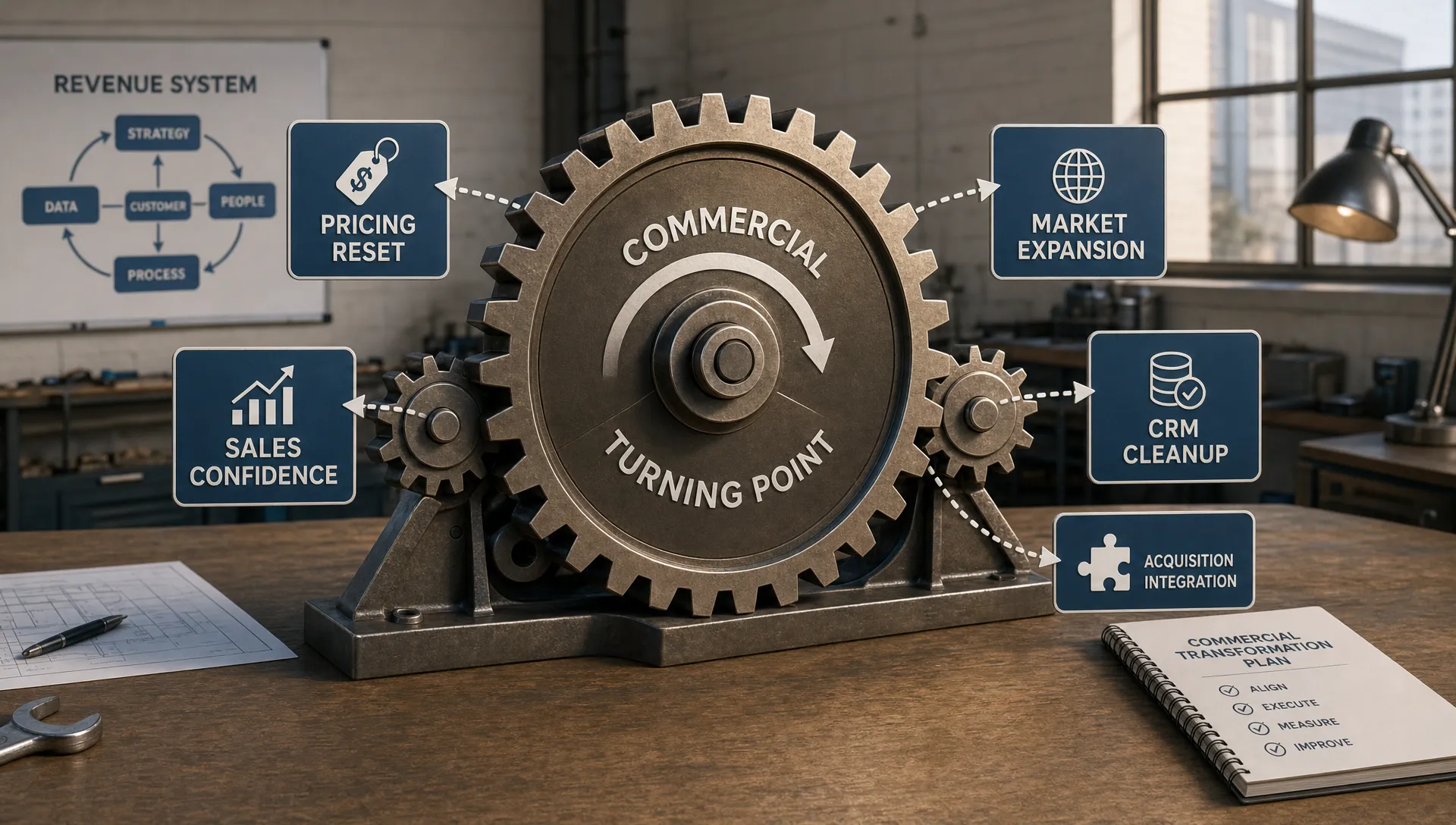
A pricing reset exposes weak sales confidence. A new market push reveals unclear ICP definition. A CRM cleanup shows that the pipeline was never as strong as the board deck suggested. A bolt-on acquisition adds revenue, but also creates conflicting offers, territories, and incentive plans.
That is when sponsors and management teams often ask the same question: should we solve this internally, hire another executive, or bring in a PE consultant?
The answer depends on timing, scope, and risk. A consultant is not needed every time revenue misses plan. But when commercial change affects the value creation plan, the operating rhythm, or exit readiness, outside support can prevent months of drift and avoid expensive execution mistakes.
What commercial change means in a PE context
In a founder-led or privately held company, commercial change often means “sell more.” Under private equity ownership, the definition becomes more specific.
Commercial change is about improving the quality, repeatability, and scalability of revenue. That may include better segmentation, sharper positioning, disciplined pricing, stronger sales management, cleaner forecasting, new channel strategy, acquisition integration, or AI-enabled commercial workflows.
The sponsor is not simply asking, “Can this company grow?” The more important question is, “Can this company grow in a way that supports the investment thesis and creates a stronger exit story?”
That shift is important. As explored in this article on how private equity changes commercial priorities, PE ownership changes the standard of proof. Growth must become more measurable, more durable, and less dependent on heroic individual effort.
A PE consultant becomes useful when the company needs that commercial standard installed faster than the current organization can achieve alone.
The best time to bring in a PE consultant
The best time is usually earlier than most sponsors think.
Many firms wait until the company has already missed two quarters, the CEO is under pressure, and the board is debating whether the original plan was too aggressive. By then, the work is still possible, but the emotional and political cost is higher.
A better trigger is not failure. It is uncertainty about execution.
If the investment thesis depends on commercial improvement and the path from today’s operating model to tomorrow’s growth target is unclear, that is the moment to bring in support. The consultant’s role is to reduce ambiguity, identify the true constraints, and help management translate strategy into operating change.
That does not mean replacing the CEO or undermining the sales leader. In the best cases, a PE consultant strengthens management by giving them a practical architecture for change.
Signs it is time to bring in a PE consultant for commercial change
The value creation plan depends on revenue improvement, but the commercial system is underdeveloped
This is the most common trigger.
The deal model assumes growth through new customers, higher wallet share, pricing improvement, better sales productivity, or expansion into new verticals. Yet the portfolio company still operates with informal sales processes, inconsistent qualification, weak handoffs, and limited performance visibility.
In that situation, hiring more salespeople may only scale confusion. A PE consultant can help determine whether the company has a sales capacity problem, a positioning problem, a management problem, or a revenue architecture problem.
This distinction matters. If the engine is not designed correctly, additional activity can make the company busier without making it more valuable.
Management and sponsor agree on the goal, but not the operating path
Agreement at the headline level can hide disagreement underneath.
Everyone may support “accelerating growth,” “improving EBITDA,” or “expanding into the U.S. market.” But when the team discusses execution, differences appear. The CEO wants to protect existing customer relationships. The sponsor wants faster commercial experimentation. The sales leader wants headcount. Finance wants cleaner forecasting. Marketing wants more budget.
A PE consultant can provide an independent commercial diagnosis and create a shared operating plan. This is especially useful when the issue is not intelligence or effort, but translation.
The sponsor understands the investment case. Management understands the business. The consultant helps convert both into an executable commercial model.
The company is pushing growth before fixing foundational weaknesses
Sometimes the pressure to grow comes too early.
A business may have an unclear ideal customer profile, inconsistent pricing logic, low CRM discipline, overreliance on a few relationships, or a sales team that cannot explain why deals are won or lost. In these cases, aggressive growth targets can create waste.
Before adding more pipeline, the company may need to fix the constraints that make growth unreliable. That is why sponsors should be careful when the proposed answer to every commercial problem is “more leads” or “more reps.”
The underlying question is whether the company is ready to scale. If not, the better move is to address what PE funds should fix before pushing growth, then accelerate from a stronger base.
Pipeline reporting is high confidence, but low credibility
A board deck can show a growing pipeline while the business still has poor revenue visibility.
Warning signs include vague deal stages, inconsistent close dates, low conversion from proposal to signed contract, limited next-step discipline, and sales forecasts that rely on optimism rather than observable buyer behavior.
This is not just a reporting issue. It affects capital allocation, hiring decisions, budget approval, and sponsor confidence.
A PE consultant can help redesign the operating cadence around reliable leading indicators. That may include pipeline hygiene, sales stage definitions, qualification standards, account prioritization, and management routines that make forecast discussions more factual.
Market expansion is part of the thesis, but the current sales engine is not yet proven
Market expansion can create significant enterprise value, but it can also expose fragility.
A company that sells effectively in one geography, vertical, or founder-led network may struggle when it enters a new market. The message may not travel. The competitive set may change. Buyer access may be weaker. Sales cycles may lengthen. The team may underestimate localization, channel dynamics, or trust-building requirements.
This is a good time to bring in external commercial support, especially if the expansion is material to the investment thesis.
The goal is not simply to “enter the market.” The goal is to validate whether the company can win repeatably in that market without damaging the core business. That requires disciplined sequencing, as discussed in this piece on why PE backed companies need better revenue architecture.

The company needs specialist execution, but lacks the framework to manage it
Commercial change often requires outside execution partners. A portfolio company may need help with SEO, paid acquisition, web conversion, sales enablement, CRM implementation, pricing research, or industry-specific demand generation.
The risk is hiring vendors before the commercial strategy is clear.
For example, a healthcare services portfolio company may need a niche digital partner such as Louisville Web Lab to support lead generation, SEO, PPC, or website conversion. But the value of that work depends on whether the company has already clarified its target buyers, economics, market priorities, and follow-up process.
A PE consultant can help define the commercial brief before specialist partners are engaged. That improves vendor selection, reduces wasted spend, and ensures execution partners are measured against thesis-relevant outcomes rather than disconnected activity metrics.
The business is approaching exit planning and cannot yet prove commercial durability
Exit readiness is not only about EBITDA and financial reporting. Buyers also test revenue quality.
They will ask questions such as:
- Where is growth really coming from?
- Which customer segments are most profitable and repeatable?
- How dependent is revenue on the founder or a few senior sellers?
- Is the pipeline credible?
- Can the next owner scale the commercial model further?
- Are pricing, retention, and expansion levers understood?
If the company cannot answer these questions with confidence, commercial change should not wait until the final stage of a sale process. It should begin early enough to create evidence.
The stronger exit story is built through observable operating improvements, not last-minute narrative polish.
What a PE consultant should do first
A strong PE consultant does not arrive with a generic playbook and force it onto the company. The first job is diagnosis.
That diagnosis should connect the investment thesis to commercial reality. It should identify where revenue performance is constrained, which issues matter most to value creation, and what must change in the operating model.
A practical first phase often includes:
- Reviewing the deal thesis, board materials, sales data, customer economics, and current commercial plan
- Interviewing sponsor, CEO, sales, marketing, finance, customer success, and selected frontline team members
- Testing ICP clarity, pricing discipline, pipeline quality, conversion rates, sales productivity, retention dynamics, and market expansion assumptions
- Identifying the few commercial constraints that create the greatest value leakage
- Building a prioritized change plan with owners, milestones, and measurable indicators
The consultant should help management move from general concern to specific action.
| Situation | What the PE consultant should clarify | What progress looks like |
|---|---|---|
| Growth is behind plan | Whether the issue is demand, conversion, capacity, pricing, or retention | Fewer assumptions, clearer constraints, revised commercial priorities |
| Sales hiring is proposed | Whether the current sales model is ready to scale | Role design, territory logic, productivity expectations, onboarding plan |
| Market expansion is planned | Whether the company has proof of repeatable demand and access | Sequenced market tests, clear entry criteria, defined learning milestones |
| Exit preparation is starting | Whether revenue quality can withstand buyer scrutiny | Cleaner segmentation, evidence of repeatability, stronger forecast credibility |
| Vendor spend is increasing | Whether external partners are tied to strategy | Better briefs, sharper KPIs, reduced activity without impact |
The most valuable output is not a long presentation. It is a commercial operating plan that the company can actually run.
When a consultant is not the right answer
There are situations where bringing in a PE consultant will not solve the problem.
If the sponsor and management team are not aligned on the desired outcome, a consultant may become a referee instead of a change agent. If the CEO does not support the work, even a strong diagnosis may not convert into action. If the issue is purely a missing full-time operator, the better move may be to hire the right executive rather than start a consulting engagement.
A consultant is also the wrong answer when the board wants validation rather than truth. Commercial diagnostics can surface uncomfortable findings. The sales team may be weaker than assumed. The ICP may be too broad. The pricing opportunity may require customer segmentation that leadership has avoided. The expansion plan may be premature.
If the organization is unwilling to act on those findings, the engagement will create insight without value.
How to choose the right PE consultant
The right consultant for commercial change needs more than sales advice. PE-backed environments have unique pressures: compressed timelines, sponsor reporting, management sensitivity, debt service, exit requirements, and a constant need to prioritize.
Look for a PE consultant who can operate across strategy and execution. They should understand how revenue decisions affect enterprise value, not just top-line growth.
A good fit will usually show these traits:
- Experience working with sponsors, operating partners, CEOs, and commercial leaders
- Ability to diagnose revenue constraints without defaulting to one favorite solution
- Comfort translating strategy into sales management routines, KPIs, and operating cadence
- Understanding of market expansion, pricing, pipeline quality, and revenue repeatability
- Enough independence to challenge assumptions without creating unnecessary friction
- Practicality, meaning they can help the company install change rather than simply describe it
The best engagements leave the portfolio company stronger after the consultant steps back. The team should have clearer priorities, better commercial discipline, and more confidence in what drives revenue performance.
The real cost of waiting too long
Commercial change becomes harder when the company has already built decisions around weak assumptions.
If the business hires ahead of a flawed sales model, it must later unwind cost and morale damage. If it enters a new market without proof of repeatability, it may burn time and budget while distracting the core team. If it waits until exit preparation to address revenue quality, buyers may discover risks before the company has enough evidence to counter them.
The cost is not just missed revenue. It is lost time inside the hold period.
For PE sponsors, time is one of the most expensive resources in the value creation plan. A quarter spent debating the problem is a quarter not spent improving the asset.
That is why the decision to bring in a PE consultant should be based less on whether the company is in crisis and more on whether commercial uncertainty is putting the thesis at risk.
Frequently Asked Questions
What does a PE consultant do for commercial change? A PE consultant helps sponsors and portfolio companies diagnose revenue constraints, prioritize commercial initiatives, and install the operating model needed to improve growth, revenue quality, and exit readiness.
When should a private equity firm bring in a consultant after acquisition? The strongest timing is often early in the hold period, especially when the value creation plan depends on revenue acceleration, sales optimization, market expansion, or pricing improvement. Waiting until performance deteriorates can make change more expensive.
Is a PE consultant different from a sales consultant? Yes. A sales consultant may focus mainly on sales tactics or team performance. A PE consultant should connect commercial decisions to the investment thesis, sponsor priorities, management execution, and enterprise value.
Can a PE consultant work alongside the existing CEO and sales leader? Yes, and that is often the best model. The consultant should support management by adding diagnostic rigor, structure, and execution support, not by creating parallel authority or undermining the leadership team.
What should sponsors expect from the first phase of work? Sponsors should expect a clear diagnosis of commercial constraints, a prioritized action plan, agreed operating metrics, and practical recommendations that management can execute within the company’s value creation timeline.
Ready to pressure-test the commercial change plan?
If your portfolio company is entering a growth push, preparing for market expansion, improving sales execution, or building toward exit readiness, the right time to clarify the commercial model is before performance pressure turns into value leakage.
Phil Pelucha Consulting supports PE firms, VC investors, family offices, and portfolio companies with revenue acceleration consulting, commercial diagnostics, fractional CRO support, sponsor advisory, and AI-powered systems for portfolio companies.
If commercial change is central to the investment thesis, start by pressure-testing the revenue architecture, execution risks, and operating plan before adding more activity to the system.