
How Investee Companies Can Improve Exit Readiness
Exit readiness is not a transaction project. It is an operating condition.
For investee companies, the sale process can feel like something that happens at sponsor level, led by bankers, advisors, and the board. In reality, the quality of the exit is shaped inside the company years before the information memorandum is written. Buyers do not only assess the market, the brand, or the headline growth rate. They test whether the business can keep growing under new ownership, without heroic founder involvement, spreadsheet assumptions, or fragile sales execution.
That means exit readiness is a management discipline. It requires commercial clarity, clean financial evidence, dependable systems, credible leadership, and a growth story that can survive diligence.
What exit readiness means for investee companies
An investee company is exit ready when management can prove the business is lower risk, more scalable, and easier to underwrite than comparable assets in the market.
This does not mean the company must be perfect. Buyers expect some gaps. What they penalize is uncertainty. If a management team cannot explain where growth comes from, why margins are sustainable, how pipeline converts, or which customers are most valuable, buyers will either reduce their valuation, demand more protection in deal terms, or walk away.
Exit readiness usually comes down to four questions:
- Can the company prove the quality and repeatability of its revenue?
- Can management explain the next phase of growth with evidence, not optimism?
- Can the operating model scale without breaking margin, delivery, or culture?
- Can buyers trust the data used to support the story?
For a deeper sponsor-side view, Phil Pelucha’s guide on how to prepare for a PE exit years before the sale explains why the strongest exits are created well before the formal process begins.
Start with the buyer’s future thesis
Many investee companies prepare for exit by documenting the past. They compile financial performance, customer wins, case studies, and operational milestones. That matters, but buyers are ultimately paying for the future.
The company therefore needs a clear exit thesis: the reason a buyer should believe the next owner can create more value from the asset.
A strong exit thesis connects three things. First, it shows the company’s current performance in a way that is credible and well evidenced. Second, it explains the market opportunity that remains. Third, it demonstrates that the company has the commercial infrastructure to capture that opportunity.
For example, a software company might show that enterprise customers have higher retention, shorter payback, and stronger expansion potential than small business customers. A services company might demonstrate that one vertical produces better margins and lower delivery complexity than others. A healthcare or industrial business might prove that geographic expansion is already repeatable because the company has tested the model in two or three adjacent markets.
The best exit narratives are not slogans. They are operating choices backed by numbers.
Fix commercial truth before scaling harder
Exit readiness weakens when the business cannot separate real growth from noisy growth. Revenue can rise while the underlying commercial engine remains fragile. That is especially common when a company has grown through founder-led selling, relationship-driven deals, underpriced contracts, or inconsistent sales discipline.
Before pushing for aggressive growth in the final ownership phase, investee companies should establish commercial truth. This means understanding where revenue is genuinely profitable, repeatable, and defensible.
Key areas to test include:
- Ideal customer profile, including which segments generate the best retention, margin, and expansion potential
- Pipeline quality, including whether opportunities reflect real buyer intent or optimistic CRM activity
- Pricing discipline, including discounting patterns, leakage, and contract profitability
- Sales productivity, including ramp time, win rates, cycle length, and dependence on top performers
- Customer concentration, including renewal risk and account expansion potential
This is often where management teams discover that the business has been scaling around averages. Average customer value, average margin, average win rate, and average churn can hide the truth. Buyers will not underwrite averages if the underlying segments behave differently.
Phil Pelucha’s article on what private equity-backed companies must fix first is especially relevant here because growth initiatives tend to magnify weak commercial foundations.
Build buyer-grade evidence
The strongest exits are not won by telling a better story. They are won by proving a better story.
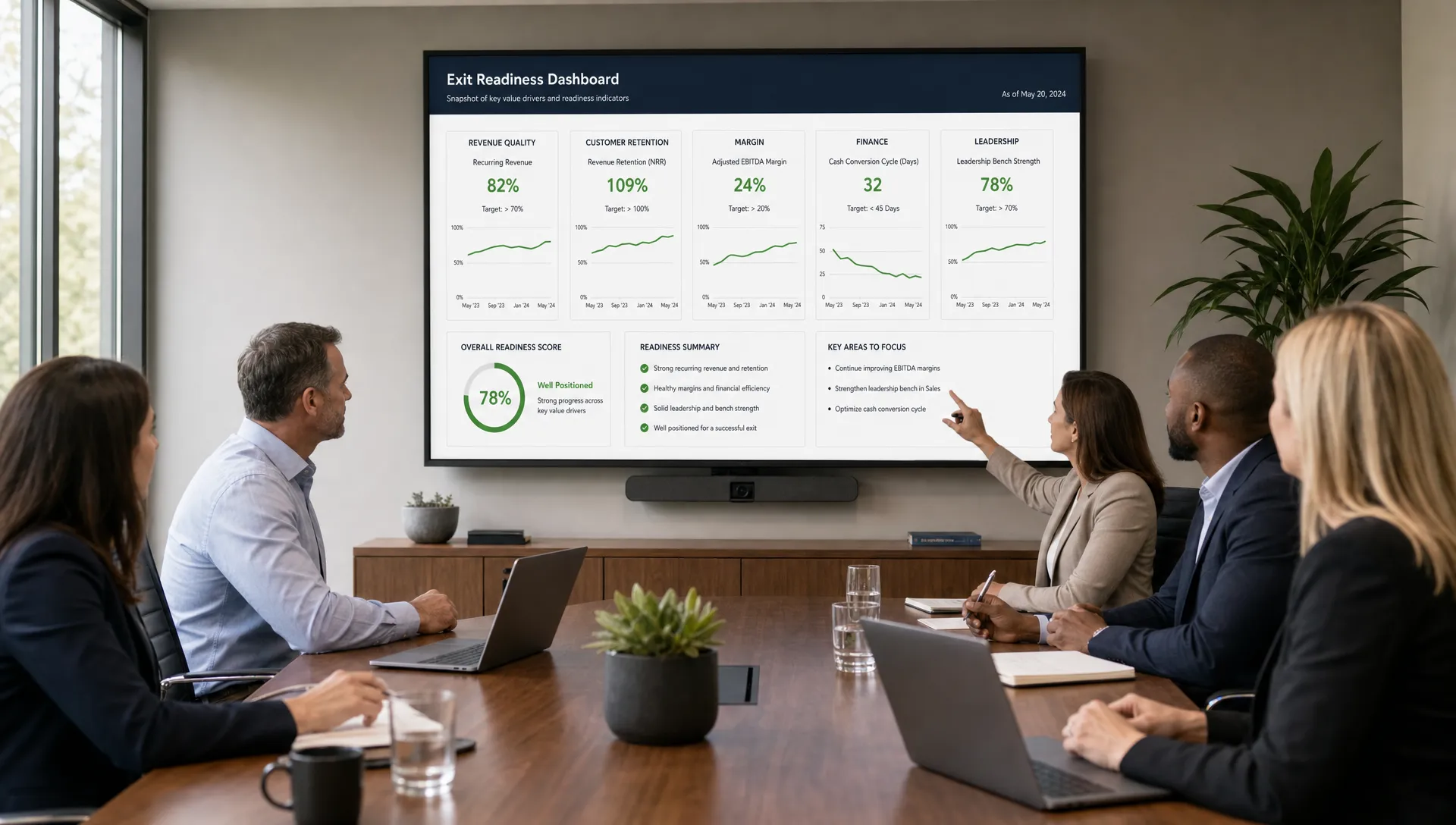
Buyers want evidence that revenue is high quality, systems are reliable, management understands the business, and future growth is achievable. Investee companies should therefore build an evidence base long before diligence begins.
| Exit readiness area | What buyers want to see | What management should prepare |
|---|---|---|
| Revenue quality | Repeatable, diversified, and resilient revenue | Cohort analysis, retention data, contract terms, customer concentration trends |
| Growth engine | A clear path to future growth | Segment performance, pipeline conversion, channel economics, expansion playbooks |
| Margins | Sustainable profitability | Gross margin by segment, pricing analysis, delivery cost drivers, operating leverage assumptions |
| Finance | Reliable numbers and clean reporting | Monthly management accounts, reconciliations, working capital trends, tax compliance records |
| Leadership | A business that is not dependent on one person | Organization design, succession depth, role clarity, incentive alignment |
| Systems | Data that can be trusted | CRM hygiene, finance system discipline, KPI definitions, audit trails |
Financial hygiene deserves special attention. Buyers often lose confidence when accounting, tax, or reporting processes are informal, delayed, or overly dependent on manual adjustments. If an investee company operates across jurisdictions, local compliance and tax support become even more important. For example, Australian operating companies may benefit from specialist tax and accounting services in Australia to strengthen reporting discipline before a transaction process.
Strengthen the revenue architecture
Revenue is more valuable when buyers can see how it is produced.
A company with strong revenue architecture does not depend on scattered tactics. It has a defined market focus, clear positioning, consistent sales motions, measurable conversion points, disciplined account management, and a leadership cadence that turns data into decisions.
This matters because buyers are not only valuing current EBITDA or ARR. They are valuing the reliability of the machine that creates future EBITDA or ARR. If the revenue engine is understandable and transferable, the buyer can underwrite growth with more confidence.
Investee companies should examine whether their revenue architecture answers these questions:
- Which customer segments are strategically important, and why?
- What is the repeatable path from lead generation to closed revenue?
- Where do conversion rates improve or deteriorate?
- Which sales activities create measurable pipeline, not just activity volume?
- How does customer success or account management drive renewals and expansion?
- Which metrics are reviewed weekly, monthly, and quarterly by leadership?
The link between commercial design and valuation is significant. As Phil Pelucha explains in this article on how exit valuation improves with revenue architecture, buyers often pay more for growth that appears predictable, transferable, and supported by operating evidence.
Reduce key-person dependency
Many investee companies underestimate how much exit risk sits in people dependency.
A founder, CEO, sales leader, technical expert, or customer relationship owner may be central to performance. That can be useful during growth, but it becomes a risk during exit. Buyers will ask what happens if that person leaves, loses motivation, or cannot scale with the next phase of ownership.
Management teams should identify where the business relies too heavily on individual knowledge or relationships. This includes sales relationships held by the founder, pricing decisions made informally by one executive, delivery knowledge concentrated in senior operators, and reporting logic understood by only one finance leader.
The solution is not to remove talented people from critical roles. The solution is to make the business more institutional. Document the playbooks. Build second-line leadership. Clarify decision rights. Introduce repeatable reporting. Align incentives with the exit plan and the company’s longer-term strategy.
Buyers pay for capability. They discount dependency.
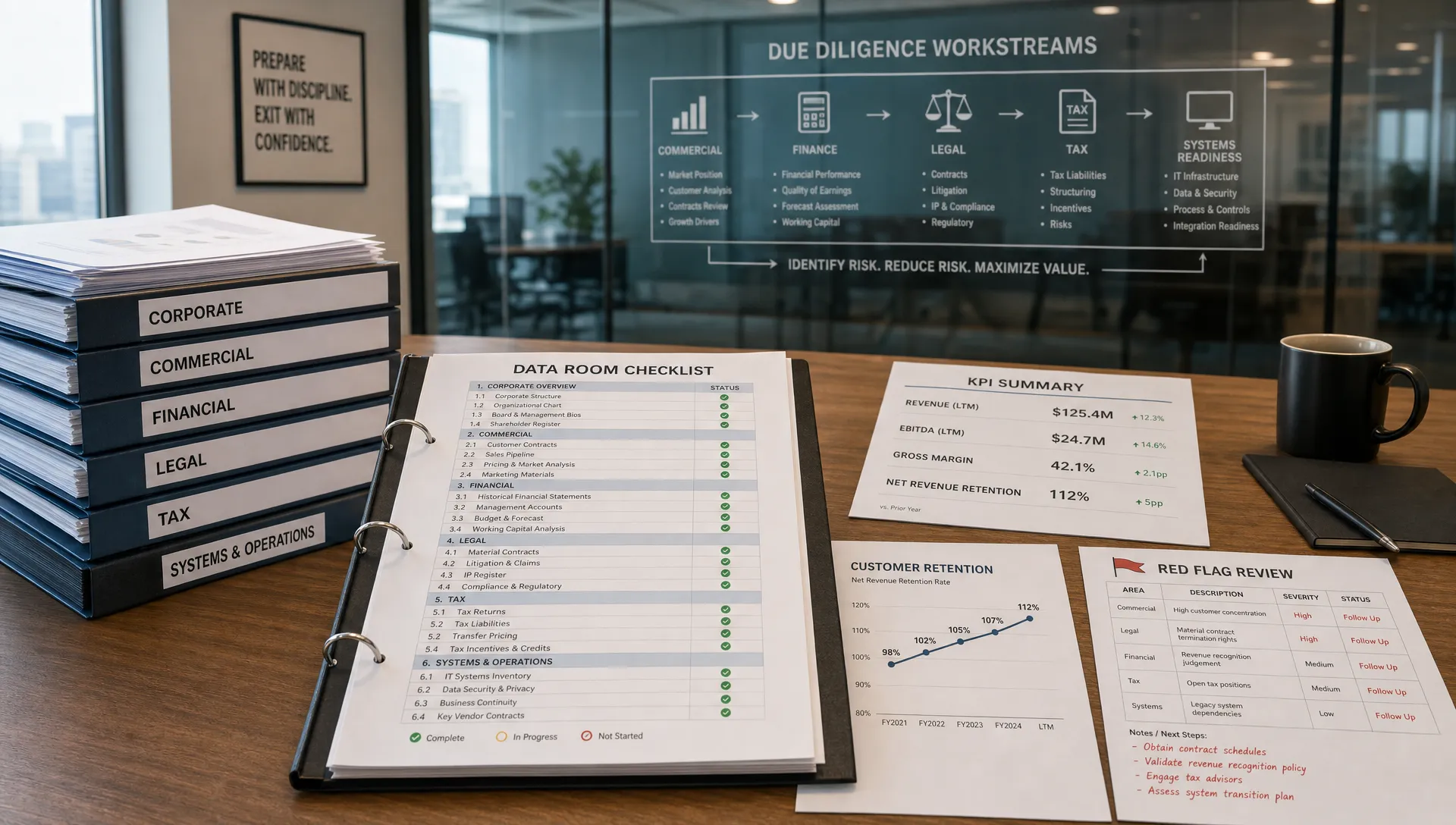
Make diligence easier before diligence starts
A chaotic diligence process can damage valuation even when the underlying business is strong. Slow responses, inconsistent numbers, unclear ownership of materials, and unresolved operational questions create doubt.
Investee companies should run a pre-diligence process well before exit. This is not just about organizing a data room. It is about finding and fixing the issues that a sophisticated buyer will find anyway.
A practical pre-diligence review should cover commercial, financial, operational, legal, tax, technology, HR, and customer evidence. The goal is to identify gaps while management still has time to improve the story, not merely explain it.
For example, if churn reporting is inconsistent, fix the definitions and rebuild the analysis. If the CRM does not reconcile to finance reports, solve the process problem. If margins vary widely by customer type, create a clear explanation and a plan to improve the mix. If customer concentration is unavoidable, document relationship strength, contract terms, renewal history, and expansion opportunities.
Good diligence preparation reduces friction. Great diligence preparation increases buyer confidence.
Install an exit readiness cadence
Exit readiness should not live in a one-off project plan. It should become part of the management operating rhythm.
A simple cadence can help investee companies track progress without overwhelming the team:
| Cadence | Focus | Example management questions |
|---|---|---|
| Weekly | Commercial execution | Is pipeline quality improving, and are conversion points moving as expected? |
| Monthly | Performance evidence | Do finance, CRM, and operating KPIs tell the same story? |
| Quarterly | Value creation priorities | Are the most important growth initiatives producing measurable results? |
| Semiannual | Exit readiness review | What would a buyer challenge if diligence began next quarter? |
This cadence should be owned by the leadership team, not delegated entirely to advisors. Advisors can help structure the work, benchmark performance, and pressure-test evidence. But the company must be able to run, explain, and defend its own operating model.
Common mistakes that weaken exit readiness
Investee companies usually do not fail at exit readiness because they ignore it completely. They fail because they start too late or focus on the wrong work.
The most common mistakes include treating exit readiness as a finance exercise, assuming revenue growth automatically proves scalability, leaving customer and pipeline analysis until diligence, allowing different departments to use conflicting KPI definitions, and relying on the sponsor or bankers to create the growth story at the end.
Another mistake is over-polishing the narrative while under-fixing the system. Buyers can usually tell when the story is stronger than the operating evidence. A polished deck cannot compensate for weak sales discipline, unreliable reporting, or unexplained margin volatility.
The earlier management faces these issues, the more options it has. Late-stage fixes often look cosmetic. Early fixes become performance improvements.
A practical exit readiness scorecard
Investee companies can begin with a simple self-assessment. Score each area from 1 to 5, where 1 means “not yet reliable” and 5 means “buyer-ready and well evidenced.”
| Area | Score | What a strong score requires |
|---|---|---|
| Revenue quality | 1 to 5 | Clear retention, concentration, cohort, and contract evidence |
| Growth thesis | 1 to 5 | Specific expansion logic supported by historical proof or tested pilots |
| Sales process | 1 to 5 | Repeatable motion, clean CRM, measurable conversion, realistic forecasting |
| Margin visibility | 1 to 5 | Segment-level margin insight and credible operating leverage assumptions |
| Finance discipline | 1 to 5 | Timely reporting, clean reconciliations, tax compliance, working capital clarity |
| Leadership depth | 1 to 5 | Reduced key-person dependency and clear second-line capability |
| Systems and data | 1 to 5 | Consistent KPI definitions, trusted data sources, clear ownership |
The score itself is less important than the discussion it creates. If the leadership team and investors disagree on the score, that disagreement is valuable. It reveals where expectations, evidence, or operating reality are misaligned.
Frequently Asked Questions
When should investee companies start preparing for exit? Ideally, exit readiness should begin early in the hold period or investment cycle. The final six to twelve months before a sale can improve presentation, but it is rarely enough time to fix weak revenue quality, leadership dependency, or unreliable reporting.
What is the biggest exit readiness issue for investee companies? The most common issue is lack of provable repeatability. A company may be growing, but if management cannot show why growth happens, where it is most profitable, and how it can continue under new ownership, buyers will apply more caution.
Is exit readiness only relevant for private equity-backed companies? No. It is also relevant for venture-backed companies, family office investees, founder-led businesses with outside investors, and corporate carve-outs. Any company that may face a future sale, recapitalization, or strategic investment benefits from stronger evidence and operating discipline.
How does revenue quality affect valuation? Revenue quality affects how much confidence buyers have in future performance. Recurring revenue, strong retention, diversified customers, disciplined pricing, and clear expansion potential usually support stronger valuation discussions than revenue that is concentrated, unpredictable, or poorly understood.
Who should own exit readiness inside the company? The CEO should sponsor it, but ownership should be shared across finance, sales, operations, customer success, HR, and technology. Exit readiness is cross-functional because buyers assess the whole operating system, not one department.
Turn exit readiness into an operating advantage
For investee companies, improving exit readiness is not just about achieving a better sale outcome. It is about building a better business before the exit arrives.
The companies that command stronger buyer interest tend to have clearer revenue architecture, cleaner financial evidence, stronger management depth, and a more credible path to future growth. They do not wait for diligence to reveal the gaps. They find them early, fix them deliberately, and turn the evidence into a stronger investment story.
If your investee company is approaching a growth inflection point, preparing for a future exit, or struggling to prove the quality of its commercial engine, Phil Pelucha Consulting helps investors and leadership teams identify the revenue, GTM, and operating improvements that increase buyer confidence before the process begins.