
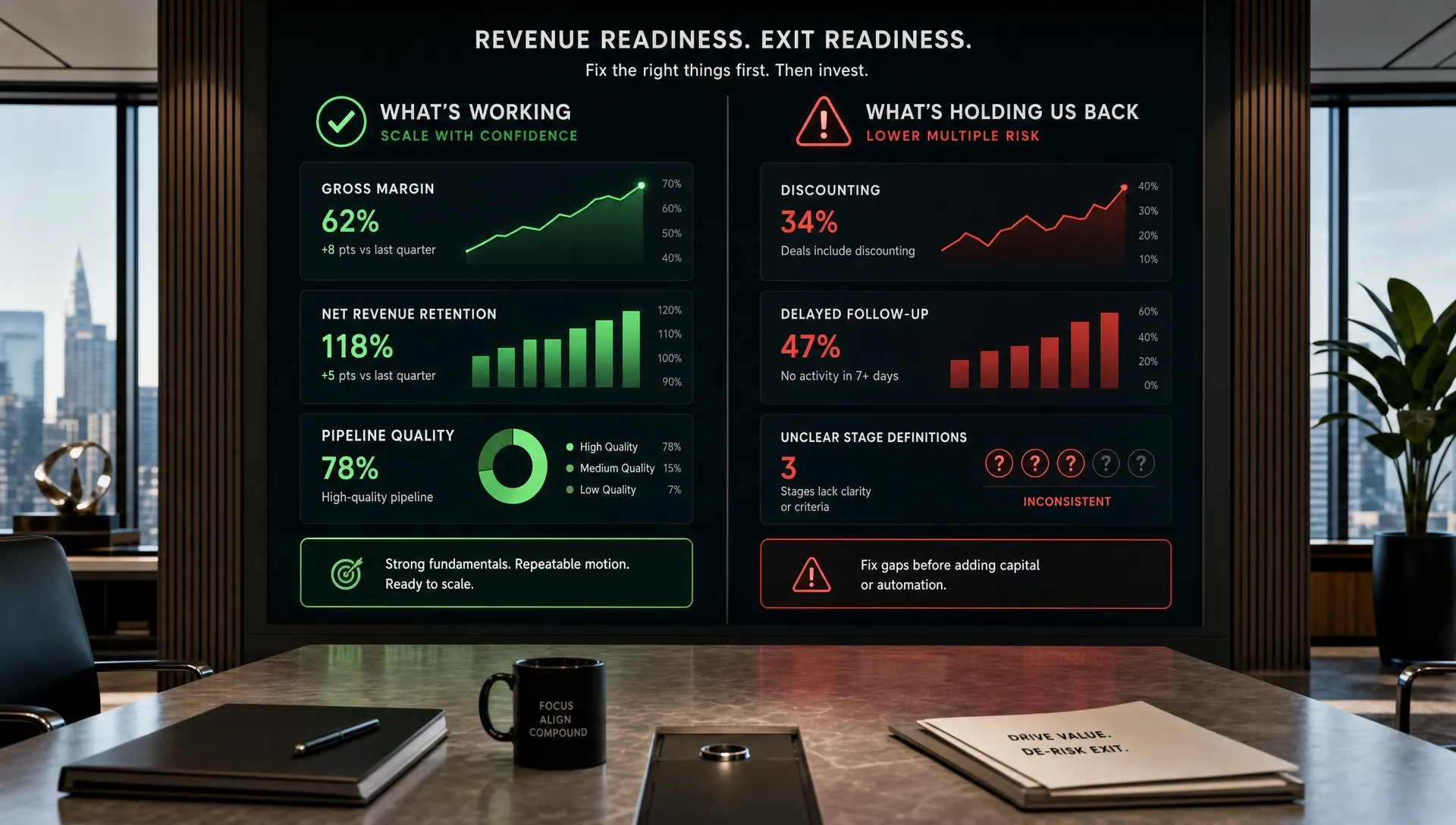
What Private Equity Backed Companies Must Fix First
Private equity ownership changes the operating clock. The business may have the same customers, the same team, and the same market, but the tolerance for vague forecasts, inconsistent sales execution, and unpriced complexity disappears quickly.
For private equity backed companies, the first priority is not always “grow faster.” It is to identify what must be fixed before growth capital, new hires, add-on acquisitions, or AI automation can produce a predictable return.
The wrong first fix creates noise. A larger sales team can multiply bad qualification. More marketing can feed the wrong pipeline. A new CRM can become a cleaner archive of the same weak process. The right first fix improves revenue quality, management visibility, and exit readiness at the same time.
The First Fix Is Commercial Truth
Most post-acquisition growth problems start with a version-of-truth problem. The sponsor has an investment case. The CEO has a revenue target. Sales has a pipeline number. Finance has a forecast. Customer success has churn warnings. Operations has delivery constraints. Too often, those views do not reconcile.
Before asking the company to accelerate, leadership needs a clean commercial baseline. That does not mean spending six months on analysis. It means getting enough shared truth to make confident decisions.
At minimum, the leadership team should be able to answer:
- Which customer segments produce the best gross margin and retention?
- Which products or services create the most delivery drag?
- Which lead sources create qualified opportunities, not just activity?
- Which sales stages are predictive of closing, and which are cosmetic?
- Where are deals being discounted, delayed, or lost?
- Which accounts are at risk, underpenetrated, or ready for expansion?
Without this baseline, the company is not really managing growth. It is managing anecdotes.
This is why many revenue issues remain hidden beneath headline growth. A company can be increasing revenue while leaking margin, selling to poor-fit customers, overstating pipeline, or relying too heavily on founder relationships. If that sounds familiar, it is worth examining the hidden revenue gaps in companies owned by private equity before pushing the next growth lever.
| Commercial signal | What it often reveals | What to fix first |
|---|---|---|
| High pipeline, low conversion | Weak qualification or inflated stage definitions | Sales process discipline |
| Revenue growth, flat EBITDA | Pricing leakage, delivery drag, or poor segment mix | Margin and ICP focus |
| Strong top accounts, weak new logo motion | Overreliance on relationships or referrals | Repeatable GTM engine |
| Forecast misses | Inconsistent deal evidence or weak CRM hygiene | Operating cadence and definitions |
| Rising churn or complaints | Sales promises exceeding delivery capability | Handoff and customer success alignment |
Fix ICP and Segment Economics Before Adding Demand
Private equity backed companies cannot afford to treat all revenue as equal. Some customers create expansion, referrals, and strong margins. Others consume management time, trigger custom delivery, demand discounts, and leave before the payback period makes sense.
The first strategic commercial fix is often ICP clarity. Not a marketing persona document that sits in a folder, but a practical definition of which customers the company should pursue, price confidently, serve profitably, and retain.
A strong ICP should be shaped by economics, not preference. Leadership should compare segments by sales cycle length, win rate, gross margin, implementation cost, retention, expansion potential, and support burden. Once this is visible, the company can decide where to focus sales effort and where to stop chasing revenue that weakens the investment case.
This applies in almost every sector. A B2B software company may need to stop pursuing enterprise logos that require excessive customization. A services business may need to focus on verticals where it has repeatable delivery proof. A construction or specialty trades platform may need to clarify project type, geography, and scope so buyers immediately understand whether the company is the right fit. For example, a local operator can make its positioning much easier to understand by showing clear service categories, regional focus, and turn-key scope, as this Tulsa-area barndominium and outdoor living contractor does on its homepage.
The lesson is simple: if the market cannot quickly understand what the company is best at, the sales team will spend too much time educating poor-fit buyers.
Fix Revenue Leakage Before Buying More Growth
Growth capital is expensive when the existing commercial engine leaks. Before increasing spend, PE-backed leadership should look for revenue that is already available but not being captured.
Common leakage points include slow speed-to-lead, weak follow-up after proposals, inconsistent renewal discipline, unmanaged discounting, poor upsell timing, and handoffs that cause customers to lose confidence after the sale. These problems rarely look dramatic in isolation. Together, they can materially reduce EBITDA and make the company look less scalable than it really is.
The advantage is that leakage fixes can move faster than new market expansion. If qualified leads are already coming in, improving response time and proposal quality can lift conversion. If the company already has a loyal customer base, structured expansion plays can increase share of wallet. If discounting is unmanaged, even modest pricing discipline can improve margin without requiring more volume.
This is where targeted sales optimisation that fixes revenue leaks fast can outperform broad transformation programs. The goal is not to create more activity. It is to convert more of the right activity into profitable revenue.
Fix the Sales Process So Forecasts Become Believable
Many portfolio companies have a CRM, but not a sales process. The difference matters.
A CRM records information. A sales process creates decision discipline. If every rep interprets opportunity stages differently, the pipeline number is not a forecast. It is a collection of opinions.
The company should define each stage with clear entry and exit criteria. A deal should not move forward because the buyer was friendly, requested a proposal, or said the budget “should be fine.” It should move forward because there is evidence of need, authority, urgency, economic fit, decision process, and next step commitment.
A useful sales process answers three questions at every stage: what has the buyer confirmed, what must happen next, and what evidence supports the close date?
This is especially important when sponsors and operators are reviewing the business weekly. If stage definitions are loose, management will overestimate future revenue and react too late. If stage definitions are tight, the team can identify risk early and make better resourcing decisions.
Fix the Management Cadence
A strong commercial plan will fail if the company does not install the right operating rhythm. PE ownership requires a cadence that connects strategy, execution, and accountability.
The leadership team should not wait until the monthly board pack to discover that pipeline quality has deteriorated. Weekly commercial meetings should focus on leading indicators, not just lagging results. Monthly reviews should test whether the company is improving the system, not simply explaining the number. Quarterly planning should connect commercial priorities to the value creation plan.
The cadence should cover forecast accuracy, pipeline quality, pricing exceptions, win-loss patterns, churn risk, delivery capacity, and strategic account movement. Just as importantly, it should force decisions. If a segment is underperforming, will the company fix the offer, change the channel, adjust pricing, or exit the segment? If a sales leader is missing targets, is the issue coaching, capacity, territory design, or market fit?
Without this rhythm, accountability becomes personality-driven. With it, the company can manage growth as a system.

Fix Pricing and Margin Discipline
Pricing is one of the most under-managed levers in private equity backed companies. It is also one of the fastest ways to expose whether the company truly understands its value.
Many businesses enter PE ownership with legacy pricing habits. Long-term customers may be underpriced. Sales reps may discount to win volume. Services may be bundled without regard to delivery cost. Renewal increases may be inconsistent. Custom work may be scoped loosely and then absorbed by operations.
Fixing pricing does not mean forcing aggressive increases across the board. It means creating discipline. Leadership should understand where price is leaking, which customers are below target margin, which discounts require approval, and how pricing should reflect value delivered.
A practical pricing review should include deal-level discount patterns, margin by customer type, renewal terms, competitor positioning, and the cost of exceptions. In many companies, the biggest issue is not the list price. It is the lack of governance around how price changes in the field.
When pricing improves, the company often gains more than margin. It gains confidence. Sales teams learn where they can defend value. Operations get fewer unprofitable promises. Sponsors get a clearer view of earnings quality.
Fix Delivery Capacity Before Scaling Demand
Commercial acceleration cannot be separated from delivery capacity. If the company sells faster than it can deliver, growth creates churn, margin compression, reputational damage, and employee burnout.
This is particularly important in service-heavy businesses, implementation-led technology companies, healthcare platforms, construction services, and industrial businesses with operational constraints. A deal that looks attractive in the pipeline may be destructive if it requires custom delivery, scarce labor, or unfavorable terms.
Before scaling demand generation, leadership should confirm that operations can absorb the work. That includes onboarding capacity, fulfillment timelines, customer success coverage, quality control, and escalation paths. Sales and delivery should agree on what can be promised, how handoffs work, and which exceptions require approval.
This fix protects exit readiness. Buyers will pay more for growth when they can see that the company can handle it without breaking the operating model.
Fix Revenue Architecture Before Automating
AI and automation can be powerful in PE environments, but only when they are applied to a clear commercial system. Automating confusion makes confusion faster.
Before deploying AI across sales, marketing, or customer operations, the company needs clean data, defined workflows, clear ownership, and measurable outcomes. Otherwise, automation projects become disconnected tools rather than value creation infrastructure.
Revenue architecture is the connective tissue. It defines how the company selects markets, generates demand, qualifies opportunities, converts customers, expands accounts, manages retention, and reports performance. When that architecture is weak, every growth initiative becomes harder to evaluate.
For a deeper look at this operating layer, see why PE backed companies need better revenue architecture before they scale. Once the architecture is in place, AI can support better targeting, faster research, cleaner handoffs, improved reporting, and more consistent execution.
A Practical 30-60-90 Day Fix Sequence
The exact order depends on the business, but most portfolio companies benefit from a disciplined first 90 days after acquisition or leadership reset.
| Timeframe | Primary objective | Key fixes |
|---|---|---|
| First 30 days | Establish commercial truth | Revenue baseline, segment economics, pipeline definitions, forecast integrity |
| Days 31 to 60 | Stop avoidable leakage | Qualification, follow-up, pricing governance, proposal discipline, renewal risk |
| Days 61 to 90 | Prepare scalable execution | ICP focus, operating cadence, delivery alignment, targeted automation, hiring plan |
The main mistake is trying to fix everything at once. PE-backed companies need sequencing. Fix the facts first. Then fix leakage. Then build the repeatable engine. Only after that should the company aggressively add headcount, expand channels, enter new markets, or automate at scale.
What Sponsors Should Watch Closely
Sponsors do not need to run the company day to day, but they do need early visibility into whether the commercial engine is improving. Board reporting should move beyond revenue, EBITDA, and pipeline total. Those numbers matter, but they are not enough.
The more useful question is whether the business is becoming more predictable. Is forecast accuracy improving? Are win rates increasing in the target ICP? Are discounts declining? Are sales cycles becoming more consistent? Is customer concentration reducing? Is expansion revenue becoming more systematic? Is the management team making decisions from shared data?
These indicators tell sponsors whether growth is becoming repeatable, not just whether the company had a good quarter.
Frequently Asked Questions
What should private equity backed companies fix first? They should first fix commercial truth: clean revenue data, segment economics, pipeline definitions, forecast accuracy, and visibility into margin and retention. Without that baseline, growth decisions are based on incomplete information.
Should a PE-backed company hire more salespeople immediately after acquisition? Not usually. Hiring before fixing ICP, sales process, pricing discipline, and management cadence can multiply existing problems. Add sales capacity once the company knows which customers to pursue and how to convert them profitably.
How quickly can revenue fixes show results? Some fixes, such as response time, proposal follow-up, discount governance, and renewal discipline, can show impact within 30 to 90 days. Larger improvements in market expansion, revenue architecture, and exit readiness take longer.
How do these fixes improve exit readiness? They create evidence that revenue is repeatable, margins are defensible, and growth does not depend on a few individuals or one-off relationships. That evidence can strengthen buyer confidence during a future sale process.
Build the Commercial System Before You Push Harder
Private equity backed companies do not fail to grow because leadership lacks ambition. They miss targets when the commercial system cannot support the ambition.
The first fixes should make the business clearer, more predictable, and easier to scale. That means better commercial truth, sharper ICP focus, less revenue leakage, disciplined sales execution, stronger pricing, aligned delivery, and revenue architecture that can support automation and expansion.
Phil Pelucha Consulting helps PE, VC, family office, and portfolio leadership teams identify and install the commercial infrastructure needed for revenue acceleration and exit readiness. If your portfolio company needs a sharper diagnostic, stronger revenue cadence, or fractional CRO support, start with Phil Pelucha.