
Sales Optimisation That Fixes Revenue Leaks Fast
Revenue leaks rarely announce themselves as one obvious problem. In PE-backed and investor-owned companies, they usually hide in the handoffs, the stage definitions, the pricing exceptions, the follow-up discipline, and the gap between the board plan and the weekly sales reality.
That is why sales optimisation should not start with a generic sales training day or a bigger marketing budget. If speed matters, the work must begin close to cash. The fastest gains usually come from finding where qualified demand already exists, then removing the friction that prevents it from becoming revenue.
For operating partners, CEOs, CROs, and commercial leaders, the goal is not to create a prettier funnel. The goal is to stop preventable revenue loss, improve forecast confidence, and make growth more repeatable before more capital is pushed into the go-to-market engine.
The fastest revenue gains are usually already in the system
When a portfolio company misses a growth target, the first instinct is often to add more pipeline. More leads, more campaigns, more salespeople, more territories. Sometimes that is necessary. But in many companies, extra activity simply pours more volume into a leaking system.
Fast sales optimisation asks a sharper question: where is revenue already close, but not converting?
That question changes the work. Instead of debating whether the company needs a new CRM, a new agency, or a new compensation plan, leaders inspect the points where money is currently being lost. A sales optimisation sprint should reveal whether the company is losing revenue through poor qualification, slow response times, weak discovery, discounting, stalled proposals, inconsistent expansion, or lack of management cadence.
This matters in a PE context because time is compressed. The hold period, the lender model, and the exit narrative all depend on growth that can be explained and repeated. A company that grows through heroic founder selling may still be valuable, but a company that can show disciplined conversion, predictable pipeline, and improving revenue quality is easier for buyers to believe.
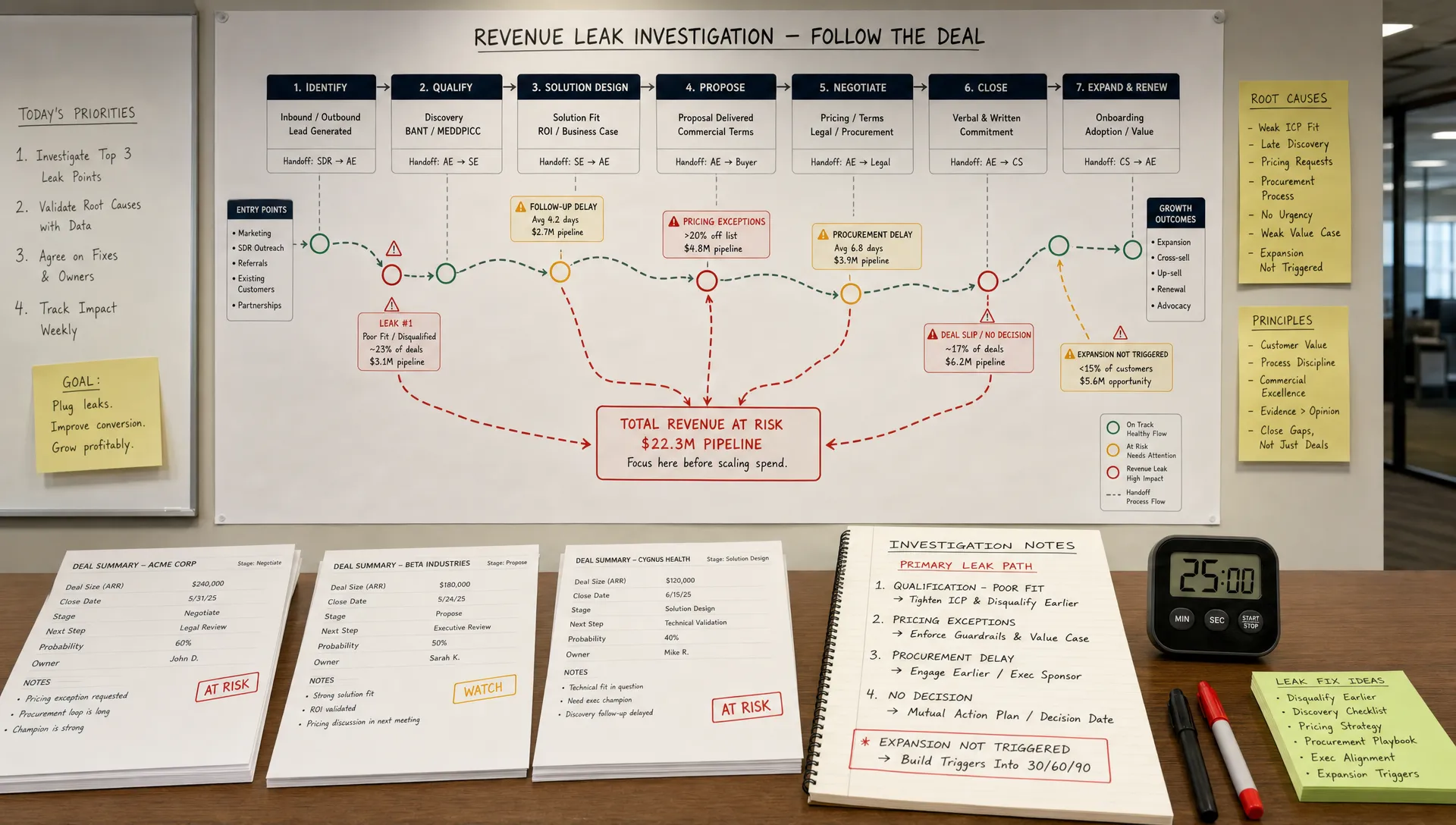
Build a revenue leak map before changing the team
A revenue leak map is a simple diagnostic that identifies where commercial value is escaping. It does not require months of analysis. In most companies, a practical first version can be created by reviewing CRM data, interviewing sales and customer success leaders, inspecting recent won and lost deals, and comparing the official process with what sellers actually do.
If the sales process is already visibly inconsistent, it can help to step back and review the fundamentals of fixing a broken sales optimization process. For a fast leak-repair sprint, however, the key is to focus on bottlenecks that can change behavior quickly.
| Revenue leak | What it looks like | Fast optimisation move | Signal to track |
|---|---|---|---|
| Poor-fit pipeline | Many opportunities enter the funnel but few progress | Tighten ICP rules and disqualify earlier | Qualified opportunity rate |
| Slow follow-up | Inbound or event-driven interest goes cold | Set response SLAs and owner accountability | Speed to lead and meeting conversion |
| Inflated stages | Deals sit in late stages without buyer evidence | Define exit criteria for each stage | Stage aging and forecast accuracy |
| Pricing leakage | Discounts vary by rep, region, or urgency | Introduce approval thresholds and value framing | Average discount and gross margin |
| Proposal drag | Proposals are sent without clear next steps | Require mutual action plans for larger deals | Proposal-to-close rate |
| Account neglect | Existing customers renew but do not expand | Segment accounts and trigger expansion plays | Net revenue retention and expansion pipeline |
The map should be uncomfortable. If it only confirms what everyone already believes, it is probably too shallow. The best diagnostics expose the mismatch between leadership assumptions and customer-facing reality.
Six revenue leaks sales optimisation can fix quickly
Not every commercial weakness can be solved in 30 days. Hiring quality, product-market fit, channel strategy, and market expansion all take time. But several leaks can be tightened fast enough to create visible momentum within a quarter.
1. Weak qualification that creates false confidence
A bloated pipeline is one of the most common causes of missed targets. On paper, coverage looks healthy. In reality, sellers are carrying opportunities that do not match the ideal customer profile, lack urgency, have no economic buyer access, or were created because activity targets rewarded volume over quality.
The fix is to make qualification observable. A rep should not be able to advance a deal simply because a meeting happened. There should be evidence of business pain, decision process, budget logic, buyer authority, and a compelling event. If those signals are missing, the opportunity may still be nurtured, but it should not distort the forecast.
Fast improvement comes from cleaning the current pipeline, not just changing future rules. In a PE-backed company, this often reveals that the true pipeline is smaller than reported. That can feel negative at first, but it gives leadership a more honest base from which to act.
2. Slow response and weak handoff after attention is created
Many companies spend heavily to create attention, then lose momentum because the sales handoff is vague. Leads from webinars, referrals, events, partner introductions, or content campaigns need a clear owner, a response window, and a conversion path.
Demand generation also needs this discipline. A high-visibility campaign or corporate experience can create attention, but attention is not revenue until it is converted. Even specialist activations such as world-record corporate event concepts need named account follow-up, meeting ownership, and a next-step sequence if the commercial team wants measurable pipeline from the moment.
The fast fix is not complicated. Assign ownership before the campaign starts, define what qualifies as sales-ready interest, create response scripts for priority segments, and track time from engagement to first meaningful contact. If the company cannot follow up quickly, it should not scale the campaign yet.
3. Stage progression based on seller opinion instead of buyer proof
A CRM stage should represent buyer progress, not seller optimism. If a deal moves from discovery to proposal because the rep wants it to, the forecast becomes political. If it moves because the buyer confirmed pain, decision criteria, stakeholders, timing, and next steps, the forecast becomes useful.
This is one of the fastest places to improve sales management. Each stage should have exit criteria that a manager can inspect. For example, a late-stage opportunity should have a confirmed decision process, known competitors or alternatives, quantified value, and a scheduled next action. If those elements are missing, the opportunity belongs in an earlier stage.
The result is often a temporary reduction in late-stage pipeline. That is not a failure. It is the removal of false confidence.

4. Proposal leakage and uncontrolled discounting
Proposal leakage happens when sellers send documents too early, price too defensively, or offer concessions without a value exchange. This is especially damaging when a company is preparing for exit because margin quality matters as much as revenue growth.
A fast proposal fix usually includes three controls. First, proposals should only be issued after the buyer agrees to a decision path. Second, pricing should be tied to business outcomes and risk reduction, not just features. Third, discounts should require a reason, an approval threshold, and ideally a trade, such as faster signature, longer term, broader scope, or a reference commitment.
This is not about making sellers rigid. It is about protecting value. If discounting is the only tool sellers trust, the company has a positioning, qualification, or negotiation problem that will keep showing up in gross margin.
5. Existing-account leakage hidden behind new-logo obsession
New logos are important, but many portfolio companies underuse the revenue already available in their customer base. Account expansion is often informal, reactive, and dependent on a few senior people who know which customers have potential.
Fast optimisation begins by segmenting accounts into clear groups. Some accounts are renewal only. Some have cross-sell potential. Some have geographic expansion potential. Some are at risk. Each group needs a different motion.
The most immediate gains often come from creating triggers. These can include usage milestones, new stakeholder changes, contract anniversaries, customer success signals, or new business units inside an existing customer. The commercial team should not wait for the customer to ask for more. Expansion should be managed as deliberately as acquisition.
6. Sales management cadence that inspects activity but not quality
Many sales meetings are busy but commercially weak. Managers review activity, ask for deal updates, and pressure reps to close before month end. That may create motion, but it does not necessarily improve conversion.
A better cadence inspects the quality of the work. Are reps reaching the right accounts? Are discovery calls exposing economic pain? Are next steps mutual and dated? Are proposals connected to quantified value? Are stalled deals being requalified or removed?
This is where fractional CRO support or sponsor-level commercial advisory can be valuable. The company may not need a permanent executive hire immediately. It may need a stronger operating rhythm, cleaner deal inspection, and a management system that makes performance visible.
Apply AI automation only where the bottleneck is proven
AI can accelerate sales optimisation, but only if it is pointed at the right constraint. Automating a broken process usually creates faster noise. Automating a validated bottleneck can create faster revenue.
For example, AI can help summarize call notes, identify missing qualification data, draft follow-up sequences, surface stalled deals, prioritize accounts, or flag pricing exceptions. Those use cases sit close to revenue conversion. They are different from broad automation projects that improve internal efficiency but do not change commercial outcomes quickly.
The practical rule is simple: diagnose first, automate second. If a bottleneck is manual, repetitive, measurable, and close to cash, it is a strong candidate for automation. If the bottleneck is strategic ambiguity, weak ICP, poor offer positioning, or lack of buyer access, automation will not fix the root cause. For a deeper view, see where AI-powered automation creates revenue fastest in PE-backed environments.
A 30-day sales optimisation sprint for PE-backed companies
A fast sprint should be narrow enough to execute and rigorous enough to influence board-level decisions. The objective is not to transform the entire commercial function in a month. The objective is to identify the most expensive leaks, fix the ones closest to cash, and create a repeatable management rhythm.
| Timeframe | Focus | Output |
|---|---|---|
| Days 1 to 5 | Data review and leadership alignment | Agreed revenue leak hypotheses |
| Days 6 to 10 | Deal inspection and customer-facing interviews | Evidence-based leak map |
| Days 11 to 15 | Pipeline cleanup and stage criteria | Cleaner forecast and disqualification rules |
| Days 16 to 20 | Proposal, pricing, and follow-up fixes | New controls and response standards |
| Days 21 to 25 | Management cadence and accountability | Weekly inspection rhythm |
| Days 26 to 30 | Board-ready findings and next sprint design | Priority actions, owner map, and KPI baseline |
The most important discipline is sequencing. Do not try to fix every leak at once. Choose the two or three that are closest to cash and easiest to measure. A cleaner pipeline, faster follow-up, and tighter proposal control can change the commercial conversation quickly.
What the board should see after the first sprint
A sales optimisation initiative should not be judged by activity alone. The board does not need a long list of meetings held, dashboards created, or workshops delivered. It needs evidence that revenue leakage is being reduced and that management has a clearer view of future performance.
| Board-level metric | Why it matters | What improvement looks like |
|---|---|---|
| Forecast accuracy | Reduces surprises and improves capital planning | Fewer late-stage slips and cleaner commit logic |
| Qualified pipeline | Shows whether demand matches the ICP | Lower volume may be acceptable if quality rises |
| Sales cycle movement | Reveals whether deals are actually progressing | Fewer stalled opportunities by stage |
| Discount discipline | Protects margin and exit quality | Lower unnecessary discounting and clearer approvals |
| Proposal conversion | Connects sales effort to buying intent | More proposals tied to mutual next steps |
| Expansion pipeline | Improves revenue quality | More growth from existing accounts, not only new logos |
The first sprint should also produce a sharper commercial narrative. Instead of saying the company needs more sales activity, leadership can say which leak is constraining growth, what is being changed, who owns it, and how progress will be measured.
That is the difference between pressure and operating discipline.
Fast optimisation is not a substitute for revenue architecture
Fast fixes matter, but they are not the whole answer. If a company has unclear market positioning, inconsistent sales roles, weak management capability, poor data hygiene, founder-dependent selling, or fragmented customer ownership, the leaks will return.
Sales optimisation should therefore be treated as the first layer of a broader commercial operating system. The sprint identifies and repairs urgent leaks. The next phase builds the architecture that prevents those leaks from reopening as the company scales.
For PE and VC investors, this distinction is important. A short-term sprint can improve conversion, confidence, and accountability. A stronger revenue architecture can improve scalability, reduce key-person dependency, and support a more credible exit story.
Frequently Asked Questions
What is sales optimisation? Sales optimisation is the process of improving the sales engine so revenue is generated more predictably and efficiently. In a PE-backed company, it usually focuses on qualification, pipeline discipline, conversion, pricing, account expansion, and management cadence.
How fast can revenue leaks be fixed? Some leaks can be tightened within weeks, especially those involving pipeline hygiene, follow-up speed, stage criteria, and proposal controls. Structural issues such as market positioning, hiring gaps, or channel strategy usually require a longer program.
Should a company add more leads before fixing sales leaks? Not usually. If the company already loses qualified opportunities through weak handoffs, poor discovery, or inconsistent follow-up, more leads may increase waste. Fixing close-to-cash leaks first often makes future demand generation more productive.
Where does AI fit into sales optimisation? AI is most useful when the bottleneck is clear, repetitive, measurable, and close to revenue. Good examples include follow-up support, call summaries, stalled-deal alerts, account prioritization, and missing qualification prompts. It should not be used to automate a process that has not been diagnosed.
Fix the leak before scaling the spend
For portfolio companies, the fastest path to better revenue performance is often not a bigger growth push. It is a cleaner, more disciplined system that stops preventable leakage and turns existing demand into closed revenue.
If your company needs a sharper commercial diagnostic, stronger sales operating rhythm, or portfolio-level revenue support, Phil Pelucha Consulting helps PE firms, VC investors, family offices, and portfolio companies improve revenue acceleration and exit readiness through practical commercial infrastructure.