
How to Fix a Broken Sales Optimization Process
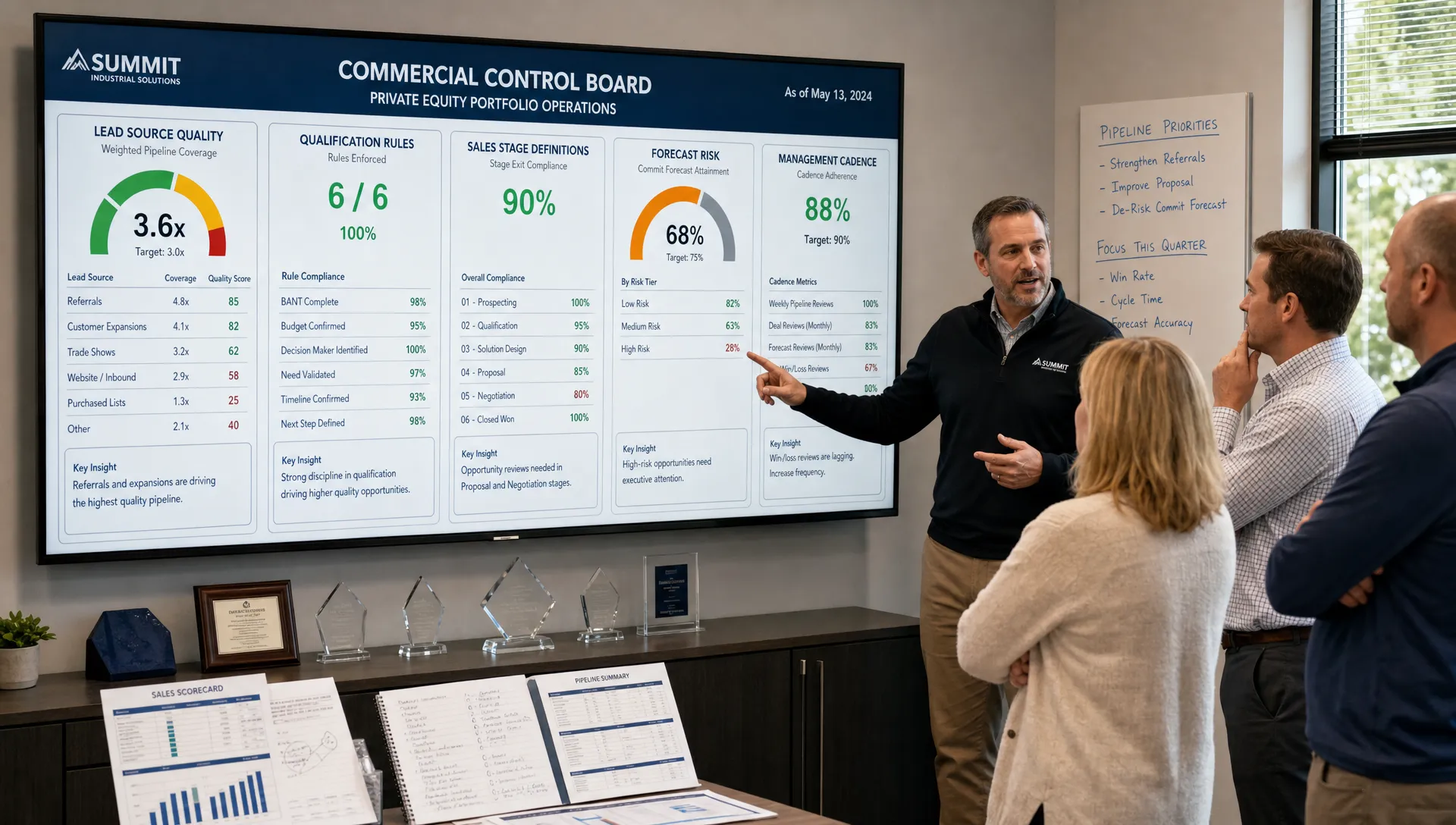
A broken sales optimization process rarely announces itself as broken. It shows up as missed forecasts, inconsistent rep performance, bloated pipeline, slow deal cycles, and leadership meetings where everyone has a different explanation for the same revenue gap.
For PE-backed and investor-owned companies, the cost is higher than a bad quarter. A weak commercial process damages confidence in the growth thesis, makes add-on integration harder, slows market expansion, and weakens exit readiness. The problem is not always the quality of the sales team. More often, the process has become a collection of habits, tools, and opinions instead of a repeatable revenue system.
Fixing it requires more than motivational sales training or a new dashboard. You need to identify where the process is breaking, rebuild the commercial operating rhythm, and connect every stage of the funnel to measurable buyer progress.
What a broken sales optimization process really looks like
A sales optimization process is supposed to improve how revenue is created, measured, managed, and scaled. When it works, leadership can see which markets convert, which segments are profitable, which reps are coachable, and which activities create revenue quality.
When it breaks, the business still appears active. Reps are making calls. Marketing is generating leads. Managers are reviewing pipeline. The CRM is full of opportunities. But the activity does not convert reliably into revenue.
Common symptoms include:
- Forecasts change dramatically from week to week.
- Reps define qualified opportunities differently.
- Pipeline coverage looks healthy, but close rates are poor.
- Sales stages reflect seller optimism, not buyer commitment.
- Discounting increases near the end of the quarter.
- New hires take too long to ramp.
- Leadership cannot explain why top performers win.
- CRM data is incomplete, duplicated, or distrusted.
The danger is that these symptoms are often treated separately. A forecasting issue becomes a finance problem. A conversion issue becomes a rep performance problem. A CRM issue becomes an operations problem. In reality, they are usually connected.
| Symptom | Likely root cause | Commercial fix |
|---|---|---|
| Pipeline is large but unreliable | Weak qualification and unclear stage criteria | Redefine opportunity standards and stage exit rules |
| Win rates vary heavily by rep | Process depends on individual heroics | Capture winning behaviors and standardize execution |
| Forecast misses repeat | CRM data does not reflect buyer reality | Rebuild forecasting around evidence and deal risk |
| Sales cycles are stretching | Poor urgency, weak business case, or wrong ICP | Tighten ICP, discovery, and value messaging |
| Growth stalls after hiring | Scaling happened before process maturity | Fix the revenue engine before adding capacity |
If your portfolio company is under pressure to grow, this distinction matters. Pushing harder on a broken process usually amplifies the weakness. Before adding reps, launching new territories, or increasing marketing spend, it is worth reviewing what PE funds should fix before pushing growth.
Step 1: Separate demand problems from conversion problems
The first mistake in repairing a sales optimization process is assuming every revenue problem is a sales execution problem. Sometimes the issue is demand quality. Sometimes it is conversion. Sometimes it is pricing, product-market fit, channel conflict, or post-acquisition confusion.
Start by breaking the funnel into objective layers:
- Lead source and campaign quality
- ICP fit and segment performance
- Speed to lead and first meeting conversion
- Discovery quality and qualification standards
- Proposal conversion and pricing discipline
- Sales cycle length by segment, rep, and deal size
- Closed-won revenue quality, including margin, retention risk, and expansion potential
This analysis should identify whether the company has too few qualified opportunities, poor conversion of qualified opportunities, poor deal economics, or weak retention after the sale. Each diagnosis leads to a different fix.
For example, if demo-to-proposal conversion is strong but lead-to-meeting conversion is weak, the issue may sit in targeting, messaging, response speed, or SDR execution. If proposal-to-close conversion is weak, the issue may be qualification, stakeholder mapping, business case creation, procurement handling, or pricing confidence.
For PE sponsors, this is where commercial diagnostics create value. They turn subjective management narratives into a fact base that shows whether the investment thesis is being constrained by market demand, sales execution, management cadence, or infrastructure.
Step 2: Rebuild sales stages around buyer evidence
Many sales pipelines are broken because the stages are built around seller activity rather than buyer commitment. A rep books a meeting, so the deal moves forward. A proposal is sent, so the probability increases. A prospect says they are interested, so the forecast becomes optimistic.
That is not sales optimization. That is stage inflation.
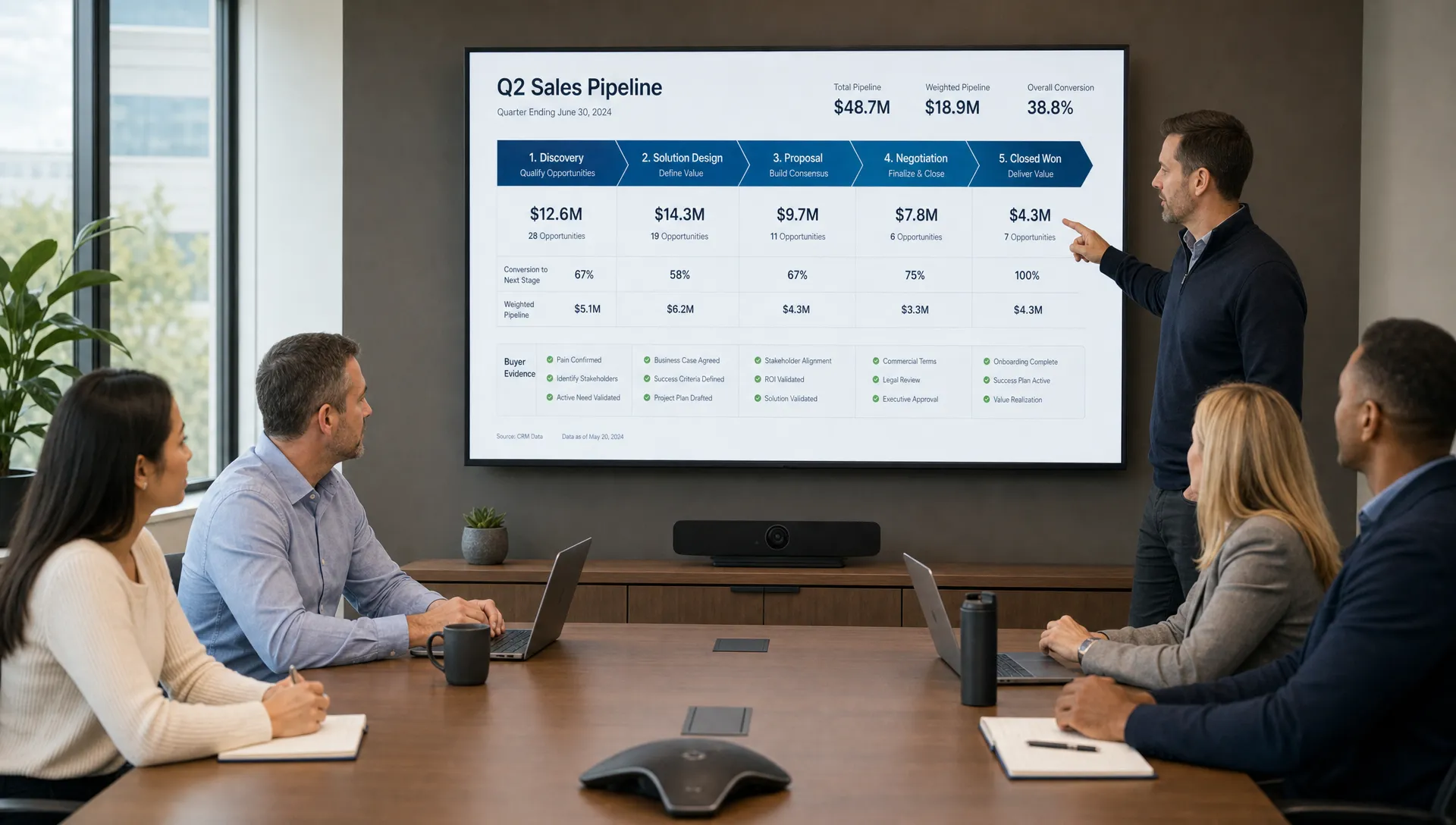
A stronger process defines each stage by observable buyer evidence. The buyer has confirmed a business problem. The buyer has shared decision criteria. The buyer has introduced additional stakeholders. The buyer has agreed to a mutual action plan. The buyer has validated economic impact.
| Pipeline stage | Weak definition | Stronger buyer-evidence definition |
|---|---|---|
| Qualified | Prospect took a call | Prospect matches ICP, has a relevant problem, and has a reason to act |
| Discovery | Rep completed a meeting | Buyer confirmed pain, impact, stakeholders, timing, and current alternatives |
| Solution fit | Demo delivered | Buyer agrees the proposed approach addresses the business problem |
| Proposal | Proposal sent | Buyer has confirmed scope, decision path, success criteria, and next step |
| Commit | Rep feels confident | Buyer has confirmed decision date, approval path, commercial terms, and implementation plan |
This shift improves coaching, forecasting, and accountability. Managers can inspect deal quality instead of asking for rep confidence. Leadership can compare pipelines across teams. New hires learn what good looks like faster.
Most importantly, buyer-evidence stages reduce false pipeline. That matters when ownership is making decisions about hiring, expansion, pricing, and exit timing.
Step 3: Fix CRM data before trusting the dashboard
A broken CRM does not just create administrative pain. It distorts commercial decisions. If fields are incomplete, stages are subjective, duplicates are common, and historical data is unreliable, the company cannot accurately diagnose its sales optimization process.
CRM cleanup should not begin with adding more required fields. It should begin with deciding which data is actually necessary to run the revenue engine. For most companies, that includes ICP segment, source, deal type, stage, next step, close date, decision process, expected value, reason lost, and owner.
Data migration also matters. When companies change systems, integrate acquisitions, or consolidate regional sales teams, bad imports can create years of reporting confusion. Teams should treat CRM data import as a commercial infrastructure task, not a back-office chore, because migrated customer and opportunity data becomes the foundation for segmentation, forecasting, and account management.
Once the data model is clear, enforce standards through management behavior, not just software settings. If managers tolerate vague next steps, stale close dates, and missing decision criteria, the CRM will degrade again. If every pipeline review uses the CRM as the source of truth, data quality improves quickly.
Step 4: Tighten the ICP before optimizing activity
You cannot optimize a sales process around a vague customer profile. If the company is selling to too many segments with different pain points, buying processes, price sensitivity, and implementation needs, the sales motion becomes noisy.
A precise ideal customer profile helps leadership answer practical questions:
- Which prospects should sales prioritize?
- Which deals should managers disqualify early?
- Which messages should marketing test?
- Which verticals justify specialist coverage?
- Which customer types create the best margin, retention, and expansion potential?
The best ICP work combines quantitative and qualitative evidence. Look at win rate, deal size, cycle length, gross margin, retention, expansion, implementation burden, and customer support load. Then interview the sales team, customer success, delivery leaders, and customers to understand why certain segments perform better.
For PE-backed companies, ICP discipline is especially important after acquisition. Leadership may be tempted to chase every growth opportunity to validate the deal thesis. But not all revenue is equally valuable. Poor-fit revenue can increase churn, drag delivery teams, inflate support costs, and reduce exit quality.
Step 5: Re-engineer qualification so reps stop carrying bad deals
Qualification is where many broken sales optimization processes quietly lose months. Reps keep poor-fit opportunities alive because pipeline pressure rewards volume. Managers allow weak deals to remain because they need coverage. Leadership receives a forecast that looks full but lacks commercial truth.
A stronger qualification standard should test four things.
First, does the prospect fit the ICP? A deal outside the ICP may still close, but it should require a conscious exception. Second, is there a business problem with measurable impact? Interest is not enough. Third, is there a real decision process? If nobody knows who signs, who influences, or who can block the deal, the opportunity is immature. Fourth, is there a reason to act now? Without urgency, deals drift.
This does not mean reps should interrogate buyers with a rigid script. It means the sales organization needs a shared definition of qualified. That shared definition helps managers coach effectively and prevents the pipeline from becoming a storage unit for hopeful conversations.
Step 6: Install a management cadence that exposes constraints early
Even a well-designed sales process will fail without operating discipline. Sales optimization is not a quarterly project. It is a weekly management rhythm that identifies constraints, removes friction, and reinforces standards.
A useful cadence separates different types of conversations. Forecast meetings should focus on commit quality and risk. Pipeline generation meetings should focus on future coverage. Deal reviews should focus on strategy, stakeholders, and next actions. Coaching sessions should focus on skill development. When all of these topics are crammed into one meeting, none of them receive enough attention.
A practical weekly rhythm might include:
| Meeting | Primary question | Output |
|---|---|---|
| Forecast review | What will close, and what evidence supports it? | Clean commit view and risk actions |
| Pipeline review | Do we have enough qualified future opportunity? | Gap analysis by segment and source |
| Deal strategy | How do we improve probability on priority deals? | Stakeholder plan, value case, next step |
| Rep coaching | Which behavior needs improvement? | Skill focus and follow-up action |
| Revenue leadership review | What constraint is slowing growth? | Decision, resource allocation, accountability |
This cadence gives leadership a sharper view of where the sales optimization process is failing. It also prevents the common habit of diagnosing everything at the end of the quarter, when the only remaining levers are discounting and pressure.
Step 7: Align incentives with revenue quality, not just bookings
If compensation rewards the wrong behavior, the process will break again. A sales team that is rewarded only on bookings may close poor-fit customers, over-discount, skip discovery, or create implementation risk. A manager rewarded only on short-term target attainment may keep unqualified pipeline alive too long.
Incentives should reinforce the commercial outcomes the company needs. That might include margin discipline, multi-year agreements, product mix, expansion potential, retention quality, or strategic account penetration. The right answer depends on the business model and investment thesis.
The key is to avoid accidental contradictions. If leadership says ICP discipline matters but celebrates every out-of-segment win, reps will ignore the ICP. If managers say CRM hygiene matters but never inspect it, reps will treat it as optional. If the board says profitable growth matters but only asks about top-line bookings, the organization will optimize for top-line bookings.
A repaired sales optimization process requires alignment between strategy, process, data, incentives, and management behavior.
Step 8: Use AI and automation only after the process is clear
AI can accelerate revenue operations, but it will not fix a confused sales motion by itself. Automating a broken process usually creates more noise faster. The best use cases come after the business has defined its ICP, stages, data standards, messaging, and management cadence.
Once those foundations are in place, AI and automation can help with lead routing, account research, call summarization, CRM updates, follow-up drafting, churn risk signals, and pipeline inspection. For portfolio companies, the highest-value opportunities are usually the ones closest to existing revenue constraints. If response speed is weak, automate routing and alerts. If managers lack deal visibility, automate risk flags. If reps spend too much time on admin, automate CRM capture and summarization.
This is why automation should be connected to the commercial diagnosis. For a deeper look at prioritization, see where AI-powered automation creates revenue fastest in investor-backed businesses.
A 90-day plan to repair the sales optimization process
A broken process does not need a year-long transformation before results improve. Most companies can create meaningful commercial clarity in 90 days if leadership focuses on the constraints that matter.
| Timeframe | Focus | Key actions | Success indicator |
|---|---|---|---|
| Days 1 to 30 | Diagnose | Audit funnel data, CRM quality, stage definitions, ICP performance, forecast accuracy, and rep behavior | Leadership agrees on the real commercial constraints |
| Days 31 to 60 | Rebuild | Redefine stages, qualification, ICP, CRM fields, pipeline review structure, and coaching expectations | Managers inspect the same standards across the team |
| Days 61 to 90 | Reinforce | Run the cadence, clean pipeline, coach priority skills, adjust reporting, and remove process friction | Forecast quality, conversion visibility, and deal discipline improve |
The goal of the first 90 days is not perfection. It is to create a revenue operating system that leadership can trust. Once the system is visible, the company can make better decisions about hiring, market expansion, pricing, partnerships, and exit preparation.
This is also where sponsor involvement can be valuable. Operating partners and investors do not need to micromanage the sales team. They need to ensure the portfolio company has the commercial infrastructure required to execute the value creation plan. That includes reliable data, clear ownership, repeatable process, and a leadership cadence that surfaces problems early.
The board-level questions that reveal whether the process is fixed
A sales optimization process is improving when leadership can answer specific questions without relying on anecdotes.
Can we explain conversion by segment, source, and rep? Do we know which customers produce the best revenue quality? Are stage definitions consistent across the team? Can managers identify deal risk before the final week of the quarter? Do forecasts reflect buyer evidence? Are new hires ramping against a documented process? Is the CRM trusted by sales, finance, and leadership?
If the answer is no, the process is not fully repaired. If the answer is yes, the company is in a better position to scale with discipline.
For PE-backed companies, this also supports exit readiness. Buyers want evidence that growth is repeatable, not dependent on a few heroic sellers or founder relationships. A clean sales process strengthens the commercial narrative and helps demonstrate that the business can continue growing under new ownership. For more on that connection, review how private equity companies improve exit readiness.
Frequently Asked Questions
What is a sales optimization process? A sales optimization process is the structured system used to improve sales performance across targeting, qualification, pipeline management, conversion, forecasting, coaching, and revenue quality. It connects daily sales activity to measurable business outcomes.
How do you know if your sales process is broken? Warning signs include unreliable forecasts, inconsistent qualification, low conversion despite high activity, poor CRM data, long sales cycles, heavy discounting, and performance that depends too much on a few top reps.
Should you hire more salespeople before fixing the process? Usually not. If the process is unclear, hiring more reps often increases cost without improving predictable revenue. Fix the ICP, stages, qualification, data, and management cadence first, then scale capacity.
How long does it take to fix a broken sales optimization process? Many companies can create meaningful improvement in 90 days, especially around CRM hygiene, stage discipline, qualification, and management cadence. Full optimization continues over time as the company tests and refines the revenue engine.
Where does AI fit into sales optimization? AI fits best after the core process is defined. It can improve speed, consistency, research, CRM updates, follow-up, and pipeline inspection, but it should automate a clear process rather than compensate for a confused one.
Turn a broken sales process into a repeatable revenue system
Fixing a broken sales optimization process is not about adding more pressure to the sales team. It is about building the commercial infrastructure that allows good strategy to become consistent execution.
For PE firms, VC investors, family offices, and portfolio leadership teams, the opportunity is to move from reactive revenue management to a repeatable operating system. That means clearer ICP discipline, cleaner data, stronger qualification, better management cadence, and smarter use of automation.
If your portfolio company needs sharper commercial execution, stronger growth discipline, or better exit readiness, Phil Pelucha Consulting helps investor-backed businesses diagnose revenue constraints and install the systems needed to accelerate growth with confidence.