
Where AI-Powered Automation Creates Revenue Fastest
AI has moved from boardroom curiosity to commercial expectation. McKinsey’s 2024 global survey on AI found that generative AI adoption had accelerated sharply, but adoption alone is not the same as revenue impact.
For PE firms, operating partners, and portfolio company leaders, the better question is not which AI tool should we buy? The better question is where does manual friction slow down cash?
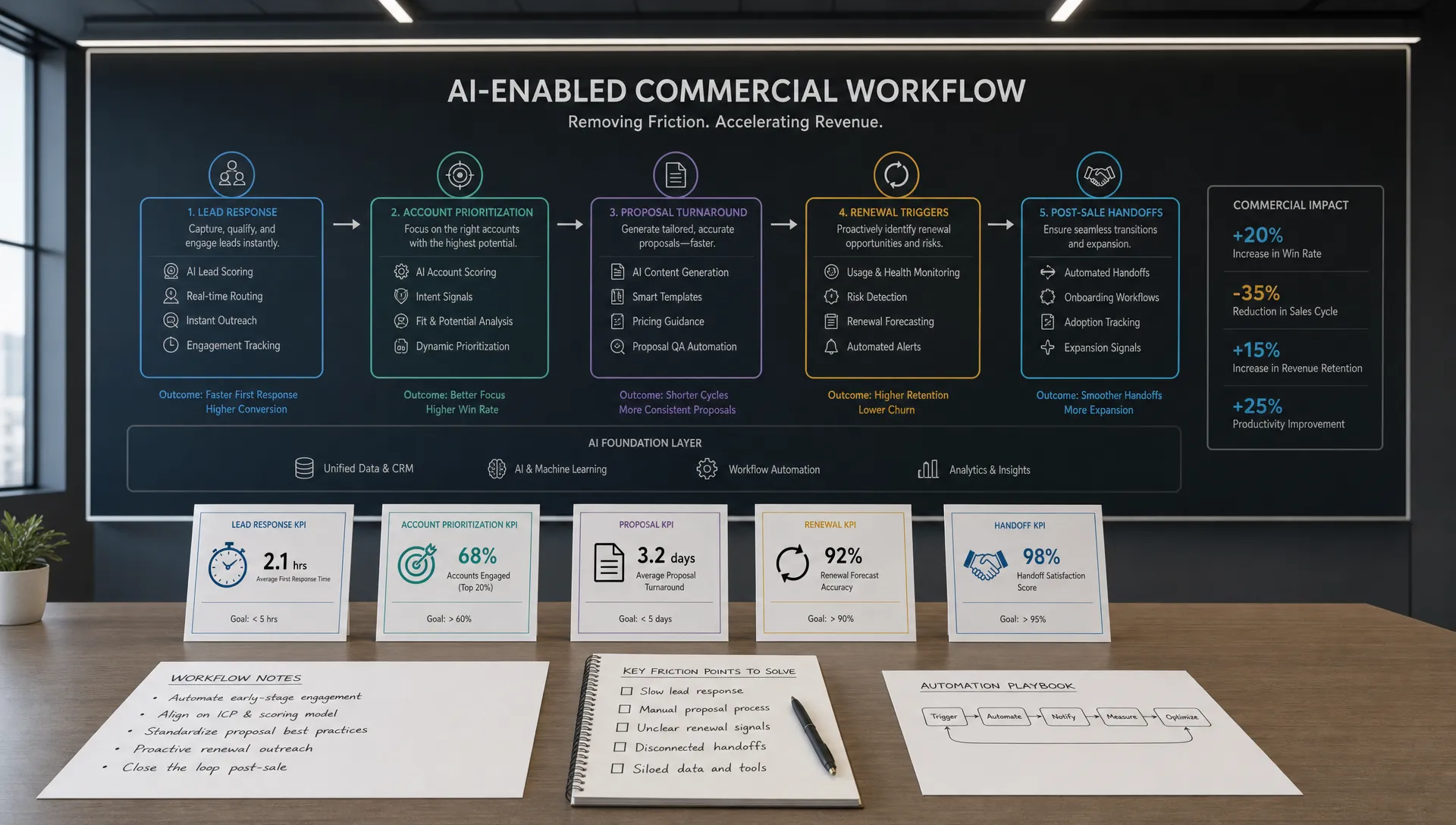
AI-powered automation creates revenue fastest when it sits close to the revenue constraint. That constraint might be slow lead response, poor account prioritization, proposal bottlenecks, missed expansion signals, or delivery handoffs that damage customer experience after the sale. The common pattern is simple: revenue is already available, but the business is too slow, too inconsistent, or too manually constrained to capture it.
The fastest wins rarely come from broad transformation programs. They come from focused commercial systems that shorten cycle time, improve conversion, reduce leakage, and give management cleaner signals to act on.
The rule: automate constraints, not activities
A common mistake is to automate whatever looks busy. Sales emails, meeting notes, reports, marketing content, and CRM updates all consume time, but not all of them constrain revenue. Automating low-value activity can create the illusion of progress while leaving the real bottleneck untouched.
Before implementing AI, leadership should identify the constraint in the commercial engine. Is pipeline volume weak? Is the team failing to convert qualified demand? Are reps spending time on poor-fit accounts? Is pricing inconsistent? Are customers churning before expansion? Are operational handoffs undermining sales promises?
If the answer is unclear, automation should wait. A portfolio company needs a stable commercial foundation before adding more speed, which is why it is worth revisiting what every portfolio company needs before scaling before treating AI as a growth shortcut.
The highest-return use cases usually pass three tests.
| Test | What it means | Why it matters |
|---|---|---|
| Close to cash | The workflow directly affects bookings, renewals, expansion, or collections | Impact is easier to measure and faster to realize |
| Repetitive with judgment | Humans repeat the same decision pattern, but still need context | AI can increase speed without removing commercial control |
| Data already exists | CRM, support, billing, web, product, or operations data is available | The system can learn from real behavior instead of assumptions |
When those three conditions exist, AI-powered automation can create measurable lift within a quarter rather than becoming another long-running digital transformation project.
Speed-to-lead and qualification
The fastest revenue impact often appears at the very top of the sales process, especially in businesses with meaningful inbound demand. A qualified lead that waits in a queue is not an asset. It is a decaying opportunity.
Harvard Business Review research on online sales leads showed how dramatically response time affects qualification outcomes. The principle still applies: buyers reward speed, relevance, and confidence. AI can help deliver all three when the workflow is designed correctly.
This is not just about sending an automated email. The revenue opportunity is in orchestrating the full first-response system. AI can enrich the lead, match it against the ideal customer profile, route it to the right owner, summarize context for the rep, recommend the opening message, and trigger follow-up if the first attempt fails.
For a B2B services company, this might mean recognizing that a CFO from a target vertical has downloaded a pricing guide and should be routed to a senior seller immediately. For a healthcare, logistics, industrial, or software portco, it might mean separating urgent commercial opportunities from low-fit inquiries that should be nurtured instead of pursued.
The revenue benefit comes from reducing delay and variance. The best rep should not be the only person who responds quickly and with context. Automation makes the expected standard repeatable.
Sales focus and account prioritization
Many portfolio companies do not have a pipeline problem. They have a focus problem. Reps chase accounts with weak fit because those accounts are visible, familiar, or responsive. Meanwhile, higher-value accounts sit untouched because nobody has translated the investment thesis into daily commercial priorities.
AI can help by scoring accounts based on fit, intent, engagement, buying triggers, deal history, firmographics, and customer similarity. More importantly, it can turn that scoring into action. A useful system tells the team which accounts to contact, why now, what message is likely to matter, and what outcome to pursue.
This is where sponsor-level strategy needs to meet frontline execution. If the thesis depends on increasing enterprise penetration, expanding into a new vertical, or improving wallet share in existing accounts, the CRM and sales motion should reinforce that priority every day.
The risk is false precision. A score that nobody trusts will be ignored. The model should be transparent enough for commercial leaders to challenge, improve, and coach against. AI should not replace sales management judgment. It should make that judgment easier to deploy at scale.
Proposal, RFP, and quote velocity
In many B2B companies, revenue stalls after interest is created. The buyer is qualified. The need is real. The seller has momentum. Then the business slows down because proposals, RFP responses, pricing approvals, legal language, or technical scoping take too long.
This is one of the cleanest places for AI-powered automation to create revenue quickly. The work is repetitive, knowledge-heavy, and close to cash. AI can draft proposal sections from approved messaging, pull relevant proof points, summarize discovery notes, suggest scope language, flag missing inputs, and prepare deal review packs for managers.
The commercial goal is not prettier proposals. The goal is faster, more consistent movement from qualified opportunity to signed agreement.
Pricing also matters. If every quote requires executive intervention, growth becomes leadership-constrained. AI can support pricing guidance by surfacing similar deals, margin thresholds, discount patterns, and approval risks. The final decision should remain human, especially in complex enterprise deals, but the preparation work can become much faster.
For PE-backed companies, this has a second benefit. Faster quote and proposal cycles improve forecast quality because stale opportunities become visible sooner. The pipeline becomes less sentimental and more operational.
Expansion, retention, and churn prevention
New logo growth gets attention, but retained and expanded revenue often creates faster enterprise value. In many portcos, the next dollar is more likely to come from an existing customer than from a cold prospect, yet customer data sits across support tickets, billing systems, spreadsheets, account notes, and product usage reports.
AI can connect those signals and trigger commercial action. It can identify customers whose engagement has dropped, accounts with repeated support friction, buyers approaching renewal with unresolved issues, or customers whose usage patterns suggest readiness for an upgrade.
The value is timing. Customer success teams often know which accounts are at risk, but they know too late or too informally. Sales teams often know where expansion could happen, but they lack a systematic trigger. Automation gives management a common view of account health and helps teams act before the renewal or expansion window closes.
This matters for exits as well. Buyers do not only underwrite growth rate. They look for quality, repeatability, retention, and evidence that growth is not dependent on heroic effort. Strong renewal and expansion systems contribute to the buyer-ready evidence discussed in how private equity companies improve exit readiness.
Operational handoffs after the sale
Some of the fastest revenue gains sit outside the sales department. If onboarding, fulfillment, delivery, implementation, or service handoffs are inconsistent, the company pays for it through delayed revenue recognition, lower referrals, missed upsells, higher churn, and frustrated sales teams.
For product businesses, the commercial system is only as strong as the post-sale operating model. A portco selling through e-commerce, retail, or distributed channels may benefit more from better order visibility and fulfillment integration than from another prospecting tool. For example, connecting sales promises to a capable UK 3PL fulfilment and warehousing partner can help make availability, packing, delivery, and customer communication part of the revenue engine rather than an afterthought.
AI can automate status updates, identify orders at risk, summarize delivery issues for account managers, recommend proactive customer outreach, and flag recurring operational problems that threaten revenue. In services businesses, the same principle applies to onboarding, implementation, staffing, scheduling, and milestone communication.
This is often where PE sponsors find hidden EBITDA and revenue upside together. The customer experience improves, manual firefighting declines, and commercial teams stop selling around operational uncertainty.

Where AI tends to create revenue more slowly
Not every automation use case deserves immediate attention. Some AI initiatives are useful but too far from cash to matter in the first phase. Others sound exciting but require more data maturity, process redesign, or change management than leadership expects.
Generic content automation is a good example. It can increase output, but more content does not automatically mean more qualified pipeline. A corporate chatbot can improve customer experience, but if it is not tied to conversion, retention, or support deflection, the revenue case may be weak. A company-wide copilot rollout may improve productivity, but the impact can be hard to isolate unless it is embedded in specific workflows.
The slower use cases are not necessarily bad. They are simply less likely to produce fast, attributable revenue impact.
| Use case | Revenue speed | Why it may be slower |
|---|---|---|
| Generic blog or social content automation | Low to moderate | Output can rise without improving buyer intent or conversion |
| Broad internal productivity copilots | Moderate | Benefits are diffuse unless tied to specific workflows |
| Full customer service replacement | Variable | Risk is high if escalation, trust, and context are weak |
| Large ERP or data lake transformation | Slow | Often necessary, but usually not a quick revenue lever |
| Predictive forecasting without process discipline | Low | Forecasts improve only when stages, definitions, and accountability are clear |
A practical rule is to avoid starting with tools that make everyone slightly more efficient. Start with workflows that make a revenue constraint materially less restrictive.
A PE-ready prioritization matrix
Operating partners need a way to compare use cases across multiple portcos without getting trapped in vendor demos. The simplest approach is to score each opportunity by speed, revenue proximity, implementation complexity, and management accountability.
| Revenue area | Why automation can work fast | First KPI to watch | Common failure mode |
|---|---|---|---|
| Inbound lead response | Demand already exists and speed affects conversion | Time to first qualified response | Automating replies without improving routing or qualification |
| Account prioritization | Reps can focus on higher-probability opportunities | Target account engagement rate | Scoring model is opaque or disconnected from ICP |
| Proposal and quote creation | Qualified opportunities are already in motion | Days from discovery to proposal | AI drafts are not governed by approved pricing or messaging |
| Renewal and expansion triggers | Customer data reveals risk and opportunity | At-risk account action rate | Alerts are generated but nobody owns follow-up |
| Post-sale handoffs | Delivery friction delays revenue and damages trust | Onboarding or fulfillment cycle time | Operations and sales keep separate systems and incentives |
This matrix also helps align sponsors and management. A CEO may want AI to reduce cost. A CRO may want more pipeline. A CFO may want better forecast quality. A sponsor may want evidence that the growth model is repeatable. The best first use case should serve more than one of these priorities.
The 30-60-90 day installation approach
Fast revenue impact requires a disciplined installation plan. Buying software is not the same as installing a commercial operating system.
Days 0 to 30: diagnose the revenue constraint
The first month should focus on mapping where revenue slows down. Review funnel conversion, stage aging, lead response time, proposal turnaround, churn signals, expansion rates, discounting, handoff delays, and CRM quality. Interview frontline teams to understand where manual effort, ambiguity, and rework appear most often.
The output should be a short list of automation candidates ranked by revenue proximity and operational feasibility. This is also where an operating partner can translate the value creation plan into practical commercial priorities, a theme explored in the Operating Partner Playbook for Revenue Growth.
Days 31 to 60: pilot one workflow close to cash
The pilot should be narrow enough to manage but meaningful enough to prove value. Examples include automating inbound lead routing for one business unit, generating first-draft proposals for one product line, or creating churn alerts for one customer segment.
Define the baseline before launch. If the team does not know current response time, conversion rate, quote cycle time, or renewal risk, it will be difficult to prove improvement. Assign a commercial owner, not just a technical owner. Revenue automation succeeds when it changes behavior.
Days 61 to 90: expand, govern, and measure
Once the pilot shows signal, expand the workflow carefully. Add guardrails for data privacy, approval rights, customer communication, pricing language, and management review. Train teams on how to use the automation, but also on when to override it.
The 90-day goal is not full transformation. It is proof that the company can identify a revenue constraint, automate part of the workflow, measure the impact, and repeat the method elsewhere.
What must be true before automation works
AI is not a substitute for commercial discipline. If the CRM is unusable, stage definitions are vague, the ICP is unclear, and managers do not inspect the pipeline, automation will accelerate confusion.
The company does not need perfect data to begin. It does need enough reliable data to support a decision. It also needs clear ownership. Every AI workflow should have a business owner who is accountable for adoption, quality, and commercial outcomes.
Governance should be practical rather than bureaucratic. Sensitive customer data, pricing recommendations, legal language, and external communications require review. Internal summarization, routing, and prioritization may need lighter controls. The point is to match governance to risk without slowing the business back down.
Finally, leadership should treat AI outputs as recommendations, not truth. The system should improve with feedback from sales, customer success, operations, and finance. The best automation becomes part of the management cadence, not a side project owned by IT.
The fastest revenue comes from system design
The companies that win with AI will not be the ones with the longest tool list. They will be the ones that install automation where it changes commercial throughput.
For PE-backed companies, that usually means lead response, account focus, proposal velocity, renewal and expansion triggers, and post-sale handoffs. These areas are close to cash, measurable, and often constrained by manual work. They also create evidence that matters beyond short-term growth: better process discipline, cleaner data, stronger management visibility, and a more repeatable revenue engine.
AI-powered automation is not the strategy. It is the accelerator. The strategy is knowing where revenue is stuck and installing the operating system that lets the company capture it faster.
Frequently Asked Questions
Where should a PE-backed company start with AI-powered automation? Start with the revenue constraint closest to cash. In many companies, that will be lead response, proposal turnaround, renewal risk, account prioritization, or post-sale handoffs. Avoid starting with broad productivity tools unless they are tied to measurable commercial outcomes.
Does AI replace salespeople or customer success teams? In high-performing commercial systems, AI usually supports people rather than replaces them. It handles repetitive research, routing, summarization, drafting, alerts, and workflow triggers so teams can spend more time on judgment, relationships, negotiation, and customer outcomes.
How quickly can AI automation affect revenue? A focused workflow can often show leading indicators within 30 to 90 days, such as faster response time, shorter proposal cycles, better follow-up compliance, or more timely churn intervention. Actual revenue impact depends on deal cycle length, sales volume, and adoption quality.
What data does a company need before starting? The company needs enough reliable data to support the chosen workflow. That may include CRM activity, lead sources, customer records, support tickets, billing history, product usage, or operational status data. Perfect data is not required, but unclear definitions and poor ownership will limit results.
What AI automation projects should sponsors avoid first? Sponsors should be cautious with use cases that are far from revenue, difficult to measure, or dependent on major data transformation before value appears. Generic content production, broad copilot rollouts, and fully automated customer-facing bots may be useful later, but they are rarely the fastest route to revenue.
Turn AI into a revenue operating advantage
If your portfolio company is exploring AI but needs clearer commercial impact, start with the constraint. Phil Pelucha Consulting helps PE, VC, family offices, and portfolio companies diagnose revenue bottlenecks, improve GTM execution, and install AI-enabled commercial systems that support growth and exit readiness.
To identify where automation can create the fastest revenue impact across your portfolio, connect with Phil Pelucha Consulting.