
Portfolio Acceleration Starts With Better Revenue Design
For many investors and operators, portfolio acceleration is treated as a speed problem. More pipeline. More outbound. More hires. More marketing spend. More pressure on the CEO.
But in most portfolio companies, the issue is not that the team is moving too slowly. It is that the revenue system was never designed to absorb speed.
That distinction matters. A company can have a strong product, a large addressable market, and a motivated sales team, yet still miss the value creation plan because its commercial model is improvised. The go-to-market motion depends on heroic sellers. Forecasts are based on optimism rather than conversion logic. Pricing decisions vary by rep. Customer segments are too broad. Marketing generates activity, but not enough qualified demand. Revenue meetings focus on symptoms, not root causes.
Portfolio acceleration starts when sponsors, CEOs, and operating partners stop asking, “How do we push harder?” and start asking, “What revenue design would make growth more repeatable, measurable, and valuable?”
What revenue design means in a portfolio company
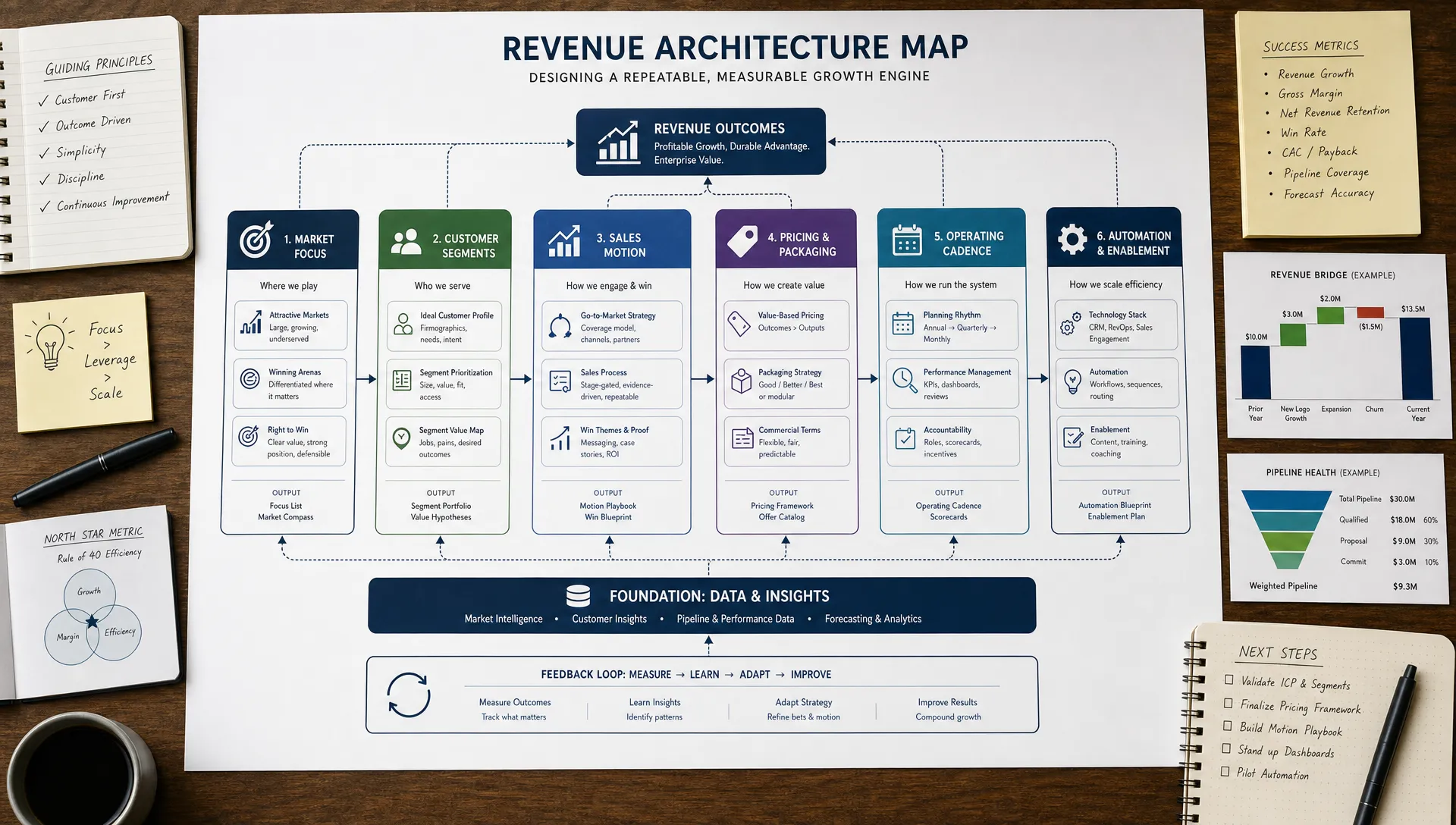
Revenue design is the intentional architecture behind how a company creates, captures, and expands revenue. It connects market selection, customer segmentation, sales process, pricing, operating rhythm, data, incentives, and leadership accountability into one commercial system.
It is not the same as a sales playbook. A sales playbook usually tells a seller what to do. Revenue design determines whether the entire commercial engine is built to produce the right revenue at the right pace with the right level of predictability.
In a private equity or venture-backed environment, that difference is critical. Investors are not simply looking for growth. They are looking for credible, efficient, repeatable growth that supports the investment thesis and improves valuation.
A well-designed revenue system answers questions such as:
- Which customer segments should the business prioritize, and which should it stop chasing?
- Where are conversion rates breaking down across the funnel?
- Which sales motions fit each buyer type, deal size, and market?
- How should pricing and packaging support margin expansion?
- What leading indicators should management review weekly?
- Which parts of the revenue process can be automated without damaging buyer trust?
When these questions are left unresolved, acceleration becomes expensive. When they are designed properly, acceleration becomes an operating discipline.
Why many portfolio companies cannot scale revenue cleanly
Most portfolio companies were not originally built for sponsor-grade growth. They were built to survive, win customers, and reach a milestone. That early-stage commercial model often contains strengths worth preserving, but it also contains hidden constraints.
Founder-led relationships may have carried the business for years. Senior sellers may rely on personal networks rather than a documented process. Marketing may be underdeveloped because referrals historically filled the gap. The CRM may exist, but the data inside it may be inconsistent. Finance may report bookings and revenue, but not the commercial indicators that explain what will happen next quarter.
These weaknesses do not always appear during diligence. They become visible after acquisition, when the growth plan requires more volume, more consistency, and more accountability than the existing revenue system can handle.
That is why pushing growth too soon can backfire. If a company adds sellers before defining the ideal customer profile, it can multiply inefficiency. If it increases demand generation before fixing conversion, it can waste marketing spend. If it expands into new markets before proving the core motion, it can distract leadership from the highest-value opportunities.
This is closely related to the pre-scaling foundations discussed in what every portfolio company needs before scaling, where readiness matters more than ambition. Scaling before the commercial system is ready often creates more noise than enterprise value.
Portfolio acceleration is a design challenge, not a motivation challenge
Boards often diagnose missed revenue targets as a people problem. Sometimes they are right. Talent matters, and weak commercial leadership can slow down an otherwise promising asset.
But many revenue misses are design failures disguised as performance failures.
A sales leader cannot forecast accurately if stages are poorly defined. A marketing team cannot generate quality pipeline if the company has not chosen its best-fit market segments. A CEO cannot manage growth effectively if the board pack reports lagging indicators but ignores deal velocity, stage conversion, win-loss patterns, and sales capacity.
Better revenue design creates the conditions in which good people can perform. It removes ambiguity, clarifies priorities, and gives leadership a practical way to identify the highest-leverage fixes.
| Revenue problem | Common surface-level response | Better revenue design response |
|---|---|---|
| Pipeline is too light | Hire more SDRs or increase ad spend | Reassess ICP, demand channels, messaging, and conversion economics |
| Forecasts are unreliable | Pressure sales leaders for better numbers | Redefine stages, qualification rules, exit criteria, and inspection cadence |
| Win rates are declining | Push reps to improve close rates | Analyze segment fit, competitive position, pricing, proof points, and sales enablement |
| Growth is margin dilutive | Chase more revenue to cover the gap | Redesign pricing, packaging, discount governance, and customer mix |
| Sales cycles are too long | Ask reps to follow up more often | Map buyer friction, stakeholder complexity, procurement risk, and decision triggers |
This shift from pressure to design is where portfolio acceleration becomes more predictable.
The five layers of better revenue design
A strong revenue design usually has five connected layers. If one layer is weak, the others struggle to compensate.
1. Market focus
Acceleration starts with choosing where not to compete. Many portfolio companies define their market too broadly because they do not want to exclude potential revenue. The result is scattered messaging, inconsistent win rates, and a sales team that spends too much time on poor-fit opportunities.
Market focus means identifying the segments where the company has the strongest right to win. That includes buyer pain, willingness to pay, competitive differentiation, implementation fit, sales cycle length, and expansion potential.
This is not a theoretical exercise. It should directly shape territory planning, campaign strategy, account targeting, product roadmap priorities, and board reporting.
2. Revenue motion
Different customer segments require different sales motions. A high-velocity SMB motion, a mid-market consultative sale, an enterprise land-and-expand model, and a channel-led strategy all require different roles, metrics, enablement, and technology.
Portfolio companies often struggle when they blend motions without designing the operating model behind them. Sellers chase small deals and enterprise opportunities at the same time. Customer success owns expansion informally. Marketing supports every segment equally. Leadership measures all pipeline as if it has the same quality.
The right revenue motion clarifies how each target segment should be acquired, converted, onboarded, retained, and expanded.
3. Commercial process
A commercial process is not a CRM checklist. It is the management system that turns buyer movement into measurable progress.
The process should define qualification standards, stage exit criteria, buyer evidence, proposal rules, pricing approvals, handoffs, and post-sale expansion triggers. It should also define what managers inspect, how often they inspect it, and what decisions follow.
Without this discipline, pipeline reviews become storytelling sessions. With it, they become decision-making forums.
4. Data and operating cadence
Revenue design depends on a small number of trusted metrics. Too many dashboards can create confusion. Too few can hide risk.
The most useful metrics vary by business model, but portfolio companies usually need visibility into leading indicators, conversion quality, capacity, retention, margin, and forecast risk. The key is to connect these metrics to management behavior.
If stage conversion is falling, what happens next? If discounting rises, who reviews it? If expansion revenue is below plan, which customer segment or onboarding issue is responsible? Data only accelerates growth when it changes decisions.
5. Automation and enablement
AI and automation can create significant leverage, but only when they are added to a clear revenue design. Automating a broken process usually makes the problem faster, not better.
The most valuable use cases tend to reduce administrative drag, improve targeting, accelerate research, strengthen follow-up, identify churn or expansion signals, and support better management visibility. The goal is not to replace commercial judgment. It is to give leadership and customer-facing teams more time, better signals, and cleaner execution.
Revenue design creates better board conversations
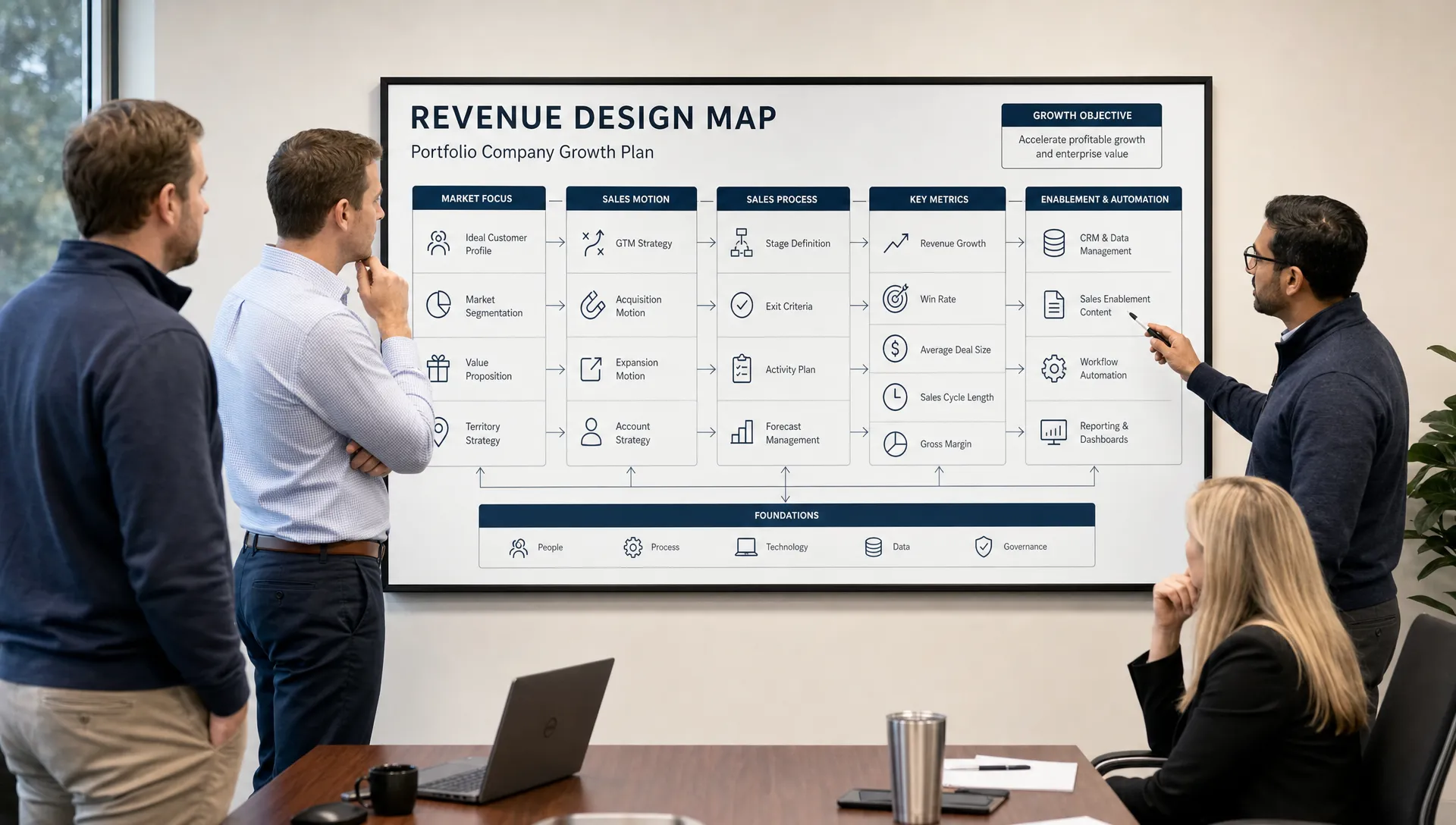
One of the most practical benefits of better revenue design is that it improves the quality of board conversations.
When the revenue system is weak, board meetings often drift between optimism and interrogation. Management explains what happened. Sponsors ask why it happened. Everyone debates whether the forecast is realistic. The same issues reappear next quarter with slightly different language.
When the revenue system is designed properly, the conversation becomes more diagnostic. Leaders can separate market problems from execution problems. They can see whether pipeline quality, conversion, deal size, sales cycle, retention, or pricing is driving the gap. They can decide where intervention will have the most impact.
This is especially important for operating partners who need to support multiple assets without becoming trapped in anecdotal updates. A consistent revenue design framework makes it easier to compare portfolio companies, prioritize support, and identify where specialist help is required.
For example, a sponsor may discover that two companies are both missing new logo targets, but for entirely different reasons. One has strong demand but poor qualification and discount discipline. The other has a clear sales process but weak market positioning and low awareness in the right segment. The intervention should not be the same.
Where revenue leaks usually hide
Portfolio acceleration depends on finding the leaks that slow growth or reduce revenue quality. Some leaks are obvious, such as low pipeline coverage or high churn. Others are harder to see because they are embedded in everyday commercial behavior.
Common hidden leaks include inconsistent qualification, slow speed to lead, unclear sales handoffs, uncontrolled discounting, weak proposal follow-up, poor onboarding, underdeveloped account expansion, and CRM data that cannot be trusted.
The cost of these leaks compounds over a hold period. A two-point difference in conversion, a modest improvement in retention, or tighter pricing governance can materially change the revenue profile of a company. More importantly, these improvements can make growth more credible to future buyers.
If the immediate challenge is leakage rather than long-term architecture, the approach in sales optimisation that fixes revenue leaks fast is a useful companion to a broader design effort.
Better buyer experience is part of revenue design
Revenue design is not only an internal operating model. It is also the buyer’s experience of how easy, credible, and low-risk it feels to purchase from the company.
Many portfolio companies unintentionally make buying difficult. They ask prospects to repeat information. They send generic proposals. They fail to explain implementation clearly. They introduce pricing late. They rely on sales persistence rather than buyer confidence.
Companies in complex, trust-based categories offer a useful reminder that growth often improves when technology and human guidance work together. In residential lending, for instance, smart mortgage solutions made simple can reduce friction by combining digital tools with personalized support, which is the same design principle many B2B revenue teams should apply to their own buying journeys.
The lesson is not that every business should copy a lending process. The lesson is that buyers value clarity. If the commercial journey feels confusing, slow, or risky, conversion suffers even when the product is strong.
A well-designed revenue journey makes the next step obvious. It gives buyers the evidence they need at the right time. It aligns sales, marketing, customer success, and delivery around the customer’s decision process rather than the company’s internal preferences.
How sponsors can assess revenue design quickly
A full commercial diagnostic can go deep, but sponsors can often identify design issues quickly by asking a few practical questions.
Start with the investment thesis. What must be true commercially for the thesis to work? Then compare that requirement with the company’s current revenue system. The gap between the two is where value creation risk usually sits.
Useful questions include:
- Can leadership clearly define the highest-value customer segment and explain why it wins there?
- Are sales stages based on buyer evidence or seller opinion?
- Does the company know conversion rates by source, segment, and deal type?
- Is pricing governance protecting margin and value perception?
- Are expansion and retention motions designed, or are they left to account managers?
- Does the board review leading indicators early enough to intervene?
- Are automation and AI being applied to priority bottlenecks, or simply added as tools?
The purpose is not to create a perfect academic model. The purpose is to identify the few commercial design changes that can unlock the next stage of growth.
Revenue design and exit readiness
Exit readiness is often treated as a finance, legal, or process workstream. Those workstreams matter, but commercial credibility is just as important.
A buyer wants to believe that growth will continue after the transaction. That belief is stronger when the company can show a designed revenue engine rather than a collection of individual heroics.
Strong revenue design supports exit readiness in several ways. It reduces dependency on founders or a few senior sellers. It creates clearer visibility into future performance. It improves the quality of revenue by focusing on better-fit customers and healthier margins. It gives buyers confidence that growth can be scaled under new ownership.
This connects directly to the case for better revenue architecture in PE-backed companies, especially when the goal is to make revenue more repeatable and easier to diligence.
In practical terms, the best time to design the revenue system is not six months before exit. It is early in the hold period, when there is still time to install, test, refine, and prove the model.
The operating rhythm that makes acceleration stick
Even strong revenue design fails without rhythm. Portfolio acceleration requires a cadence that turns strategy into behavior.
That rhythm should include regular pipeline inspection, win-loss analysis, pricing review, customer retention review, capacity planning, and initiative tracking. It should also include clear ownership. If every revenue issue belongs to everyone, no issue is truly owned.
A useful operating rhythm has three qualities.
First, it is simple enough to sustain. Leaders should not need a 40-slide deck to understand whether the revenue engine is improving.
Second, it is tied to decisions. Meetings should result in resource shifts, coaching priorities, campaign changes, pricing actions, or escalation of risks.
Third, it is consistent across time. Acceleration is not created by one intense workshop. It is created by repeated management behavior that compounds.
What better revenue design looks like in practice
A redesigned revenue system does not always look dramatic from the outside. Internally, however, the changes are significant.
The company knows which segments matter most. Marketing campaigns speak to specific pains rather than broad category claims. Sellers qualify with more discipline. Managers inspect buyer evidence rather than deal sentiment. Pricing exceptions are visible. Customer success has a defined expansion role. Leadership can explain what is improving, what is stuck, and what action is being taken.
The board also gets a clearer view of value creation. Instead of debating whether the team is “doing enough,” sponsors can see which parts of the revenue engine are working and which need intervention.
That is the real purpose of portfolio acceleration. Not more activity for its own sake, but better commercial design that converts effort into enterprise value.
Frequently Asked Questions
What is portfolio acceleration? Portfolio acceleration is the process of improving growth, efficiency, and enterprise value across portfolio companies. In a commercial context, it means building the revenue systems, leadership cadence, and market focus required to grow faster without creating unnecessary risk.
Why does revenue design matter for PE-backed companies? Revenue design matters because PE-backed companies need growth that is repeatable, measurable, and credible to future buyers. Without a designed revenue system, growth often depends too heavily on individual sellers, founder relationships, or inconsistent execution.
Is revenue design the same as sales optimization? No. Sales optimization usually improves specific parts of the sales process, such as conversion, pipeline management, or rep productivity. Revenue design is broader. It connects market focus, sales motion, pricing, customer expansion, data, and operating cadence into one system.
When should sponsors review revenue design? Sponsors should review revenue design early in the hold period, ideally during the first phase of value creation planning. Waiting until growth stalls or exit preparation begins leaves less time to install and prove a stronger commercial model.
Can AI help with portfolio acceleration? Yes, but AI works best when applied to a clear commercial system. It can support research, targeting, follow-up, reporting, automation, and management visibility. However, AI will not fix unclear strategy, weak qualification, poor segmentation, or inconsistent leadership cadence on its own.
Build acceleration into the revenue system
Portfolio acceleration should not depend on pressure alone. Pressure may create urgency, but design creates repeatability.
For PE firms, VCs, family offices, and portfolio leadership teams, the priority is to understand where the current revenue system is constraining the investment thesis. Once that is clear, growth initiatives become sharper, board conversations become more useful, and commercial execution becomes easier to manage.
Phil Pelucha Consulting helps investors and portfolio companies improve revenue performance through commercial diagnostics, revenue acceleration support, fractional CRO leadership, sponsor advisory, and AI-enabled commercial systems.
If your portfolio company has a strong thesis but an underdesigned revenue engine, the next step is not simply to push harder. It is to design revenue better.