
Portfolio Company Value Creation Through Revenue Systems
Portfolio company value creation is no longer won by asking sales teams to “do more.” In most PE-backed businesses, the next level of EBITDA expansion, valuation improvement, and exit confidence comes from building a revenue system that makes growth more measurable, repeatable, and transferable.
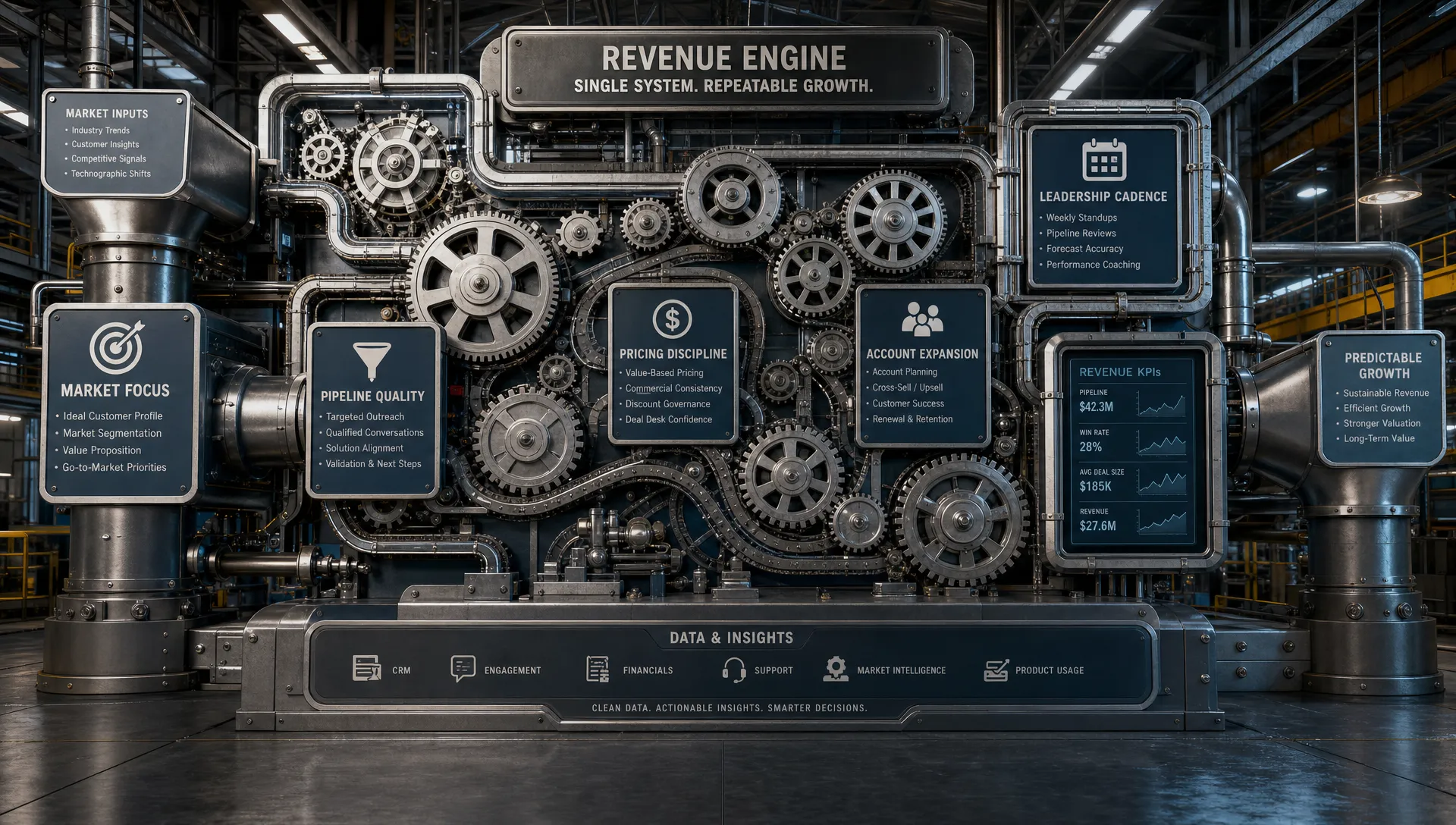
A revenue system is the operating infrastructure behind commercial performance. It connects market focus, sales execution, pricing discipline, account expansion, leadership cadence, data, and accountability. When that system is weak, growth depends on heroic individuals. When it is strong, growth becomes an asset the sponsor can underwrite, manage, and eventually sell.
For private equity firms, this distinction matters. Buyers do not simply pay for last year’s revenue. They pay for the likelihood that future revenue will continue after ownership changes. That is why portfolio company value creation should move beyond isolated sales initiatives and toward revenue systems that survive leadership turnover, market volatility, and the pressure of an exit timeline.
Why Revenue Systems Matter in Portfolio Company Value Creation
Traditional value creation plans often include commercial goals such as enter a new market, increase sales productivity, improve pricing, expand accounts, or professionalize the revenue team. These are useful goals, but they often fail because they are treated as projects rather than system changes.
A pricing initiative without sales enablement creates discounting tension. A CRM cleanup without inspection discipline becomes administrative theater. A new VP of Sales without a clear market thesis inherits ambiguity. A lead generation program without qualification standards produces pipeline noise.
Revenue systems solve this by making the commercial model coherent. Instead of asking, “How do we grow faster?” the operating question becomes, “What commercial system must exist for this company to grow predictably?”
That shift changes the sponsor’s role. The PE firm is not merely monitoring numbers. It is helping the portfolio company install a value creation engine.
A strong revenue system clarifies:
- Who the company should sell to and why those customers buy
- Which channels, motions, and geographies deserve investment
- How pipeline quality is defined and inspected
- Where pricing authority sits and how leakage is controlled
- How customer expansion is triggered, measured, and managed
- Which metrics indicate real momentum versus temporary activity
This is why revenue systems sit at the center of modern commercial value creation. They turn growth from aspiration into operating architecture.
The Difference Between Revenue Activities and a Revenue System
Many portfolio companies have plenty of revenue activity. They run campaigns, hire sellers, attend conferences, implement tools, create pitch decks, and set ambitious targets. Activity can create motion, but it does not always create enterprise value.
A revenue system is different because it has logic, sequence, and governance. It defines how the company creates demand, converts demand, retains demand, and expands demand in a way that leadership can manage.
| Revenue activity | Revenue system |
|---|---|
| Hiring more salespeople | Defining capacity needs based on market focus, quota math, ramp time, and coverage model |
| Running campaigns | Linking campaigns to ideal customer profiles, conversion standards, and pipeline quality metrics |
| Updating the CRM | Using CRM data to drive inspection, coaching, forecasting, and management decisions |
| Launching a pricing project | Embedding pricing discipline into deal review, packaging, incentives, and renewal motions |
| Holding sales meetings | Creating a weekly operating cadence that identifies risks, decisions, and required interventions |
The problem with activity-led growth is that it often looks busy before it looks broken. Pipeline grows, but conversion does not. Headcount rises, but productivity lags. Revenue increases, but margin erodes. Forecasts improve in presentation quality, but not in accuracy.
A system-led approach makes those issues visible earlier. It helps sponsors and management teams distinguish between a business that needs more resources and a business that needs better commercial design.
The Core Components of a Portfolio Revenue System
Every portfolio company is different, but most effective revenue systems share the same core components. These components create the commercial backbone required for scalable value creation.
Market and customer focus
Value creation starts with focus. A company cannot build a repeatable revenue system if it is chasing too many customer types, too many geographies, or too many use cases at once.
The first task is to define where the business has the strongest right to win. That may include segment attractiveness, customer pain intensity, competitive advantage, sales cycle length, willingness to pay, and expansion potential.
For PE-backed companies, this focus is especially important because the hold period is finite. The company does not need every possible growth option. It needs the best sequence of growth options.
Go-to-market motion design
Once the target market is clear, the company needs a deliberate go-to-market motion. Founder-led selling, enterprise field sales, channel-led expansion, inside sales, product-led growth, and account-based selling all require different systems.
Problems emerge when a portfolio company mixes motions without acknowledging the operational consequences. Enterprise sellers are asked to handle transactional volume. Channel partners are expected to create strategic demand without enablement. Marketing generates leads that sales does not trust. Customer success is asked to expand accounts without commercial authority.
A revenue system defines the motion, roles, handoffs, and metrics before scaling spend. If the company is not yet ready to scale, the sponsor should first address the foundations outlined in what every portfolio company needs before scaling.
Pipeline quality and inspection
Pipeline is often the most misunderstood commercial asset in a portfolio company. A large pipeline can hide weak qualification, stalled opportunities, discount dependency, or late-stage deal fragility.
A strong revenue system defines pipeline stages based on buyer evidence, not seller optimism. It also creates inspection routines that identify whether opportunities are real, progressing, and aligned with the company’s value proposition.
Good pipeline governance answers practical questions:
- What evidence is required for an opportunity to move stages?
- Which deals require executive involvement?
- Where do opportunities most often stall or disappear?
- Which sources produce high-conversion pipeline rather than activity volume?
- How does pipeline coverage differ by segment, product, region, or rep?
When pipeline quality improves, forecasting becomes less political and more operational. That helps management make better decisions on hiring, cash planning, marketing spend, and exit timing.
Pricing and margin discipline
Revenue growth that damages margin is not value creation. In many portfolio companies, pricing leakage is hidden in discounting habits, inconsistent packaging, weak renewal discipline, unmanaged custom work, or poor sales compensation design.
Pricing should not be treated as a one-time spreadsheet exercise. It needs to be embedded into the revenue system. That includes deal desk rules, approval thresholds, renewal playbooks, value messaging, packaging, and compensation alignment.
When pricing discipline is operationalized, the company can grow with more confidence. Sales teams understand where flexibility exists. Finance sees margin impact earlier. Customers receive clearer value communication. Sponsors gain a cleaner view of revenue quality.

Account expansion and customer success
For many portfolio companies, the fastest and most efficient growth opportunity is inside the existing customer base. Yet account expansion is often under-managed because the company separates customer success, sales, delivery, and product feedback into disconnected functions.
A revenue system treats existing customers as a strategic growth channel. It defines expansion triggers, account health signals, renewal risk indicators, cross-sell plays, executive sponsor routines, and customer outcome metrics.
This matters for valuation because retained and expanded revenue is usually more attractive than revenue that must be replaced every year. A business that can prove durable customer relationships, expansion potential, and low revenue leakage tells a stronger exit story.
Leadership cadence and commercial governance
Even the best strategy fails without management rhythm. A revenue system needs cadence: weekly, monthly, and quarterly routines that create accountability and decision velocity.
The cadence should not be limited to sales updates. It should connect commercial performance to the value creation plan. Sponsors, operating partners, CEOs, CFOs, CROs, marketing leaders, and customer leaders need a shared view of the same commercial truth.
In practice, this means meetings should produce decisions, not just reporting. Where is the company behind plan? Which constraint matters most? What must change this week? What evidence suggests the thesis is working or not working?
The operating partner’s role is often to help translate the investment thesis into this kind of rhythm, which is why a practical operating partner playbook for revenue growth is so valuable across a portfolio.
How Revenue Systems Improve Exit Readiness
Exit readiness is not something to address in the final two quarters before sale. It is built throughout the hold period through cleaner data, clearer narratives, stronger management discipline, and evidence of repeatable growth.
Revenue systems improve exit readiness in four important ways.
First, they make performance easier to explain. Buyers can see where growth comes from, which segments are most profitable, how pipeline converts, and how customer expansion behaves.
Second, they reduce key-person risk. If revenue depends on one founder, one rainmaker, or one relationship-heavy executive, buyers will discount future certainty. A system distributes knowledge, process, and accountability across the organization.
Third, they improve management credibility. When executives can explain commercial performance with evidence, not anecdotes, buyer confidence increases.
Fourth, they create a stronger growth narrative. The company is not just reporting momentum. It is showing a machine that a buyer can continue to operate and scale.
This is the connection between commercial infrastructure and valuation. If the revenue architecture is visible, transferable, and tied to future growth, it can directly strengthen the exit case. That logic is explored further in how exit valuation improves with revenue architecture.
A Practical Revenue System Diagnostic for Portfolio Companies
Before installing new initiatives, sponsors should diagnose the current revenue system. The goal is not to produce a long consultant report. The goal is to identify the few constraints that most affect value creation.
A useful diagnostic looks across strategy, execution, data, people, and governance.
| Diagnostic area | What to assess | Common value creation risk |
|---|---|---|
| Market focus | ICP clarity, segment profitability, win rates, buyer pain, competitive position | Growth spread too thin across low-fit opportunities |
| GTM motion | Sales model, channel strategy, marketing alignment, role clarity | Spend increases faster than conversion or productivity |
| Pipeline | Stage definitions, source quality, cycle length, forecast accuracy | Leadership mistakes activity for real demand |
| Pricing | Discounting, packaging, approval rules, renewal pricing, margin impact | Revenue growth hides margin leakage |
| Customer base | Retention, expansion, account health, renewal risk, cross-sell triggers | Existing customers are under-monetized or quietly churning |
| Cadence | Meeting rhythm, decision rights, KPI visibility, sponsor alignment | Issues are identified too late for timely intervention |
The highest priority gaps are usually those that connect directly to the investment thesis. If the thesis depends on enterprise expansion, pipeline quality and sales capability may matter most. If it depends on margin expansion, pricing governance may be the priority. If it depends on market expansion, segmentation and GTM motion design may come first.
The key is sequence. Portfolio companies rarely fail because they lack ideas. They fail because too many ideas compete for attention at once.
The Human Side of Revenue System Change
Revenue systems are not only technical. They also require behavioral change. Sales teams may resist new qualification standards. Executives may prefer optimistic forecasts. Customer success may be uncomfortable with commercial accountability. Founders may struggle to move from relationship-led selling to institutional process.
This is why communication matters. Leaders must explain that the system is not bureaucracy for its own sake. It is a way to protect growth, improve decision quality, and increase enterprise value.
Commercial transformation also benefits from moments that create shared belief. Portfolio days, leadership offsites, and annual kickoffs can help teams internalize the behaviors required for change. Some firms even use external facilitators or business event speakers such as Dave van Gulik to reinforce personal leadership, attention, and commitment during high-stakes transformation moments.
The best revenue systems are adopted because people understand how they help. The process gives sellers better focus. The data gives leaders better decisions. The cadence gives teams faster support. The governance gives sponsors more confidence.
How Sponsors Can Install Revenue Systems Without Overburdening Management
A common mistake is to turn revenue system design into a heavy transformation program. Portfolio company leaders are already managing customers, employees, cash, and board expectations. If the system feels like extra work, adoption will suffer.
Sponsors can improve adoption by following a few principles.
Start with the value creation thesis. Do not optimize every commercial process at once. Identify which revenue system improvements most directly support the underwriting case.
Simplify the metrics. A portfolio company does not need dozens of KPIs. It needs a small number of leading and lagging indicators that reveal commercial truth.
Make cadence practical. Weekly meetings should focus on exceptions, decisions, and constraints. Monthly reviews should connect execution to plan. Quarterly reviews should test whether the thesis remains valid.
Align incentives. If compensation rewards the wrong behavior, process changes will fail. Sales, customer success, and leadership incentives should support the revenue system the company is trying to build.
Use technology carefully. AI, CRM automation, and analytics can accelerate the system, but they cannot replace commercial clarity. Automating a broken process simply makes the problem move faster.
Where AI Fits in Portfolio Company Revenue Systems
AI is becoming a practical lever in portfolio company value creation, especially when applied to repeatable commercial processes. It can support account research, pipeline analysis, call review, forecasting patterns, sales enablement, customer segmentation, and workflow automation.
However, AI only creates leverage when the revenue system has enough structure. If the ideal customer profile is unclear, AI will help teams pursue more of the wrong prospects. If pipeline stages are poorly defined, AI forecasting will inherit flawed inputs. If pricing rules are inconsistent, automated proposal tools may scale inconsistency.
The right sequence is commercial design first, automation second. Once the revenue system is clear, AI can help portfolio companies operate it with greater speed, consistency, and visibility.
For sponsors, the larger opportunity is portfolio-wide learning. If multiple companies use consistent diagnostic frameworks, KPI definitions, and commercial operating rhythms, the firm can compare patterns across assets. That creates better interventions, faster onboarding for management teams, and stronger sponsor-level insight.
What Good Looks Like After 90 Days
Revenue system improvement does not require years before progress becomes visible. Within the first 90 days, a portfolio company should be able to show clearer commercial focus and a better operating rhythm.
Good early signs include:
- A sharper definition of priority customer segments and disqualified segments
- Pipeline stages based on buyer evidence rather than seller opinion
- A weekly revenue meeting that produces decisions and follow-up actions
- Better visibility into win rates, sales cycle length, discounting, and expansion opportunities
- A short list of commercial constraints tied directly to the value creation plan
- More accurate conversations between management and sponsors about revenue risk
These early improvements matter because they change the quality of management dialogue. Instead of debating whether the company is “busy enough,” the team can evaluate whether the system is producing the right commercial evidence.
Over time, that evidence compounds. Forecasts become more reliable. Hiring plans become more rational. Marketing becomes more accountable. Pricing becomes more disciplined. Customer expansion becomes more intentional. The exit story becomes easier to defend.
Frequently Asked Questions
What is a revenue system in a portfolio company? A revenue system is the commercial infrastructure that connects market focus, go-to-market execution, pipeline management, pricing, customer expansion, data, and leadership cadence. It helps growth become repeatable rather than dependent on individual heroics.
How does a revenue system create value for private equity firms? It improves revenue predictability, margin discipline, management visibility, and exit readiness. These factors can strengthen the investment thesis and give buyers more confidence in future performance.
When should a PE sponsor assess a portfolio company’s revenue system? The best time is immediately after acquisition or during the first value creation planning cycle. A second diagnostic is useful before major scaling decisions, market expansion, leadership changes, or exit preparation.
Is revenue system design only for underperforming portfolio companies? No. High-growth companies often need better systems because scale exposes weaknesses in pipeline quality, sales productivity, pricing governance, and account management. Strong performance can hide structural fragility.
Where does AI fit into portfolio company value creation? AI can accelerate research, automation, pipeline analysis, enablement, and reporting. It works best when the underlying revenue system is already clear, because AI amplifies the quality of the process it supports.
Build the System Before You Scale the Spend
Portfolio company value creation depends on more than ambition, talent, or a bigger sales budget. It depends on whether the business has a revenue system that can convert strategy into consistent commercial performance.
For PE firms, operating partners, and management teams, the mandate is clear: diagnose the commercial system, remove the constraints that matter most, and install the cadence, data, and accountability required for repeatable growth.
Phil Pelucha Consulting helps PE firms, VC investors, family offices, and portfolio companies accelerate revenue through commercial diagnostics, revenue architecture, fractional CRO support, GTM optimization, market expansion, and AI-powered systems. If your portfolio company needs stronger revenue infrastructure before the next phase of growth or exit preparation, start with the system that will make value creation measurable.