
Private Equity Investment and the Revenue Risk Few Spot
Private equity investment is often assessed through the obvious risk filters: leverage capacity, customer concentration, margin profile, working capital, management depth, and the credibility of the investment thesis. Those matter. But many deals carry a quieter risk that only becomes visible after close: the company cannot reliably convert market demand into predictable revenue under a sponsor timeline.
That is the revenue risk few spot early enough.
It is not always visible in the P&L. A company can show attractive growth, healthy EBITDA, and a compelling market narrative while still relying on fragile commercial mechanics. The founder may be carrying the largest relationships. The sales team may be busy but inconsistent. The pipeline may look large but lack buyer urgency. The CRM may show activity, not probability. Pricing may be more emotional than governed.
For a private equity investment, that distinction matters because value creation depends on repeatability. If revenue growth cannot be explained, managed, and scaled, the deal is not just exposed to market risk. It is exposed to execution risk inside the asset.
The hidden risk is not revenue, it is revenue reliability
Most investors do not miss revenue entirely. They review historical growth, net revenue retention, sales bookings, pipeline, churn, customer cohorts, and market size. The problem is that these indicators can create confidence without proving that the revenue engine is controllable.
Revenue reliability asks a different question: if the sponsor changes the growth requirement, hires more sellers, enters a new market, raises prices, or pushes toward exit readiness, will the commercial system respond in a predictable way?
That question is harder to answer because it sits between strategy and execution. It requires understanding how the company chooses its customers, creates demand, qualifies opportunities, converts buyers, expands accounts, defends pricing, and captures learnings from losses.
A business may have revenue momentum for reasons that do not scale. Examples include a favorable market cycle, a charismatic founder, a handful of legacy relationships, reseller enthusiasm, underpriced offerings, or one large customer rollout. These can all produce growth, but they do not necessarily prove that the company owns a repeatable growth system.
This is why a private equity investment can look safe on historical performance while being vulnerable on future revenue conversion.
Why this revenue risk slips through diligence
Commercial diligence often operates under compressed timelines. Teams are trying to validate the market, assess competitors, test customer satisfaction, confirm management claims, and support the investment committee narrative. In that environment, revenue risk can be summarized too quickly.
The data room usually contains reports that show what happened. It rarely contains enough evidence to explain why it happened, whether it can happen again, and which parts of the growth motion are dependent on individuals rather than process.
A few common diligence signals can look reassuring while hiding deeper commercial weakness.
| Diligence signal | What it may appear to prove | Hidden revenue risk |
|---|---|---|
| Strong trailing revenue growth | The market wants the product | Growth may be driven by non-repeatable relationships or a temporary demand spike |
| Large stated pipeline | Future bookings are visible | Pipeline may include stale, unqualified, or low-intent opportunities |
| High sales activity | The team is productive | Activity may not correlate with qualified meetings, proposals, or closed revenue |
| Strong customer references | Customers are satisfied | References may not represent the broader base, churn risk, or expansion potential |
| Experienced sales leader | Commercial leadership is covered | Leadership may be tactical rather than operating-system oriented |
| Planned sales hiring | Growth can be accelerated | New hires may fail if ICP, messaging, process, and enablement are weak |
This is one reason PE firms can still struggle even when the original thesis is sound. The issue is not always that the market was misread. It is often that the company lacked the commercial infrastructure required to execute the thesis. That distinction is explored further in this analysis of why PE firms miss growth targets after acquisition.
Revenue quantity and revenue quality are not the same
Revenue quantity measures how much the business sold. Revenue quality measures how dependable, profitable, defensible, and repeatable that revenue is.
A private equity investment needs both. Quantity supports the entry case. Quality supports the exit case.
High-quality revenue tends to have identifiable patterns. The company knows which customer segments convert best, why buyers choose the solution, which use cases expand, how long sales cycles take by segment, where margin leakage occurs, and which leading indicators predict bookings. Management can explain not just the revenue number, but the system that produced it.
Low-quality revenue is harder to manage. It may depend on heroics, discounts, channel luck, inconsistent qualification, or reactive selling. It can still look attractive for a period, especially if the market is buoyant. But when the sponsor asks the company to accelerate, expand, or professionalize, weaknesses surface quickly.
For investors, the question is not whether the company has sold before. The question is whether it can sell again, at higher volume, with better visibility, without damaging margin or customer quality.
Where hidden revenue risk appears after close
Post-close, revenue risk usually emerges in practical ways. The board asks for growth, management adds resources, and the commercial engine begins to show which parts were real and which parts were assumed.
One of the first symptoms is pipeline slippage. The funnel looked healthy in diligence, but opportunities move slowly, close dates drift, and forecast categories become unreliable. This is often a qualification problem, not a demand problem.
Another symptom is sales hiring underperformance. The company adds headcount, but ramp times stretch because the best sellers were relying on instinct, personal credibility, or founder support. New hires cannot replicate what was never codified.
Pricing is another common stress point. Sponsors often see pricing as an attractive value lever, but price increases require segmentation, competitive evidence, customer value proof, and frontline confidence. Without those, pricing actions can create churn, discounting behavior, or sales hesitation.
Market expansion can also expose the gap. A company may succeed in one region, vertical, or channel because the offer fits a specific buyer context. Moving into a new market without proving repeatability can turn a growth initiative into an expensive experiment.

The commercial system behind the number
The most important revenue question in private equity investment is often this: what system is producing the number?
A commercial system is more than a sales team. It includes the choices, processes, data, and management cadence that turn market opportunity into booked revenue. When this system is weak, growth becomes personality-led. When it is strong, growth becomes measurable and improvable.
A sponsor does not need every portfolio company to have enterprise-level sophistication on day one. But it does need visibility into the commercial mechanics that matter most for the thesis.
The core components usually include:
- Clear ICP definition based on conversion, margin, retention, and expansion potential
- Differentiated messaging tied to buyer pain, not internal product language
- A qualification process that removes low-probability opportunities early
- Sales stages that reflect buyer progress, not seller activity
- Pricing governance that protects margin while supporting deal velocity
- Customer success routines that identify churn risk and expansion potential
- Management reporting that connects leading indicators to revenue outcomes
If those foundations are missing, adding budget may only amplify confusion. That is why many sponsors benefit from resolving the basics before asking the asset to scale. The principle is covered in more depth in what PE funds should fix before pushing growth.
A better diligence lens for revenue risk
Revenue risk should be evaluated before investment committee, not discovered in the first two board meetings after close. The diligence process does not need to become overly complex, but it should test the operating truth behind the growth story.
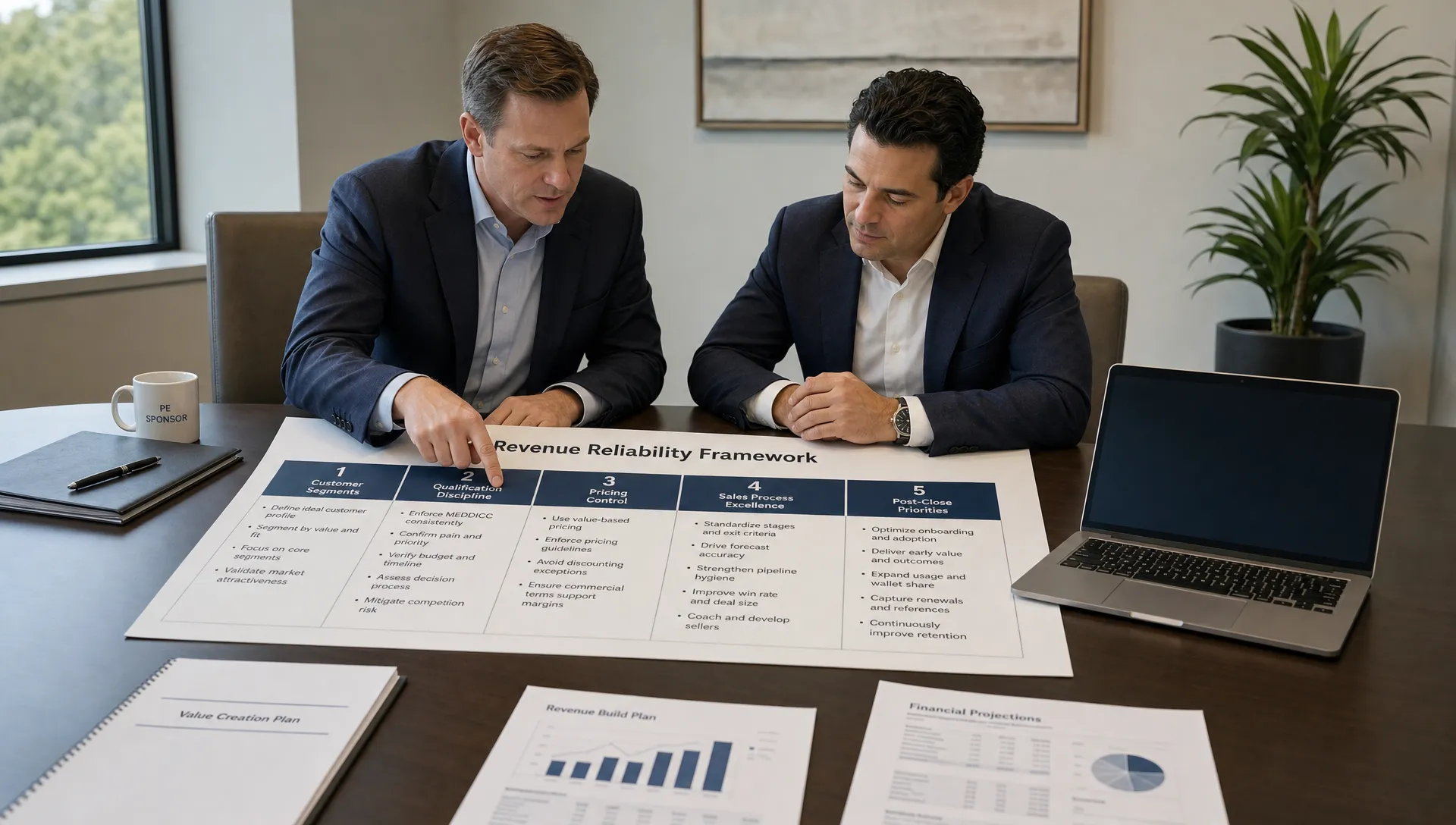
A useful approach is to examine the business through a small set of revenue reliability questions.
| Revenue reliability question | What investors are testing |
|---|---|
| Which customer segments produce the best combination of win rate, margin, retention, and expansion? | Whether the company knows where growth quality comes from |
| What percentage of pipeline is truly qualified against buyer need, authority, timing, and economic case? | Whether forecast confidence is based on evidence or optimism |
| How dependent are large deals on the founder, CEO, or one senior seller? | Whether revenue can scale beyond individual relationships |
| What are the top three reasons the company wins and loses? | Whether messaging and product-market fit are understood by the field |
| How is pricing controlled, reviewed, and defended? | Whether growth will preserve margin |
| Can a new seller ramp using documented process and enablement? | Whether headcount investment can produce predictable returns |
| What customer behaviors predict churn or expansion? | Whether post-sale revenue is actively managed |
This lens also applies to revenue streams that sit outside the traditional sales funnel. In rights-heavy or IP-driven businesses, for example, revenue risk may include unmonitored usage, weak enforcement, or underdeveloped licensing opportunities. In those cases, an AI-powered IP monitoring and licensing platform can be part of the revenue assurance conversation, especially when the investment thesis depends on protecting and monetizing owned assets.
The point is not to turn every diligence process into a months-long operating review. The point is to separate attractive historical revenue from revenue that can support the hold-period plan.
The sponsor clock changes the revenue equation
Under founder ownership, a company may tolerate informal commercial habits for years. Private equity changes the clock. The business now needs faster learning loops, clearer accountability, more reliable forecasting, and evidence that value creation is progressing.
This pressure can be productive. It can force better segmentation, stronger sales management, improved customer success, and more disciplined reporting. But pressure alone does not build capability. If the company lacks the operating system, urgency can turn into noise.
That is why private equity investment should not treat revenue acceleration as a simple matter of hiring more salespeople or increasing marketing spend. Those levers work only when the underlying system is ready to absorb them.
The sponsor should be able to answer three practical questions early in the hold period: where is revenue leaking, what must be standardized, and which growth bets deserve capital first?
Post-close actions that reduce revenue risk
Once the deal closes, the first 100 days should establish commercial truth. This does not mean disrupting the business with a heavy transformation program. It means creating visibility fast enough to protect the thesis.
| Timeframe | Commercial priority | Outcome sought |
|---|---|---|
| Day 0 to 30 | Diagnose pipeline quality, ICP fit, sales process, pricing behavior, and customer risk | Establish a fact base beyond management optimism |
| Day 31 to 60 | Stabilize the revenue operating cadence and clarify ownership of growth initiatives | Improve accountability and remove avoidable confusion |
| Day 61 to 100 | Prioritize the few growth levers most likely to produce measurable impact | Focus resources before scaling headcount or spend |
This is where operating partners, management teams, and commercial advisors need to align. A great thesis can still fail if execution is fragmented. A realistic thesis can outperform if the company builds the right commercial operating rhythm.
The same logic applies to exit preparation. Buyers do not only want to see that revenue grew during the hold period. They want evidence that future growth is credible. Stronger revenue quality, cleaner reporting, repeatable GTM motions, and lower dependency on individuals all support a better exit narrative. For a deeper view of that end-state, see how private equity companies improve exit readiness.
The revenue risk investors should name explicitly
The revenue risk few spot is not that the company may fail to sell. It is that the company may be unable to prove, manage, and scale the way it sells.
That risk should be named explicitly in the investment process. If the company is founder-led, say so. If pipeline definitions are weak, say so. If sales hiring is central to the thesis but ramp evidence is thin, say so. If market expansion is assumed but segment economics are unproven, say so.
Naming the risk does not necessarily kill the deal. In many cases, it sharpens the value creation plan. A hidden risk becomes dangerous because no one owns it. A visible risk can be priced, resourced, sequenced, and managed.
Private equity investment rewards investors who see beyond the financial snapshot. The best commercial questions are not only about how much revenue exists today. They are about whether tomorrow's revenue can be created with discipline, evidence, and repeatability.
Frequently Asked Questions
What is revenue risk in private equity investment? Revenue risk is the possibility that a portfolio company cannot deliver the growth assumed in the investment thesis. It often comes from weak sales process, poor pipeline quality, unclear ICP, pricing leakage, customer concentration, or overdependence on a few individuals.
How is revenue risk different from market risk? Market risk asks whether enough demand exists. Revenue risk asks whether the company can capture that demand reliably. A market can be attractive while the company still lacks the commercial infrastructure to convert opportunity into predictable revenue.
When should PE firms assess revenue risk? PE firms should assess it during diligence and again in the first 100 days post-close. Pre-close work helps price and plan the risk. Post-close work turns assumptions into operating priorities.
Can AI reduce revenue risk in portfolio companies? AI can help when it improves visibility, automation, qualification, reporting, or customer intelligence. It does not fix a weak commercial strategy by itself. The process, data discipline, and management cadence still need to be sound.
What is the fastest way to uncover hidden revenue risk? Start by testing whether pipeline, win rates, pricing, and sales productivity can be explained by segment and by source. If management cannot connect leading indicators to revenue outcomes, the growth engine likely needs work.
Turn revenue risk into a controllable operating agenda
Revenue risk is manageable when it is diagnosed early and translated into practical operating priorities. For PE firms, family offices, and portfolio companies, the goal is not more activity. It is a commercial system that can support the investment thesis and improve exit readiness.
Phil Pelucha Consulting works with sponsors and portfolio companies on revenue acceleration, commercial diagnostics, GTM optimization, market expansion, and AI-enabled operating systems. If a private equity investment depends on stronger growth execution, the right place to start is a clear view of the revenue engine beneath the numbers.