
Private Equity Portfolio Companies Need Revenue Proof
Revenue is easy to celebrate in a board deck and hard to defend in diligence. For private equity portfolio companies, that distinction matters. Growth that looks attractive on a trailing basis can still be discounted by lenders, strategic buyers or the next sponsor if nobody can prove why it happened, who produced it and whether it will continue after ownership changes.
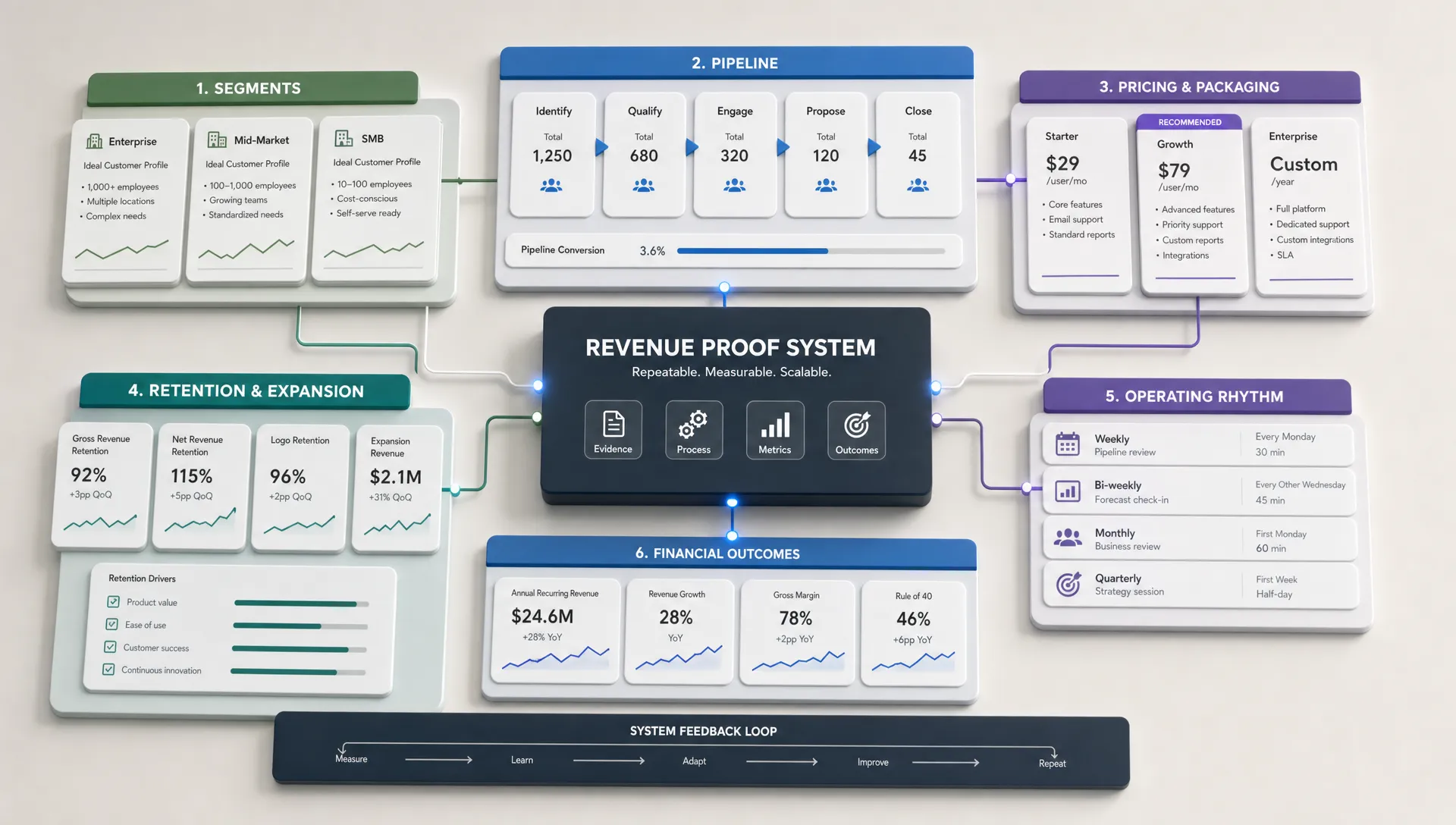
Revenue proof is not a prettier forecast. It is the evidence behind the forecast. It connects customer demand, sales execution, pricing discipline, retention behavior and management cadence into a version of the growth story that can survive scrutiny.
In a market where exits are taking more preparation and buyers are more selective, sponsors cannot wait until sale prep to ask for proof. The time to build it is during the hold period, before the pressure of an information request list exposes gaps that were visible but unresolved.
What Revenue Proof Means in a PE Context
Revenue proof is the documented case that a company can create revenue repeatedly and economically. It should show that growth is not dependent on one founder, one rainmaker, one temporary demand spike or one underpriced offer.
A strong proof base answers five questions:
- Who is the company best positioned to win?
- Which channels and sales motions produce those wins?
- What does it cost to acquire, retain and expand revenue?
- How reliable is the forecast compared with historical conversion?
- Can the leadership team manage the revenue system without informal heroics?
The exact evidence depends on the asset. A B2B services platform might prove revenue through segment profitability, referral source quality, utilization and account expansion. A software company may rely more on retention cohorts, pipeline conversion, product usage and net revenue retention. An education asset, such as a bilingual school in Chicureo, would prove demand through enrollment stability, parent trust, recognized academic differentiation and reputation in its local community.
That context matters because revenue proof should never become a generic KPI pack. The proof must match the way the business actually wins customers and creates enterprise value.
The Difference Between a Growth Story and Revenue Proof
Most private equity portfolio companies have a growth story. Fewer have enough commercial evidence to defend it under pressure. The gap is often invisible until a board asks why forecast confidence is slipping or a buyer asks how much growth would survive without the founder.
| Boardroom claim | Weak version | Revenue proof |
|---|---|---|
| Demand is strong | Recent revenue is up | Demand is segmented by customer type, trigger event, geography and win rate |
| The sales team can scale | More hires are planned | Rep ramp, productivity, conversion and quota quality are measured by cohort |
| The pipeline is healthy | CRM value is large | Stage definitions, aging, close rates and next steps are tied to buyer actions |
| Pricing has room to grow | Management believes customers will pay | Realized price, discount patterns, churn impact and win-loss data support the case |
| Customers are loyal | Testimonials are positive | Renewal, expansion, churn reasons and account concentration are tracked |
| The market is attractive | TAM slides show headroom | Target segments have proven economics and a defined path to penetration |
A buyer does not pay full value for a story that the management team cannot trace to customer behavior. If the business cannot explain where revenue comes from and why it should continue, the buyer will create its own risk adjustment.
Why Revenue Proof Is Often Missing
Revenue proof is usually missing for understandable reasons. Many companies were acquired because they already had attractive growth, not because their commercial system was clean. During the first year after close, the focus often shifts to integration, talent, cash management and quick wins. Revenue reporting gets better, but the underlying proof base remains thin.
Founder-led and relationship-led businesses are especially exposed. The company may know customers well, but that knowledge lives in conversations rather than systems. The CRM records activity, finance records revenue and leadership carries the real context in memory. That can work while the business is smaller, but it becomes fragile when a sponsor needs predictable acceleration.
Effective commercial due diligence for private equity teams should test the growth engine before close, but diligence cannot replace post-close operating discipline. The company still has to install the habits, definitions and accountability that make proof accumulate month after month.
This is the hidden risk: a portfolio company may be growing and still be under-evidenced. When that happens, every missed forecast feels like an isolated issue, even though the real problem is that nobody can see the revenue system clearly enough to manage it.
The Five Layers of Revenue Proof
Revenue proof is strongest when it is built in layers. Each layer answers a different diligence question and gives the board a clearer view of what is real, repeatable and risky.
1. Segment Proof
Segment proof shows where the company wins best. It moves beyond broad market language and identifies the customer types, use cases, buying triggers and economic profiles that deserve focus.
This includes revenue by segment, gross margin by segment, win rate, sales cycle, churn behavior and expansion potential. If a segment grows quickly but has weak margin or high churn, it may not support the value creation plan. If a smaller segment converts reliably and expands well, it may deserve more investment.
A useful segment view forces sharper choices. It tells management where to add sales capacity, where to refine pricing and where not to chase revenue that looks good in the month but weakens enterprise value over time.
2. Motion Proof
Motion proof shows that the company can win through a repeatable go-to-market system. It tests whether leads, qualification, sales stages, proposals, negotiation and close behavior follow a process that can be taught, measured and improved.
This is where stronger revenue architecture becomes essential. A sales process is not proof unless the stages reflect buyer behavior. A qualified opportunity should mean something specific. A late-stage deal should have documented decision criteria, commercial terms, stakeholders and timing. Otherwise, pipeline value is just optimism with a probability field.
Motion proof also reduces dependency on a few senior sellers. Buyers care about that because transferable revenue is worth more than revenue tied to personal relationships.
3. Economic Proof
Economic proof shows that growth creates value after the cost of winning it. For some companies, that means CAC payback, retention and lifetime value. For others, it means contribution margin by channel, cost to serve, utilization, territory productivity or sales expense as a percentage of gross profit.
The key is consistency. Management should be able to explain which revenue is attractive, which revenue is expensive and which revenue should be exited or repriced. Pricing discipline belongs here too, since discounting can hide inside revenue growth until margins expose the problem.
Economic proof helps sponsors avoid a common trap: accelerating the wrong revenue. Growth that consumes working capital, dilutes margin or increases churn risk may not deserve the same investment as slower but higher-quality revenue.

4. Forecast Proof
Forecast proof shows whether management can see revenue coming before it lands. It compares pipeline creation, stage conversion, deal aging and close rates with what actually happened. The objective is not to make forecasts perfect, but to make them explainable.
A revenue forecast should not depend on a leader feeling good about the quarter. It should show what has to happen in each stage, which assumptions changed and which leading indicators are moving. This is especially important in sponsor reporting because portfolio boards need time to intervene before a miss becomes unavoidable.
Forecast proof also reveals whether the CRM is a decision tool or an administrative burden. If sales leaders inspect the data weekly and reps trust the definitions, the forecast improves. If CRM updates happen right before the board deck, proof will be weak.
5. Management Proof
Management proof shows that the leadership team can operate the revenue system. It includes the cadence of weekly pipeline reviews, monthly commercial reviews, pricing governance, account planning, churn analysis and experiment tracking.
This layer matters because buyers are not only underwriting the market. They are underwriting the team that will carry the plan forward. A company with a clear revenue operating rhythm looks less risky than one where every answer depends on the CEO.
AI-powered automation can support this layer by surfacing patterns, improving data hygiene and reducing manual reporting. It cannot compensate for unclear definitions or weak accountability. The best automation amplifies a well-designed revenue system rather than masking a broken one.
Building a Revenue Proof Pack in 90 Days
A portfolio company does not need to boil the ocean to start proving revenue quality. A 90-day sprint can create enough visibility to show the board where the growth engine is strong, where it is fragile and where intervention will create the highest return.
| Period | Main question | What to build |
|---|---|---|
| Days 1 to 30 | What is true today? | Data audit, revenue segmentation, pipeline integrity review, pricing leakage review and customer concentration view |
| Days 31 to 60 | What is repeatable? | ICP definition, stage criteria, channel performance, rep productivity baseline and account expansion logic |
| Days 61 to 90 | What can we defend? | Board-ready proof pack, forecast model, priority growth experiments, operating cadence and ownership map |
The first month should be diagnostic, not political. If CRM data is poor, say so. If pricing exceptions are unmanaged, quantify the issue. If most revenue depends on three relationships, show the exposure. Sponsors do not need comforting dashboards. They need commercial truth early enough to act.
The second month should translate truth into design. This is where management defines the segments, motions and economic rules that will guide growth. The goal is not bureaucracy. The goal is to make the revenue engine observable and trainable.
The third month should turn analysis into an operating rhythm. Revenue proof gets stronger when it is reviewed consistently. A board-ready proof pack is useful, but the recurring cadence behind it is what makes it credible.
What Sponsors, Boards and Buyers Want to See
Different stakeholders use revenue proof for different decisions. Sponsors want to know whether the value creation plan is on track. Boards want leading indicators. Lenders want confidence that revenue risk will not pressure covenants. Buyers want evidence that growth will continue after the deal closes.
| Stakeholder | What they are trying to judge | Revenue proof they value |
|---|---|---|
| Sponsor | Whether the investment thesis is working | Segment growth, margin quality, pipeline conversion and management cadence |
| Portfolio board | Where to intervene | Leading indicators, forecast movement, sales productivity and pricing discipline |
| Lender | Whether downside risk is controlled | Revenue stability, concentration, churn drivers and forecast reliability |
| Strategic buyer or sponsor buyer | Whether revenue transfers after close | Repeatable motion, customer quality, leadership depth and defensible growth plan |
This is why revenue proof should be treated as part of value creation, not just exit preparation. The same evidence that improves board decisions also helps private equity companies improve exit readiness when the time comes to sell.
Common Mistakes That Weaken Revenue Proof
A few mistakes appear repeatedly across private equity portfolio companies.
- Using total revenue growth as proof of repeatability
- Reporting pipeline value without historical conversion and aging
- Treating all customers as equally valuable
- Allowing discounting decisions to happen outside a pricing framework
- Installing automation before standardizing sales definitions
The most damaging mistake is waiting until a transaction process to fix the evidence. By then, management is preparing materials while also running the business and responding to buyer questions. That pressure makes weak data harder to clean and commercial gaps harder to explain.
A better approach is to make proof a normal part of portfolio governance. The board should not only ask whether revenue grew. It should ask which revenue grew, why it grew, how much it cost and whether the same motion can produce more of it.
If a company has known revenue gaps, the response should not be a larger sales target. It should be a better operating design. For a deeper view of the risks that often sit beneath headline growth, see the discussion of hidden revenue gaps in companies owned by private equity.
Frequently Asked Questions
What is revenue proof for a private equity portfolio company? Revenue proof is the evidence that a portfolio company can generate revenue repeatedly, economically and with a manageable level of risk. It includes segment performance, pipeline conversion, pricing discipline, retention behavior, forecast reliability and management cadence.
Why do private equity portfolio companies need revenue proof before exit? Buyers and lenders discount growth when they cannot understand how it was produced or whether it will continue. Revenue proof reduces uncertainty and helps management defend the value creation story with evidence rather than assertion.
Is revenue proof the same as a sales dashboard? No. A dashboard reports activity and outcomes. Revenue proof explains cause, quality and repeatability. It should show why revenue happens, which assumptions are reliable and where the business must improve.
How quickly can a company build revenue proof? A focused 90-day sprint can create a useful proof base, especially if leadership has access to CRM, finance, customer and pricing data. The deeper work is making proof part of the monthly operating cadence.
What role does AI play in revenue proof? AI can help clean data, identify patterns, automate reporting and improve visibility across the revenue system. It works best when the company has clear sales definitions, ownership and governance already in place.
Turn Revenue Claims Into Evidence
Private equity portfolio companies do not need louder growth stories. They need proof that growth is real, repeatable and valuable.
Phil Pelucha Consulting helps PE firms, VC firms, family offices and portfolio companies pressure-test revenue quality, improve commercial infrastructure and build the operating cadence needed for acceleration and exit readiness. If your portfolio company needs to convert revenue ambition into board-ready evidence, start with Phil Pelucha Consulting.