
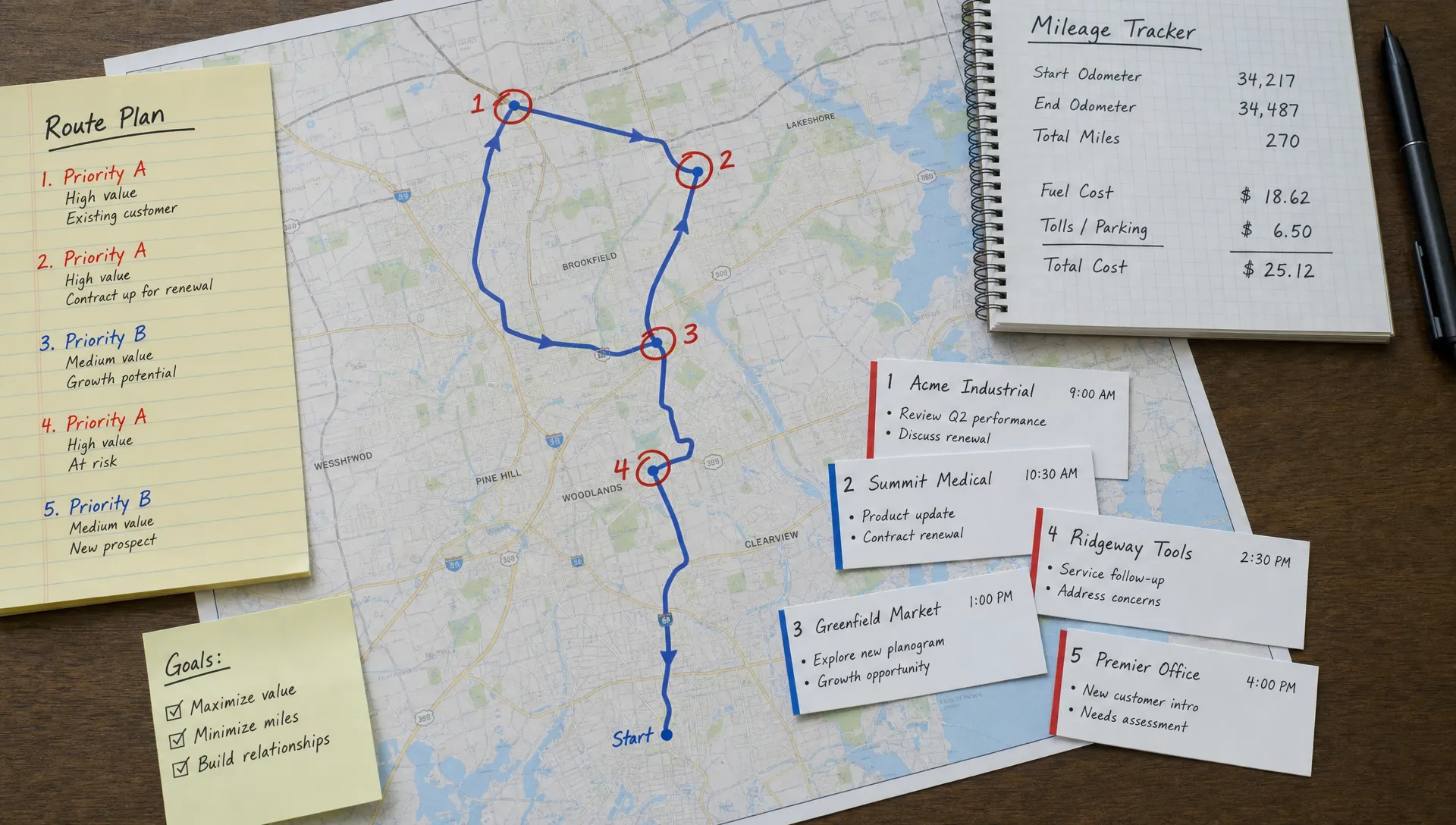
Sales Route Optimization for Field Team Efficiency
Field teams rarely become inefficient overnight. The problem usually builds in small ways: one extra detour to save a relationship, one legacy account left on a rep's calendar, one new market added without redesigning coverage, one high-value prospect treated the same as a low-probability stop.
For private equity-backed and investor-owned companies, that friction matters. Field sales is expensive. Travel time, windshield hours, missed follow-ups and poorly sequenced visits all dilute the productivity of a team that should be creating market coverage, customer insight and measurable pipeline.
Sales route optimization is the discipline of designing where field teams go, when they go there and why each visit is worth the cost. It is not only a map problem. It is a revenue design problem, because every route decision changes account coverage, meeting density, rep capacity, speed to opportunity and customer experience.
When done properly, route optimization helps field teams spend less time moving between accounts and more time advancing the right commercial outcomes.
Why sales route optimization matters in field-heavy businesses
Field teams often sit at the intersection of relationship management, market intelligence and deal creation. They visit distributors, clinics, retailers, venues, franchisees, industrial sites, offices and enterprise buyers. In many lower middle-market companies, these teams also carry historical habits that were never challenged after acquisition.
A rep may still cover an area because they always have. A weekly route may exist because a former manager approved it years ago. A low-value customer may receive monthly visits while a faster-growing account waits for a callback. None of this appears dramatic in isolation, but it compounds across a portfolio company.
The commercial cost usually appears in four places:
- Lower meeting density per field day
- Uneven account coverage across territories
- More expensive revenue generation
- Slower response to high-intent opportunities
For sponsors and operating partners, the issue is not just whether reps are busy. It is whether field capacity is being allocated to the accounts, geographies and moments most likely to move enterprise value.
This is where route optimization becomes part of the broader revenue acceleration agenda. Better routing can improve rep utilization, but the larger prize is tighter commercial execution. A cleaner field motion makes it easier to forecast coverage, allocate resources, manage customer segments and prepare the company for scale or exit.
Route optimization is not the same as territory design
Route optimization and territory design are related, but they solve different problems.
Territory design answers the question, "Who owns which market, account or geography?" Route optimization answers, "How should the field team physically cover that responsibility in the most productive way?"
A company can have logical territories and still waste hundreds of hours each month through inefficient field routes. The reverse is also true: a route can look efficient on a map while the underlying territory structure is commercially flawed.
If the problem is misallocated market ownership, start with sales territory optimisation for higher coverage. If the ownership model is broadly right but field execution is slow, inconsistent or expensive, sales route optimization is the next lever.
The best companies connect both. They design territories around opportunity, capacity and strategic value, then build routes that turn that design into repeatable field activity.
The signs your field routes need redesign
Route inefficiency is easy to normalize because field sales has always involved travel. The warning signs usually appear in operating metrics and manager conversations before they show up as an obvious P&L line item.
Common signals include:
- Reps spend more time driving than meeting customers
- High-priority accounts are visited inconsistently
- Field calendars are built manually every week with little governance
- Reps cluster visits around convenience rather than opportunity value
- Customer complaints increase in undercovered areas
- Managers cannot explain why certain accounts receive specific visit frequencies
- New reps inherit routes that no longer match the company's strategy
For PE-backed companies, these signs often surface after growth investment, add-on integration or market expansion. A team that worked reasonably well at $20 million in revenue may not work at $50 million if the same routes, cadences and account priorities remain in place.
Route optimization should not wait until margins are under pressure. It is easier to redesign coverage before poor habits become embedded in compensation plans, customer expectations and rep identity.
Start with commercial intent, not mapping software
Many companies begin route optimization by looking for software. Tools matter, especially when field teams are large, but software will only automate the logic you give it. If the commercial logic is weak, the tool simply produces a faster version of a bad plan.
The first question should be: what is the route meant to achieve?
In some businesses, the goal is to increase face-to-face selling time with high-value prospects. In others, it is to protect retention among strategic accounts, improve distributor compliance, accelerate store visits or support a new market launch. A route built for account management should not look the same as a route built for new logo creation.
Before optimizing mileage, define the commercial intent by segment:
- Strategic accounts may need scheduled executive touchpoints and predictable coverage
- Growth accounts may need more frequent visits during buying windows
- Maintenance accounts may be served through lower-touch field cadences or inside sales support
- Dormant accounts may require a short reactivation sprint rather than permanent route allocation
This segmentation prevents the common mistake of treating every visit as equal. In field sales, two meetings that take the same amount of travel time can have completely different revenue value.
The data needed for effective sales route optimization
Sales route optimization depends on clean enough data, not perfect data. Most companies can begin with what they already have in the CRM, ERP, calendar system and expense records. The goal is to build a working view of field activity, account potential and service expectations.
A practical route optimization review should include:
| Data category | What to review | Why it matters |
|---|---|---|
| Account location | Customer, prospect and partner addresses | Shows geographic clustering and travel burden |
| Account value | Revenue, margin, growth rate and strategic importance | Separates high-value visits from inherited habits |
| Opportunity stage | Pipeline stage, next step and close timing | Aligns field time with near-term revenue movement |
| Visit history | Frequency, duration and outcomes | Reveals overcoverage and undercoverage |
| Rep capacity | Available field days, admin load and travel constraints | Keeps route plans realistic |
| Customer requirements | Contractual visits, service expectations and renewal risk | Prevents efficiency gains from damaging retention |
The key is to combine geographic efficiency with commercial value. A route that minimizes miles but ignores opportunity quality may reduce cost while lowering revenue. A route that chases only high-value accounts without considering travel density may create rep burnout and inconsistent coverage.
Better route design balances both.
Build routes around cadence, clusters and trigger events
A strong field route system usually has three layers: cadence, clusters and triggers.
Cadence defines how often each account type should be visited. Strategic accounts might require monthly or quarterly visits. Smaller accounts may move to periodic field coverage combined with digital or inside sales engagement. Prospecting routes may run in concentrated sprints rather than evenly across the quarter.
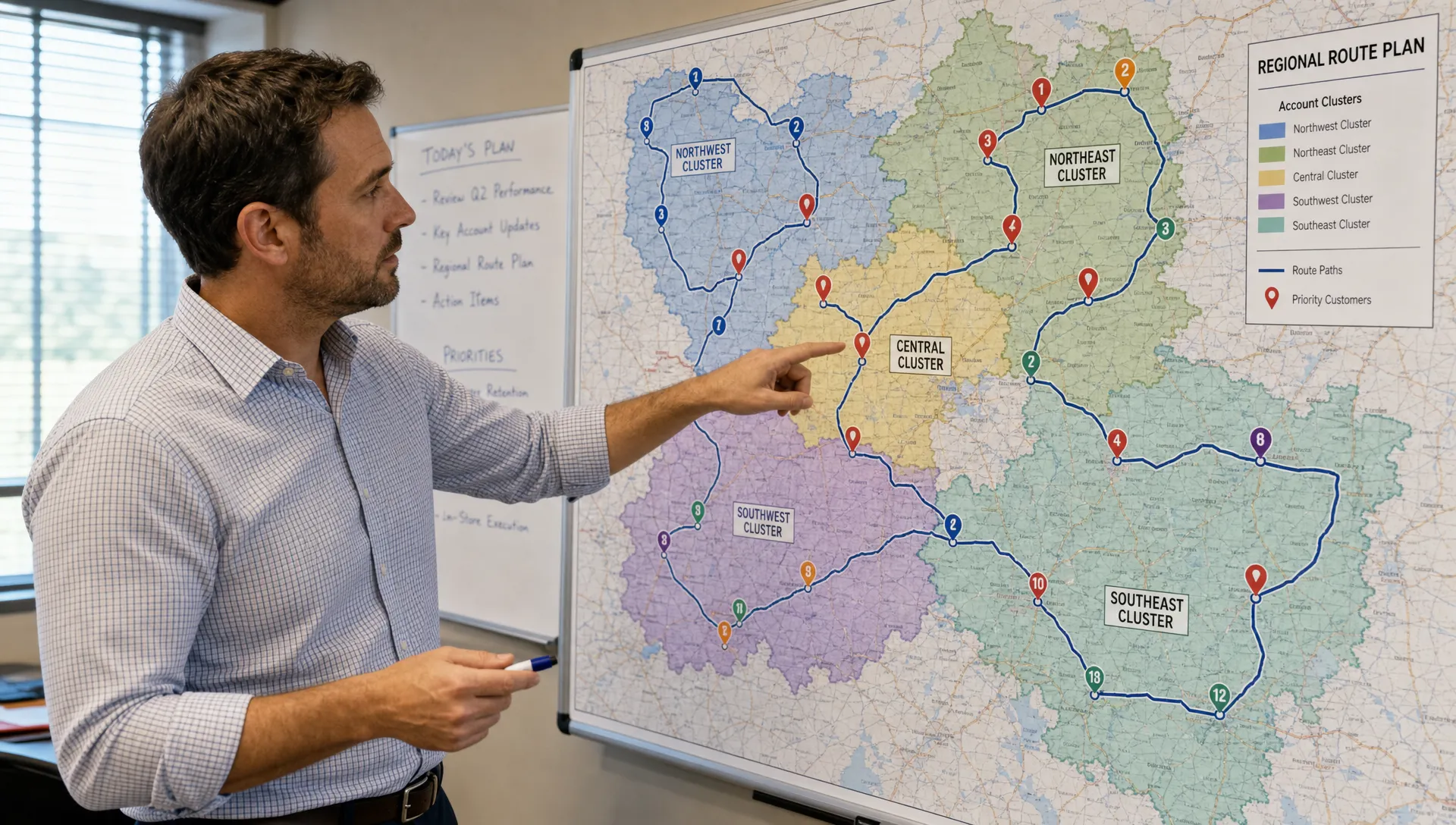
Clusters group visits geographically so reps can create dense field days. This is where routing technology can help, but managers still need to validate the commercial logic. A cluster should not exist only because accounts are close together. It should exist because the meetings belong together in a productive field motion.
Trigger events override routine cadence when timing matters. A renewal date, product launch, local event, funding announcement, complaint, competitive threat or sudden increase in demand may justify a field visit outside the normal route.
This trigger-based layer is often where field teams become more valuable. They stop acting as traveling account caretakers and start acting as responsive commercial operators.
For event, venue and live entertainment businesses, trigger events can be especially important because demand moves around launch dates, ticket releases and promotional windows. In that context, real-time commercial signals from a platform such as TixFlow's event ticketing platform can help teams understand when an organizer or venue may need timely field support.
Use AI and automation where they are closest to revenue
AI can improve route optimization, but only when it is applied to specific commercial bottlenecks. The fastest gains usually come from automating the manual decisions that slow down managers and reps every week.
Examples include prioritizing accounts based on recent buying signals, flagging route gaps, suggesting meeting sequences, identifying undercovered high-value customers and prompting reps to schedule visits before key renewal or purchasing windows.
This aligns with a broader principle: automation should be applied where it removes friction close to cash. For investor-backed businesses, the strongest use cases often sit in lead response, routing, prioritization, follow-up discipline and sales management workflows. That is why route optimization often pairs well with AI-powered automation that creates revenue fastest, especially when field capacity is constrained.
Still, AI should not replace management judgment. A route recommendation may miss local context, relationship history, rep capability or customer politics. The right model is human-led, system-supported. Managers define strategy. Systems improve speed, consistency and visibility.
Metrics that reveal whether route optimization is working
A route redesign should not be judged only by lower mileage. Cost reduction is useful, but route optimization should improve commercial output as well. A PE-backed company needs to know whether field time is converting into stronger coverage, better pipeline movement and healthier unit economics.
A balanced measurement system should include efficiency, coverage and revenue metrics.
| Metric | What it shows | Management question |
|---|---|---|
| Meetings per field day | Field activity density | Are reps spending enough time with customers? |
| Travel time as a share of field time | Route efficiency | Is too much capacity lost between visits? |
| Priority account coverage | Strategic execution | Are the right accounts receiving attention? |
| Pipeline created per field day | Demand generation productivity | Is field activity producing qualified opportunity? |
| Pipeline advanced per visit | Sales progression | Are visits moving deals forward? |
| Revenue or margin per mile | Economic return | Is the route worth the cost? |
| Missed visit rate | Execution discipline | Are routes realistic and followed? |
| Customer retention in covered segments | Relationship health | Is efficiency damaging service quality? |
These metrics should be reviewed by segment and territory, not only at company level. Aggregate performance can hide serious route problems. A national average may look acceptable while one region is overcovered, another is starved and a third is spending too much time on low-margin accounts.
How to implement route optimization without disrupting the field team
Route redesign can create internal resistance. Reps may see it as micromanagement. Customers may be used to familiar visit patterns. Regional managers may worry that centralized routing ignores local realities.
Implementation works best when leaders frame the change around capacity and commercial focus, not surveillance. The message should be simple: field time is valuable, so the company will protect it and point it toward the highest-impact work.
A practical implementation can follow four stages.
Diagnose the current route reality
Start by mapping actual field behavior, not the route plan that managers believe exists. Compare CRM activity, calendars, mileage, expense data and customer coverage. Identify where reps are spending time, which accounts are overvisited and where high-value opportunities are undercovered.
This diagnostic stage often reveals broader sales issues, such as poor qualification, unclear pipeline stages or inconsistent follow-up. If route problems are part of a wider execution gap, they should be handled within a larger sales optimisation effort that fixes revenue leaks fast.
Segment accounts before changing routes
Do not redesign routes around every account equally. Segment first by commercial value, growth potential, service obligation, renewal risk and strategic importance. This step gives managers a defensible basis for changing visit frequency.
Without segmentation, route changes become political. With segmentation, route design becomes a resource allocation decision.
Pilot before rolling out company-wide
A pilot region allows the company to test assumptions before forcing change across the entire field organization. Choose a region with enough activity to produce meaningful data and a manager willing to enforce the new cadence.
The pilot should measure both efficiency and revenue outcomes. If travel time falls but pipeline creation also falls, the route logic needs adjustment. If meeting density rises and priority account coverage improves, the company has a model that can be refined and scaled.
Install management rhythms
Route optimization is not a one-time project. Markets change, accounts grow, competitors move and reps leave. The company needs a recurring review rhythm to keep routes aligned with strategy.
Monthly reviews can focus on execution gaps and immediate route fixes. Quarterly reviews can examine territory balance, segment coverage and market changes. Annual reviews can reset the full field model around the next phase of the value creation plan.
Common mistakes that reduce field team efficiency
Several route optimization projects fail because they overfocus on logistics and underfocus on revenue design.
The first mistake is optimizing for distance alone. The shortest route is not always the best route. A longer route that includes higher-value meetings may be far more productive than a tidy loop of low-value visits.
The second mistake is ignoring rep capability. Some reps are better at strategic account expansion. Others are stronger at prospecting, technical selling or channel development. Route design should consider where each rep can create the most value, not only where they live.
The third mistake is using historical revenue as the only priority signal. Current revenue matters, but it can overweight mature accounts and underweight growth opportunities. Route planning should include future potential, not just past performance.
The fourth mistake is failing to change management routines. If managers continue approving the same weekly calendars and asking the same activity questions, reps will gradually return to old habits.
What good looks like after optimization
A well-optimized field sales organization feels different in daily operations. Reps know which accounts deserve field time and why. Managers can see whether coverage matches the commercial plan. Routes are built around account priority, geography and timing. High-value opportunities are not left waiting because a rep's calendar is full of legacy visits.
At sponsor level, good route optimization creates better visibility into field productivity. Operating partners can compare regions, assess where capacity is constrained and identify whether growth requires more people, better routing, improved segmentation or a different sales motion.
That clarity matters for exit readiness. Buyers do not only look at revenue growth. They look at repeatability, scalability and the quality of the commercial engine. A company that can show disciplined field coverage, strong productivity metrics and a scalable operating rhythm is easier to underwrite than one relying on heroic rep effort and informal local knowledge.
Frequently Asked Questions
What is sales route optimization? Sales route optimization is the process of planning field sales visits around account value, geography, cadence, rep capacity and timing so teams spend more time with the right customers and less time in unproductive travel.
How is route optimization different from territory optimization? Territory optimization defines ownership of accounts or markets. Route optimization determines how reps physically cover those accounts in the most efficient and commercially valuable sequence.
What metrics should field sales leaders track? Useful metrics include meetings per field day, travel time as a share of field time, priority account coverage, pipeline created per field day, revenue per mile and missed visit rate.
Can AI help with sales route optimization? Yes. AI can help prioritize accounts, identify route gaps, recommend visit sequences and trigger timely outreach. It works best when leadership has already defined clear segments, cadences and commercial priorities.
When should a portfolio company review field routes? Field routes should be reviewed after acquisitions, market expansion, major hiring, margin pressure, customer coverage issues or any shift in the value creation plan. Quarterly review is a practical rhythm for most active field teams.
Turn field coverage into a revenue advantage
Sales route optimization is not about squeezing more miles out of a field team. It is about protecting expensive commercial capacity and directing it toward the accounts, opportunities and moments that matter most.
For PE firms, VC-backed companies, family offices and portfolio leadership teams, the opportunity is clear: improve coverage, reduce wasted motion and build a field operating model that can scale.
Phil Pelucha Consulting helps investor-backed businesses accelerate revenue through commercial diagnostics, sales and GTM optimization, fractional CRO support, sponsor advisory and AI-powered systems for portfolio companies. If your field team is active but not efficient, route optimization may be one of the fastest ways to uncover capacity already inside the business.