

How a PE Sponsor Spots Commercial Risk Early
A missed revenue plan is rarely the first sign of trouble. It is usually the final symptom of commercial risk that has been building quietly in the pipeline, pricing model, sales process, customer base, or leadership rhythm.
For a PE sponsor, the goal is not simply to ask whether a portfolio company can grow. The sharper question is whether growth can repeat, scale, and survive scrutiny from the next buyer. Commercial risk becomes expensive when it is discovered after capital has already been deployed, a hiring plan is underway, or the board has committed to an aggressive value creation plan.
The sponsors who spot it early tend to look past headline revenue. They test the quality of the commercial engine: who is buying, why they buy, how consistently the company wins, what it costs to acquire customers, how disciplined the team is on price, and whether the GTM system depends on a few exceptional individuals.
Commercial risk behaves like physical pain. By the time it restricts movement, the underlying issue may have been developing for some time. In healthcare, providers such as Move Well MD focus on diagnosing the source of pain before recommending care. PE sponsors need the same mindset with portfolio revenue: find the source of strain before prescribing growth.
What commercial risk really means for a PE sponsor
Commercial risk is any weakness that threatens the revenue assumptions behind the investment thesis. It is broader than sales underperformance. A company can hit this quarter’s number and still carry meaningful risk if the revenue is low quality, the pipeline is inflated, the customer base is fragile, or the growth motion is not repeatable.
In sponsor terms, commercial risk usually shows up in three places:
- Thesis risk: The market, ICP, pricing power, or buyer behavior does not support the original growth case.
- Execution risk: The company lacks the people, process, data, or management cadence to deliver the plan.
- Exit risk: The business may grow, but not in a way that a future buyer will underwrite confidently.
The most dangerous commercial risks are often masked by strong historical performance. Founder-led selling, a buoyant market, a few large customers, or aggressive discounting can make revenue look healthier than the underlying system. That is why sponsors should evaluate not just what has grown, but how it grew.
If you want to go deeper on this distinction, the issue is closely tied to the hidden revenue risk in private equity: a company may show attractive growth while lacking a reliable commercial engine.
Start with revenue quality, not revenue volume
A sponsor spotting commercial risk early should begin by separating revenue volume from revenue quality. Revenue volume tells you what the company booked. Revenue quality tells you whether that revenue is durable, profitable, repeatable, and aligned with the value creation plan.
The distinction matters because weak revenue quality can create false confidence. A business may grow 20 percent while relying on discounting, one-time projects, non-core buyers, or an overworked founder. That growth may not deserve the same valuation multiple as recurring, high-fit, efficiently acquired revenue.
| What looks positive | What may be hiding underneath | Sponsor question to ask early |
|---|---|---|
| Revenue is ahead of plan | Deals were pulled forward or heavily discounted | Did we borrow from future quarters to hit this one? |
| Pipeline coverage is strong | Opportunities are stale, poorly qualified, or unlikely to close | What percentage of pipeline has a real buyer, budget, need, and timeline? |
| New logos are increasing | ICP discipline is weakening | Are we winning the customers we actually want to own? |
| Sales headcount is growing | Productivity per rep is flat or falling | Are new hires ramping predictably? |
| Gross retention looks stable | Expansion is slowing or executive sponsors are disengaging | Are customers becoming more valuable over time? |
| A major customer renewed | Concentration risk remains high | What happens if that account delays, churns, or reprices? |
This early revenue quality review should not be a finance-only exercise. The sponsor should triangulate data from the CRM, customer interviews, win-loss analysis, pricing history, sales manager reviews, and customer success feedback. Commercial risk lives between those systems, not neatly inside one report.
Signal 1: The pipeline looks bigger than it behaves
Pipeline inflation is one of the most common early warning signs. The board deck may show 3x or 4x coverage, but the conversion rate tells a different story. Opportunities slip repeatedly. Close dates move without explanation. Sales leaders defend the number based on optimism rather than buyer evidence.
A PE sponsor should inspect pipeline movement, not just pipeline size. Look at how many deals advance from stage to stage, how long they sit, how much late-stage pipeline is created by existing relationships, and whether forecast categories actually predict outcomes.
Healthy pipeline has friction, but it also has evidence. The buyer has a recognized problem, a defined decision process, commercial urgency, budget ownership, and a clear next step. Risky pipeline is full of friendly conversations, vague interest, outdated proposals, and deals that require a perfect quarter to close.
The early sponsor move is to ask for cohort views. What happened to the opportunities created 90 days ago? What percentage became closed-won, closed-lost, or stalled? How does that compare by rep, channel, segment, and deal size? These cuts reveal whether the company has demand momentum or simply CRM optimism.
Signal 2: Growth depends on a narrow group of people
Founder-led revenue is not automatically bad. In many lower middle market and founder-owned businesses, it is the reason the company exists. But after acquisition, the sponsor needs to know whether that relationship capital can be converted into a scalable commercial system.
Risk appears when too much revenue depends on one founder, one senior salesperson, one channel partner, or one account manager. The company may have a sales team on paper, but the real engine is a small number of rainmakers. That creates key-person risk, ramp risk, and exit risk.
A sponsor can test this quickly by reviewing win sources. Who originated the top 20 deals? Who influenced them? Who negotiated price? Who owns the customer relationship now? If the answers cluster around a small group, the commercial system needs strengthening before growth expectations increase.
This is also where management teams can unintentionally misread capacity. Hiring more reps will not solve the problem if the company has no clear ICP, inconsistent messaging, weak enablement, poor sales management, or limited proof that a new hire can ramp. Adding headcount to a fragile GTM system often amplifies the fragility.
Signal 3: ICP discipline starts to drift
Commercial risk often enters through the side door of opportunistic growth. The company starts saying yes to customers outside its ideal customer profile because the revenue is available. At first, that looks pragmatic. Over time, it creates operational complexity, weaker margins, lower retention, and a diluted market position.
A PE sponsor should watch for changes in the customer mix. Are new customers smaller, less profitable, harder to serve, or slower to buy than the core base? Are sales teams pursuing adjacent segments before the primary segment is penetrated? Are implementation teams struggling with use cases the company was not built to support?
ICP drift is especially dangerous before market expansion. If a company cannot define where it wins today, a new market will not fix that. It will simply create more variables. Before pushing into a new geography, channel, or vertical, sponsors should confirm that the core commercial design is strong enough to travel.
That is why the sequence matters. In many cases, PE funds should fix before pushing growth, especially when the current revenue engine has unclear segmentation, weak qualification, or inconsistent conversion.
Signal 4: Pricing discipline weakens before margins show pain
Pricing risk often appears before it is visible in financial statements. Sales teams start using discounts to create urgency. Custom terms become common. Renewal pricing gets negotiated account by account. Finance sees the margin impact later, but the behavioral pattern starts much earlier.
Sponsors should track pricing exceptions, discount approval patterns, average selling price by segment, renewal uplift, and gross margin by customer cohort. The key is to understand whether price is being used strategically or reactively.
A company with real pricing power can explain its value clearly, defend its differentiation, and walk away from poor-fit business. A company with weak pricing discipline may still win deals, but those deals can reduce quality of earnings and make future growth less attractive to buyers.
Signal 5: Customer concentration is treated as a finance issue only
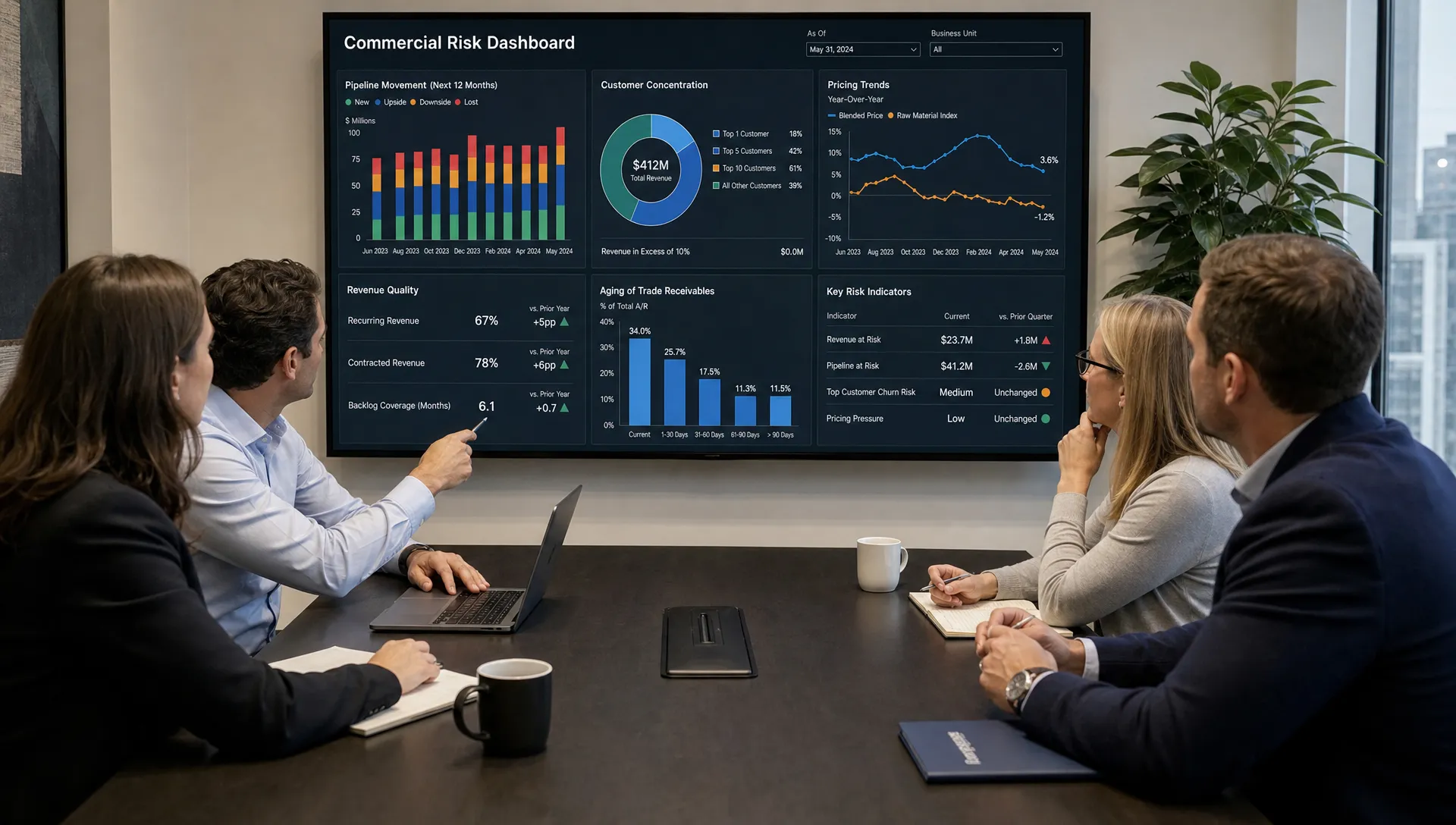
Customer concentration is not just a line item in diligence. It is a commercial risk that should be understood at the relationship, value, and dependency level.
A large account may be stable because the company is mission critical, deeply embedded, and expanding across departments. Or it may be fragile because one executive sponsor is leaving, procurement is pushing back, the customer has delayed projects, or a competitor is now in the account.
The sponsor should look beyond revenue percentage and ask qualitative questions. Why does the customer stay? Who owns the relationship? What would cause them to leave? Is the product or service critical, or merely preferred? Is there expansion potential, or has the account peaked?
Early warning signs include slower response times from senior contacts, reduced usage, delayed renewals, more procurement involvement, lower NPS or satisfaction indicators, and fewer expansion conversations. These signals may appear months before churn shows up in the numbers.
Signal 6: The sales process is described differently by every leader
A repeatable sales process should not depend on who explains it. If the CEO, CRO, VP of Sales, and top reps all describe qualification, stages, handoffs, and win criteria differently, the sponsor should assume execution risk is present.
This misalignment matters because it weakens forecasting, coaching, onboarding, and accountability. It also makes revenue harder to scale. New hires cannot ramp against tribal knowledge. Sales managers cannot coach consistently if the process is subjective. The board cannot trust forecasts if stage definitions are loose.
A strong commercial system has clear qualification standards, defined exit criteria for each stage, consistent CRM hygiene, documented messaging, reliable follow-up, and a management cadence that identifies issues early. The sponsor does not need bureaucracy. It needs repeatability.
The fastest diagnostic is to compare the stated process with actual deal history. Take recent wins, losses, and stalled opportunities. Map what happened, how long it took, which stakeholders were involved, what objections appeared, and what changed the buyer’s decision. If the real journey does not match the documented process, the process is not yet operating infrastructure.
Signal 7: Reporting is clean, but insight is thin
Many portfolio companies can produce a polished board deck. Fewer can explain what the numbers mean and what management will do next. That gap is a commercial risk.
Sponsors should be cautious when reporting is heavily descriptive but weak on diagnosis. For example, “pipeline is down” is not enough. Is it down because inbound demand softened, outbound activity fell, conversion dropped, channel partners underperformed, or the ICP shifted? Each cause requires a different response.
Useful commercial reporting connects metrics to decisions. It shows leading indicators, highlights root causes, separates controllable and external factors, and clarifies the management action required. A sponsor should leave the commercial review knowing what is working, what is not, what is being tested, and what needs intervention.
AI and automation can help here, but only when the underlying commercial logic is sound. Sponsors can use AI-enabled systems to surface patterns across CRM notes, call data, deal stages, pricing exceptions, churn signals, and customer feedback. Still, automation should not create a false sense of precision. Bad inputs and unclear definitions will simply produce faster noise.
The early commercial risk review cadence
Spotting risk early is not a one-time diligence task. It should be built into the ownership cadence from pre-close through exit preparation.
| Ownership phase | Sponsor focus | Best early-warning questions |
|---|---|---|
| Pre-LOI | Test thesis assumptions | Is growth driven by market pull, sales execution, or one-off factors? |
| Confirmatory diligence | Validate revenue quality | Which customers, channels, products, and reps truly drive profitable growth? |
| First 100 days | Install commercial visibility | What do we need to measure weekly to know if the plan is working? |
| Year 1 value creation | Strengthen repeatability | Can the company scale without relying on heroic effort? |
| Mid-hold period | Reduce exit risk | What would a sophisticated buyer challenge in diligence? |
| 18 months before exit | Prove durability | Can we show predictable growth, strong retention, and credible expansion levers? |
The sponsor’s job is to avoid being surprised. That means commercial reviews should focus less on defending the plan and more on learning where the plan is vulnerable.
Questions a PE sponsor should ask every quarter
Quarterly board discussions often focus on whether the company hit plan. That matters, but it is not enough. A sponsor trying to spot commercial risk early should make room for a small set of recurring questions.
- Which part of the revenue plan has the weakest evidence behind it?
- Where are we seeing the biggest gap between pipeline coverage and closed-won revenue?
- Which customer segment is becoming more or less attractive than expected?
- What has changed in win rates, sales cycle length, discounting, or deal quality?
- Which growth lever depends most heavily on a person, partner, or assumption we do not control?
- What would a buyer challenge if we went to market next quarter?
These questions create a better operating conversation. They help management teams surface issues earlier and give sponsors more time to support the business before risk becomes value leakage.
When early warning signs require outside support
Not every commercial issue needs a consultant. Some issues can be solved by a strong management team with better cadence and clearer accountability. But outside support becomes valuable when the sponsor needs an independent view, the commercial team lacks capacity, or the same issues repeat across multiple board cycles.
Common triggers include unreliable forecasts, unclear ICP, weak sales productivity, inconsistent market expansion results, declining price discipline, or a gap between the investment thesis and GTM execution. If those warning signs persist, it may be time to consider when to bring in a PE consultant for commercial change.
The right support should not create a large theoretical report that sits unused. It should clarify the commercial problem, prioritize the few fixes that matter most, and help install the operating rhythm needed to protect the value creation plan.
Frequently Asked Questions
What is commercial risk in private equity? Commercial risk is the possibility that the revenue assumptions behind an investment will not hold. It can come from weak sales execution, poor revenue quality, customer concentration, pricing pressure, low retention, unclear ICP, or a GTM model that cannot scale.
When should a PE sponsor start looking for commercial risk? A PE sponsor should start before signing the deal, continue through confirmatory diligence, and formalize the review during the first 100 days. The earlier the sponsor validates revenue quality and GTM repeatability, the more options it has to protect value.
What is the most common early warning sign? Pipeline inflation is one of the most common signs. The company appears to have enough opportunity coverage, but deals slip, qualification is weak, close dates move, and forecast accuracy deteriorates.
How is commercial risk different from missing a sales target? Missing a sales target is an outcome. Commercial risk is the underlying weakness that may cause that outcome, such as poor qualification, weak pricing discipline, low-fit customers, or dependence on a few senior sellers.
Can AI help sponsors spot commercial risk earlier? Yes, AI can help detect patterns across CRM data, customer feedback, call notes, churn signals, and pricing behavior. However, it only works well when the company has clear definitions, reliable data, and a disciplined commercial operating model.
The sponsor advantage is early diagnosis
A PE sponsor does not need to wait for a missed quarter to identify commercial risk. The warning signs are usually visible earlier in pipeline behavior, pricing decisions, ICP drift, customer signals, sales productivity, and the quality of management insight.
The advantage goes to sponsors who treat commercial risk as a diagnostic discipline, not a post-mortem exercise. When the revenue engine is understood early, the value creation plan becomes more realistic, management support becomes more targeted, and exit readiness improves long before the sale process begins.