
How to Manage a Venture Portfolio for Smarter Growth
Managing a venture portfolio for smarter growth is not just about backing promising companies and waiting for the winners to emerge. It is about building a disciplined system that helps each company use capital, attention, talent, and timing more effectively.
For venture firms, family offices, and growth-oriented investors, the challenge is rarely a lack of ambition. The harder problem is knowing where to intervene, when to step back, and how to create repeatable growth across companies that may sit at very different stages of maturity.
A strong venture portfolio management approach should answer four practical questions:
- Which companies are ready to scale, and which still need commercial proof?
- Where can the investor or operating team create the most value?
- Which growth constraints are company-specific, and which repeat across the portfolio?
- How do we improve upside without adding unnecessary complexity for founders?
Smarter growth comes from moving beyond reactive support. Instead of helping only when a founder asks for an introduction, misses a forecast, or prepares for the next raise, the best portfolio teams install a clear operating rhythm that identifies constraints early and turns pattern recognition into action.
Start With a Portfolio Growth Thesis
Every venture portfolio needs more than a financial thesis. It also needs a growth thesis.
A financial thesis explains why the fund invested. A growth thesis explains how the company can become more valuable from here. That distinction matters because venture investors often over-index on market size, product vision, or founder quality, then under-define the operating path required to convert potential into repeatable revenue.
At the portfolio level, your growth thesis should clarify:
- The primary value creation levers across the fund
- The types of companies that need hands-on support versus light-touch advisory
- The commercial milestones that signal readiness for follow-on capital
- The common risks that could slow growth, such as weak ICP definition, founder-led sales dependency, or poor retention visibility
This does not mean every company needs the same playbook. In fact, applying a uniform operating model to every venture-backed company is one of the fastest ways to frustrate founders. The goal is to create a shared language for growth while preserving company-specific execution.
A useful starting point is to map each portfolio company by stage and commercial maturity, not just valuation or revenue. A company with $8 million in ARR but high churn may need more foundational work than a company at $2 million ARR with a narrow ICP, high win rates, and a repeatable sales motion.
Segment the Venture Portfolio by Growth Readiness
Too many portfolio reviews group companies by fund, ownership percentage, or recent performance. Those categories are useful for reporting, but they do not always help operating teams decide what to do next.
For smarter growth, segment companies by their current constraint. This creates a sharper view of where support should go and prevents the portfolio team from treating all growth as equal.
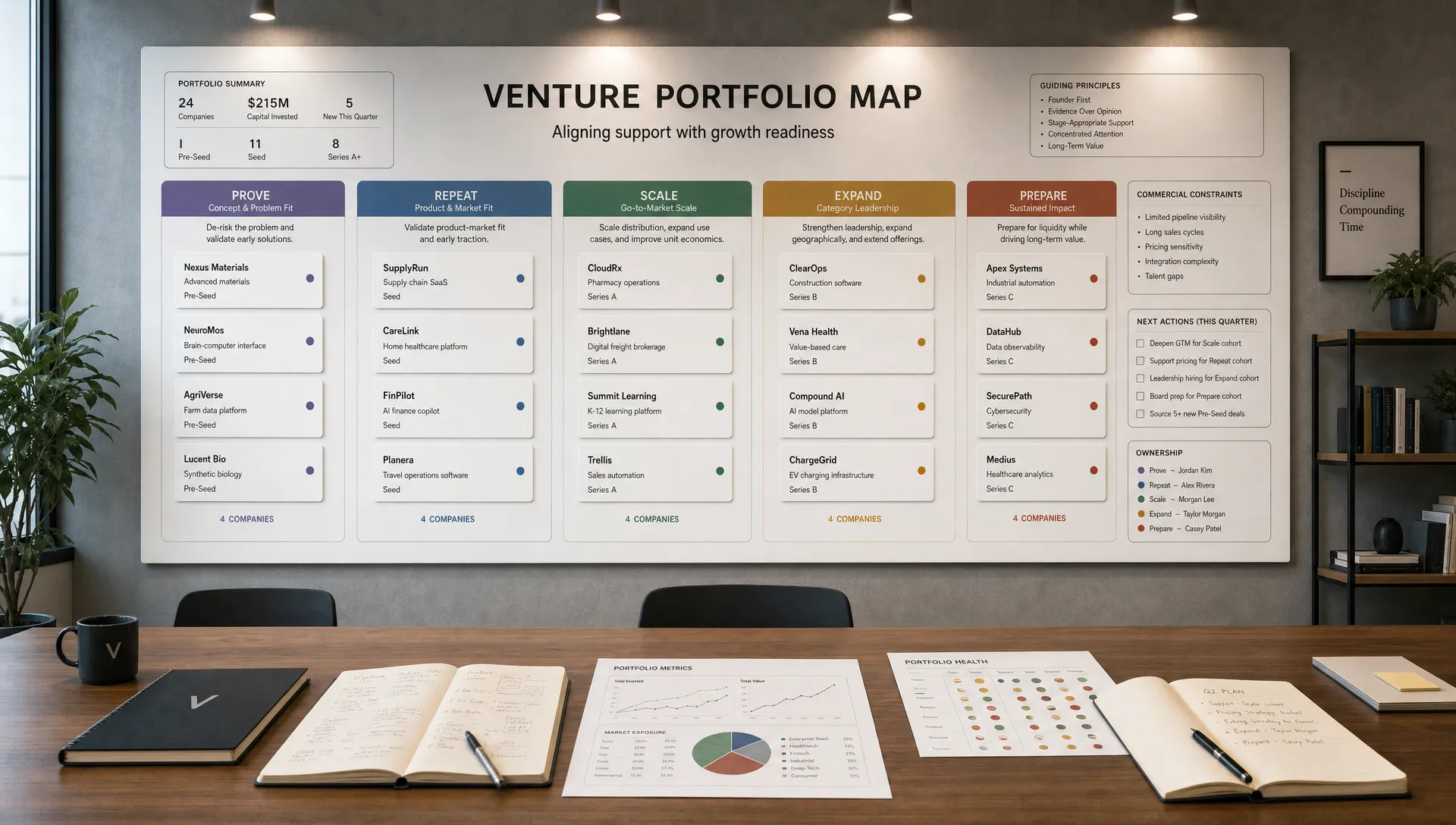
| Portfolio segment | Main question | Typical growth constraint | Best investor support |
|---|---|---|---|
| Prove | Is there a real market pull? | ICP, messaging, early sales learning | Customer discovery, positioning, founder sales coaching |
| Repeat | Can the company win consistently? | Sales process, conversion rates, pipeline quality | GTM design, CRM discipline, hiring support |
| Scale | Can growth accelerate without breaking the model? | Leadership, systems, forecasting, unit economics | Revenue operations, sales leadership, partner channels |
| Expand | Can the company enter new markets or segments? | Focus, localization, channel fit, execution risk | Market prioritization, commercial validation, expansion sequencing |
| Prepare | Is the company ready for exit, follow-on funding, or strategic options? | Revenue quality, management depth, metric credibility | Exit readiness, diligence preparation, board-level narrative |
This segmentation helps the portfolio team avoid one of the most common mistakes in venture portfolio management: pushing scale before repeatability.
A company may have strong investor interest, a compelling category narrative, and a large total addressable market, yet still lack the sales mechanics required to absorb more capital efficiently. Before accelerating spend, investors should test whether the company has the basics in place. This is why the question of what a portfolio company needs before scaling is central to portfolio-level value creation.
Install a Consistent Commercial Diagnostic
A good diagnostic is not a long consulting deck. It is a repeatable way to understand what is helping or hurting growth.
For venture portfolios, the diagnostic should be lightweight enough to run across many companies but specific enough to reveal the real bottleneck. It should combine quantitative metrics with qualitative judgment from founders, sales teams, customers, and investors.
The most useful areas to assess include:
- Ideal customer profile clarity
- Pipeline source and quality
- Conversion rates by stage
- Sales cycle length and deal velocity
- Average contract value and expansion potential
- Gross and net revenue retention where applicable
- Founder-led versus team-led sales dependency
- Pricing confidence and discounting behavior
- Marketing contribution to qualified pipeline
- Revenue leadership capability
The purpose is not to criticize management teams. It is to identify where the next unit of effort creates the highest return.
For example, if a company has a strong product but low conversion from demo to close, the issue may be qualification, sales skill, competitive positioning, or pricing. Each requires a different intervention. Simply adding more leads will make the problem bigger, not better.
Likewise, if a company has a healthy close rate but weak pipeline coverage, the portfolio team should focus on demand generation, partnerships, outbound targeting, or market awareness. The same revenue miss can have very different causes.
Build a Portfolio Operating Cadence
Smarter growth requires rhythm. Without a cadence, support becomes episodic. Founders ask for help when problems are already visible, investors react to missed numbers, and the same issues resurface quarter after quarter.
A practical portfolio operating cadence might include monthly commercial reviews for priority companies, quarterly portfolio pattern reviews, and focused 90-day growth sprints for companies facing high-impact constraints.
The key is to separate reporting from problem-solving. Reporting tells you what happened. Problem-solving tells you what must change.
A strong monthly commercial review should cover:
- Progress against the company’s current growth thesis
- Leading indicators, not only lagging revenue numbers
- Pipeline quality and forecast confidence
- Hiring, leadership, or execution risks
- The specific decision or support needed from investors
This cadence is especially valuable when paired with clear ownership. If no one owns the next action, the review becomes theater. Every discussion should end with a small number of accountable actions, deadlines, and success measures.
For larger portfolios, not every company needs the same level of review. High-performing companies may need strategic support and connections. Companies at risk may need closer operating involvement. Early-stage companies may need targeted help around positioning and customer access. The operating cadence should flex based on impact and urgency.
Allocate Support Based on Leverage, Not Noise
In every venture portfolio, some founders are more vocal than others. Some companies naturally attract attention because they are growing quickly, raising capital, or facing a visible challenge. But the loudest request is not always the highest-value use of the portfolio team’s time.
A smarter approach is to allocate support based on leverage. Ask where investor involvement can materially change outcomes.
High-leverage opportunities often include:
- A company with strong product-market fit but an immature sales engine
- A company approaching a major financing milestone with weak metric hygiene
- A company entering a new market where the investor has strong relationships
- A company with strong demand but poor revenue leadership structure
- A company where a small commercial fix could improve valuation narrative
Low-leverage support, by contrast, includes activity that feels helpful but does not change the growth curve. Endless introductions without a clear ICP, generic marketing advice, or broad strategy sessions with no operating follow-through can consume time without creating meaningful value.
A simple scoring model can help operating teams prioritize.
| Scoring area | Question to ask | Why it matters |
|---|---|---|
| Upside potential | Could support materially increase enterprise value? | Focuses attention on value creation, not activity |
| Timing urgency | Is there a funding, hiring, expansion, or exit milestone approaching? | Helps prioritize time-sensitive interventions |
| Founder readiness | Is the leadership team open to operating support? | Increases the chance that advice becomes execution |
| Investor advantage | Do we have unique expertise, relationships, or data here? | Prevents generic support that others could provide |
| Repeatability | Can the lesson help other portfolio companies? | Turns one intervention into portfolio-wide learning |
This does not mean ignoring companies with lower scores. It means matching support intensity to expected impact.

Turn Portfolio Patterns Into Shared Infrastructure
One of the biggest advantages of managing a venture portfolio is pattern recognition. Investors see similar problems across multiple companies before any single founder does.
If three companies struggle with enterprise sales cycles, the issue may not be isolated. If several companies have poor CRM discipline, weak forecasting, or unclear pipeline definitions, the portfolio team can create shared infrastructure rather than solving the same problem repeatedly.
Shared infrastructure can include sales playbooks, hiring scorecards, revenue dashboards, market-entry templates, partner ecosystems, pricing frameworks, or founder workshops. The goal is not to centralize control. The goal is to reduce avoidable friction.
AI now makes this portfolio infrastructure more powerful, but only when used with clear operating intent. Investors can use AI to improve research, automate reporting workflows, analyze sales calls, summarize customer feedback, or identify patterns across portfolio data. However, AI adoption should start with a practical audit of where time, quality, or decision speed can improve. For investors building portfolio-level AI workflows, partnering with an experienced team that can deliver AI audits, automation, and custom solutions can help turn scattered experiments into useful operating systems.
The mistake to avoid is chasing tools before defining the workflow. AI should support better portfolio decisions, not create another layer of disconnected software.
Use Venture Partners and Operators Strategically
A venture portfolio becomes easier to manage when the firm has clear roles around growth support. Partners, venture partners, operating partners, platform teams, and external advisors can all add value, but only if founders understand who does what.
A venture partner can be especially valuable when they bring specific commercial experience, market access, or pattern recognition from scaling similar companies. The best ones do not simply offer advice. They help diagnose the constraint, sharpen the growth plan, and create momentum around a focused set of actions.
If you are clarifying this role inside a fund or portfolio, it is worth understanding what a venture partner really does in portfolio growth. The role is most effective when it complements, rather than competes with, the founder and board.
The operating model should define:
- Which companies receive venture partner support
- What problems the venture partner is expected to solve
- How success is measured
- How the venture partner interacts with the board and management team
- When support should end or transition to internal leadership
This clarity prevents two common problems: advisors who hover without accountability and operating teams that overstep into management.
Manage Market Expansion With Discipline
Market expansion is one of the most attractive growth levers in a venture portfolio. It can unlock new revenue, increase strategic relevance, and support a stronger fundraising or exit story.
It is also one of the easiest ways to dilute focus.
Before encouraging a portfolio company to expand into a new geography, segment, or channel, investors should ask whether the core engine is strong enough to support expansion. If the company has not proven repeatable acquisition in its first market, expansion may simply multiply uncertainty.
A disciplined expansion review should test:
- Whether the current ICP is clearly defined
- Whether demand signals exist in the new market
- Whether the sales motion needs to change
- Whether the company has leadership bandwidth
- Whether the expansion improves or weakens unit economics
- Whether the move supports the next funding or exit narrative
Expansion should be staged. Start with evidence, then controlled testing, then resourcing. This is especially important for companies looking at international growth or new enterprise segments, where sales cycles, trust signals, procurement standards, and partner requirements may differ materially.
Investors can help by forcing sequencing. The question is not simply, “Is this market attractive?” The better question is, “Is this the right market, at the right time, with the right commercial engine?”
Make Metrics Comparable Without Flattening the Portfolio
Portfolio management becomes more difficult when every company defines metrics differently. One company’s qualified pipeline may include early conversations, while another only counts budget-confirmed opportunities. One company may report gross retention by logo, while another reports revenue retention. These inconsistencies make pattern recognition harder.
The solution is not to force every company into identical reporting. A PLG SaaS business, a services-enabled technology company, and a marketplace will naturally track different operating metrics. But there should be a shared portfolio data dictionary for core commercial terms.
At minimum, define how the portfolio measures:
- Revenue and ARR where applicable
- Gross margin
- Qualified pipeline
- Sales stages
- Win rate
- Sales cycle length
- Customer acquisition cost
- Retention and churn
- Expansion revenue
- Forecast categories
Comparable metrics help investors spot risk earlier. They also improve the quality of board conversations, follow-on decisions, and exit preparation.
The best portfolio teams combine metric discipline with context. A declining win rate may be a warning sign, or it may reflect an intentional move upmarket. A longer sales cycle may signal friction, or it may indicate larger enterprise deal sizes. Numbers matter, but interpretation creates the value.
Prepare for Exit Before the Exit Window Opens
Smarter venture portfolio management treats exit readiness as an ongoing discipline, not a last-minute project.
Even if the expected path is a Series B, strategic acquisition, secondary transaction, or eventual IPO, companies benefit from building commercial evidence early. Buyers and later-stage investors want to see more than growth. They want proof that growth is durable, explainable, and transferable beyond the founder.
Exit-ready growth usually includes:
- A clear ICP and market narrative
- Reliable revenue reporting
- Evidence of repeatable customer acquisition
- Strong retention and expansion logic
- Reduced dependency on founder-led sales
- A credible management team
- Documented sales and customer success processes
- A defensible view of future growth levers
This is where venture and private equity disciplines increasingly overlap. Venture investors do not need to impose a heavy PE-style operating model on early-stage companies, but they can borrow the discipline of commercial readiness. For firms that want a more structured revenue operating model, the operating partner playbook for revenue growth offers a useful lens.
Avoid the Common Venture Portfolio Management Traps
Most portfolio growth mistakes come from good intentions applied at the wrong time or in the wrong way.
One trap is over-helping. Investors can overwhelm founders with advice, introductions, frameworks, and requests. When support is not prioritized, it becomes another management burden.
Another trap is under-operating. Some firms remain too passive, assuming that capital and board meetings are enough. In competitive markets, that is often insufficient. Founders need practical help translating strategy into revenue execution.
A third trap is confusing activity with value creation. More meetings, more dashboards, and more introductions do not automatically create growth. The real test is whether the support changes decisions, improves execution, or increases enterprise value.
Finally, many firms intervene too late. By the time a company has missed multiple quarters, lost key sales talent, or entered a difficult fundraising market, the options are narrower. Early diagnostics and operating cadence protect both founders and investors.
A Practical 90-Day Plan for Smarter Portfolio Growth
If your venture portfolio lacks a consistent growth system today, start with a focused 90-day reset.
In the first 30 days, build the portfolio map. Segment companies by stage, commercial maturity, and primary growth constraint. Identify which companies need immediate support and which simply need better visibility.
In days 31 to 60, run commercial diagnostics on priority companies. Focus on the drivers that directly affect growth quality, such as ICP clarity, pipeline health, conversion, retention, sales leadership, and forecast confidence.
In days 61 to 90, launch focused growth sprints. Each sprint should address one high-impact constraint with a clear owner, operating rhythm, and success measure. Examples include improving enterprise pipeline qualification, tightening the sales process, preparing for a fundraise, or validating a new market.
At the end of 90 days, review what worked at both the company and portfolio level. The objective is not only to help a few companies. It is to build a repeatable system for smarter growth across the entire venture portfolio.
Frequently Asked Questions
What is venture portfolio management? Venture portfolio management is the process of supporting, monitoring, and improving the performance of companies backed by a venture fund or investor group. It includes capital allocation, governance, founder support, commercial diagnostics, talent support, and growth planning.
How often should investors review portfolio company growth? Priority companies should usually have a monthly or quarterly commercial review, depending on stage, risk, and growth importance. The key is to track leading indicators, not only historical revenue or board-level financials.
What metrics matter most in a venture portfolio? The most useful metrics depend on the business model, but common indicators include revenue growth, pipeline quality, conversion rates, sales cycle length, retention, gross margin, customer acquisition efficiency, and forecast accuracy.
How can venture investors support growth without micromanaging founders? Investors should align with founders on the growth constraint, define the support needed, and measure outcomes without taking over day-to-day management. The best support is specific, time-bound, and tied to enterprise value.
When should a venture portfolio company focus on market expansion? Market expansion makes sense when the core sales engine is repeatable, the new market has validated demand, and the leadership team has enough capacity to execute without weakening the base business.
Build a Smarter Growth System Across Your Portfolio
A venture portfolio does not grow smarter by accident. It requires disciplined diagnostics, clear operating cadence, better resource allocation, and practical support that helps founders convert potential into durable revenue.
Phil Pelucha Consulting works with investors, funds, and portfolio companies to strengthen commercial infrastructure, improve revenue execution, and prepare companies for higher-quality growth. If your portfolio needs sharper diagnostics, fractional revenue leadership, or a portfolio-wide growth operating system, start by clarifying where the next 90 days can create the most value.