
How to Optimize Sales Processes Before You Scale
Scaling a sales team before the process is ready does not create predictable growth. It creates a larger version of the same uncertainty: more reps interpreting the ICP differently, more pipeline that should never have entered the forecast, more CRM fields filled in after the fact and more discounting to rescue weak deals late in the quarter.
For PE-backed companies, VC-backed operators and founder-led businesses preparing for institutional scale, the question is not simply how to hire more salespeople. The question is how to optimize sales processes so the next dollar invested in growth has a higher probability of returning as revenue, margin and enterprise value.
A scalable sales process is not a binder of rules. It is a commercial operating system that makes good selling easier, bad pipeline harder to hide and management decisions faster to make.
What “optimized” should mean before scale
Many teams confuse optimization with CRM cleanliness, stricter reporting or a new sales methodology. Those can help, but they are not the core objective.
Before scale, an optimized sales process should be:
- Repeatable: The same type of customer can be found, qualified, won and expanded through a recognizable pattern.
- Measurable: Leadership can see conversion, velocity, deal quality and leakage without relying on anecdotes.
- Teachable: New hires can learn the motion without shadowing the founder for six months.
- Inspectable: Managers can tell whether a deal is progressing because the buyer is moving, not because the rep updated a stage.
- Economically sound: Growth improves value creation rather than hiding margin erosion behind top-line movement.
This matters because scale amplifies whatever is already true. If your ICP is vague, more demand creates more noise. If qualification is weak, more reps create more bad pipeline. If handoffs are informal, more customers create more delivery friction.
The goal is not perfection. It is enough commercial truth to know which motion deserves capital and which one needs repair before expansion.
| Process area | Pre-scale question | Evidence you should have |
|---|---|---|
| ICP | Which customers are most likely to buy, stay and expand? | Win rates, margin profile, sales cycle, retention and expansion signals by segment |
| Pipeline stages | What buyer evidence proves a deal has advanced? | Stage exit criteria tied to customer actions, not rep opinion |
| Qualification | Which opportunities should be pursued, paused or disqualified? | Consistent qualification fields, loss reasons and manager review |
| Forecasting | Can leadership trust the number? | Weighted pipeline based on stage evidence, deal risk and historical conversion |
| Handoffs | Can delivery support the promise sales makes? | Clear customer commitments, implementation readiness and feedback loops |
| Coaching | Can managers improve rep behavior quickly? | Call reviews, deal reviews, activity quality and conversion diagnostics |
Start with commercial truth, not sales theater
Before redesigning the sales process, establish what is actually happening in the business. Many portfolio companies carry inherited habits from the founder-led era: every interested buyer is treated as strategic, every large logo receives attention and every stalled deal remains in the forecast because “the relationship is strong.”
That may work when the founder is selling directly. It breaks when the company adds reps, regions, channels or verticals.
A commercial truth exercise should answer a few hard questions. Which segments convert fastest? Which customers require the most support? Which deal sources produce profitable revenue? Which products create expansion and which ones create implementation drag? Which salespeople are winning because of skill and which are winning because they inherited the best territory?
This is where sponsors and leadership teams need to separate revenue volume from revenue quality. A company can grow bookings and still damage exit readiness if growth comes from discounts, poor-fit customers, service-heavy accounts or pipeline that requires heroic founder involvement.
If the business is investor-backed, this diagnosis should happen before management pushes harder on growth targets. The logic is similar to the commercial sequencing covered in what PE funds should fix before pushing growth: pressure alone rarely fixes an unclear operating model. It usually forces the team to work around it.
Build the process around buyer evidence
A common mistake is designing sales stages around seller activity:
- Intro call completed
- Demo delivered
- Proposal sent
- Follow-up scheduled
- Verbal received
Those stages describe what the seller did. They do not prove that the buyer moved closer to a decision.
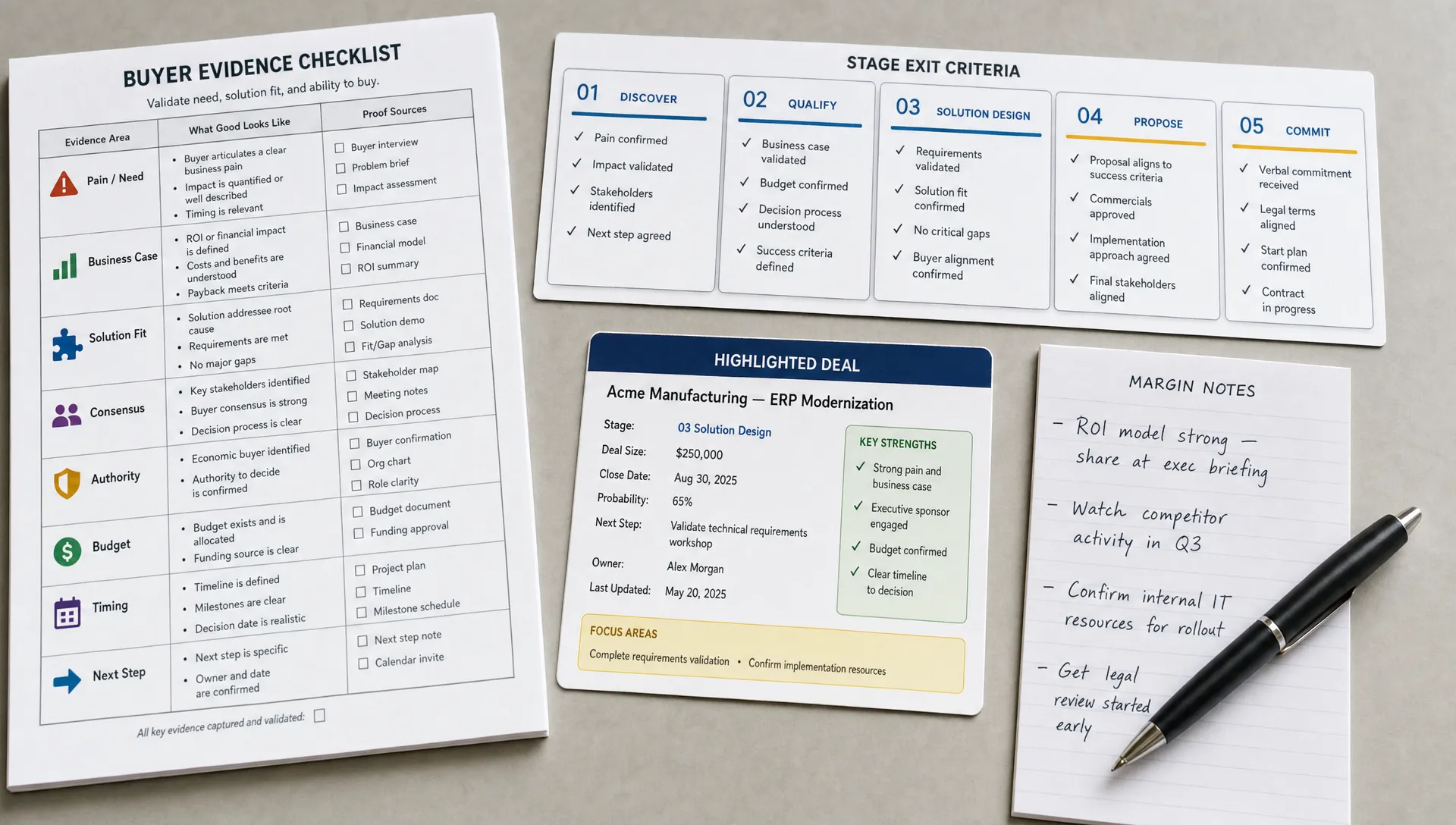
A better sales process is built around buyer evidence. For example, a deal should not advance because a demo happened. It should advance because the buyer confirmed the business problem, agreed that the proposed approach is relevant, identified the decision process and committed to a next step involving the right stakeholders.
This distinction is especially important before scale because new reps tend to mistake activity for momentum. A seller can have many pleasant conversations, deliver many demos and still create little qualified pipeline.
The simplest way to improve stage discipline is to define exit criteria for every stage. These criteria should be observable, coachable and easy to inspect during a deal review.
| Stage | Weak exit criteria | Strong exit criteria |
|---|---|---|
| Qualified | Rep believes there is interest | Buyer confirms pain, fit, urgency and a reason to change |
| Discovery complete | Discovery call held | Economic impact, current process, decision path and stakeholders identified |
| Solution fit | Demo delivered | Buyer connects the solution to a measurable business outcome |
| Proposal | Proposal sent | Buyer agrees scope, success criteria, commercial path and decision timeline |
| Commit | Rep expects signature | Final approver, procurement steps, legal blockers and close date are confirmed |
If your team already has stages but deals keep slipping, the issue may not be the CRM. It may be that the process rewards forward movement without enough proof. The related breakdown in how to fix a broken sales optimization process is useful when the pipeline exists but the conversion logic is weak.
Tighten qualification before increasing activity
When growth stalls, teams often add more leads, more sequences, more SDR activity or more events. That can help once the qualification model is strong. Before then, it usually adds cost and confusion.
Qualification is the control point that protects the entire sales engine. A weak qualification process wastes seller time, pollutes the forecast, slows management reviews and fills delivery teams with customers who were never a great fit.
Pre-scale qualification should cover more than budget and authority. At a minimum, the team should understand:
- The customer’s business problem and why it matters now
- The economic consequence of doing nothing
- The buying group and decision process
- The implementation requirements after the sale
- The competitive alternative, including internal inertia
- The fit with your best customer profile
This does not mean every business needs a heavy enterprise qualification framework. A mid-market SaaS company, field services business, B2B distributor and healthcare services platform will each need a different level of rigor. The principle is the same: do not let poor-fit demand consume your best commercial resources.
Managers should also audit disqualified opportunities. If reps never disqualify, qualification is performative. If they disqualify too aggressively, the ICP may be too narrow or the team may lack the skill to create urgency. Either way, the data becomes useful only when leaders inspect it consistently.
Standardize the moments that matter most
Not every part of selling should be scripted. Strong reps need room to adapt. But the moments that create the most revenue risk should be standardized before you scale.
In most B2B sales processes, those moments include discovery, qualification, proposal creation, pricing approval, legal review, handoff to delivery and renewal or expansion planning. If each rep handles these differently, leadership cannot know whether the process works or whether a few talented sellers are masking structural weakness.
Standardization should focus on decision quality, not robotic behavior. For example, a discovery standard might require every rep to uncover the business problem, current process, cost of inaction, decision criteria and stakeholder map. The rep can still use their own language, but the business gets consistent information.
The same logic applies to proposals. A scalable proposal process does not mean every document looks identical. It means each proposal connects the customer’s problem to the agreed outcome, scope, commercial terms, implementation assumptions and next step.
When these moments are standardized, onboarding becomes faster, coaching becomes clearer and revenue leadership can identify whether a conversion problem is caused by messaging, skill, pricing, targeting or deal process.
Remove administrative drag from the revenue motion
Sales process optimization is not only about what sellers say. It is also about what slows them down.
Administrative drag often hides in plain sight: duplicate data entry, manual quote approvals, unclear contract steps, missing customer documentation, internal Slack archaeology and compliance tasks that sit awkwardly inside the sales cycle. As the business scales, every small inefficiency compounds across more reps and more deals.
The solution is not to automate everything. Automating a bad process only makes the mess move faster. Start by identifying where reps, managers or customers repeatedly wait for information, approval or completion of a non-selling task.
Some friction should be removed with CRM workflow. Some belongs in finance, legal or operations. Some should sit in specialized tools rather than being forced into the sales stack. For instance, businesses dealing with federal excise obligations may be better served by a dedicated workflow for IRS-authorized online Form 720 filing instead of letting tax-related administration spill into commercial operations.
The broader point is simple: sellers should spend more time creating and advancing qualified demand, while the business builds clean paths for the operational steps required to support that demand.
Install a management rhythm before hiring more sellers
Many companies scale headcount before they scale management capacity. That is one of the fastest ways to turn a promising sales motion into an expensive guessing game.
Before adding reps, leadership should define the cadence for inspecting performance. This does not need to be complicated, but it must be consistent.
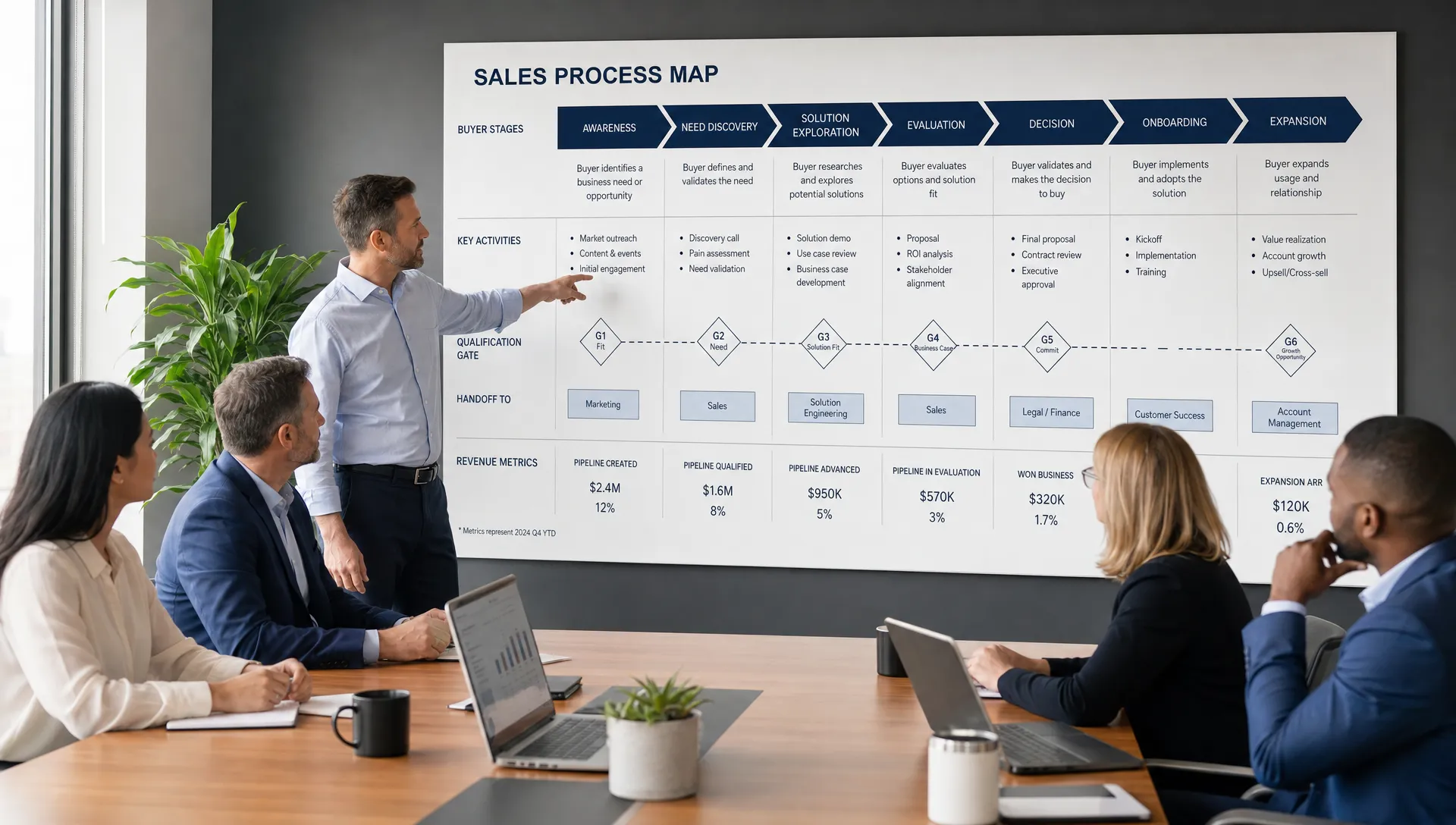
A useful revenue management rhythm usually includes weekly pipeline inspection, deal coaching, lead source review, activity quality review, forecast review and monthly analysis of conversion by segment. The point is not to create more meetings. The point is to create a shared view of where revenue is being created, delayed or lost.
The metrics should also match the maturity of the business. Early in a new motion, learning velocity may matter more than quota attainment. In a more mature motion, conversion rates, sales cycle, average contract value, gross margin, retention quality and expansion potential should receive more scrutiny.
Avoid managing only lagging indicators. Bookings, revenue and quota attainment tell you what already happened. Pre-scale leadership needs leading indicators that reveal whether the process is healthy before the quarter is over.
| Metric | What it can reveal | Common misuse |
|---|---|---|
| Qualified pipeline created | Whether demand generation is producing sales-ready opportunities | Counting all sourced opportunities as equal |
| Stage conversion | Where deals stall or exit | Ignoring segment or source differences |
| Sales cycle by segment | Whether certain customers require too much effort | Blaming reps without reviewing fit |
| Discount rate | Whether value is clear and urgency is real | Treating discounting as only a pricing issue |
| No-decision losses | Whether the team can create change energy | Grouping inertia with competitive losses |
| Handoff quality | Whether sales promises match delivery reality | Reviewing only closed-won volume |
Stress test the process before market expansion
Scaling does not only mean hiring more reps. It can mean entering a new geography, selling to a new vertical, launching a new product, adding a partner channel or moving upmarket.
Each of those moves puts pressure on the sales process. Messaging that works in one vertical may fail in another. A founder-led enterprise sale may not translate to a repeatable mid-market motion. A domestic sales process may break when the company enters the US, UAE, UK or another competitive market with different buyer expectations.
Before expansion, test whether the existing process is strong enough to travel. Can the ICP be defined in the new market? Is there proven access to buyers? Does the value proposition survive local competition? Can the team support implementation and customer success after the sale? Are the economics still attractive after longer cycles, new costs and potentially different pricing norms?
This is where staged expansion beats broad expansion. Run controlled tests, inspect the evidence and avoid calling early interest product-market fit. If market expansion is on the roadmap, the guidance in market expansion without breaking your sales engine is a useful complement to sales process optimization.
What not to optimize too early
Optimization can become a distraction if leadership starts polishing the wrong parts of the system. A company that does not understand its best-fit customer does not need a more complex dashboard. A team that cannot run discovery does not need more enablement content. A sales organization with weak qualification does not need more top-of-funnel volume yet.
Be careful with three common traps.
First, do not over-engineer the CRM before the process is validated. The CRM should reflect the sales process, not invent it. If leaders cannot explain how deals move in plain English, building more fields will not help.
Second, do not mistake scripts for consistency. Scripts can support onboarding, but mature buyers can feel when a seller is following a template instead of understanding the business problem. Standardize the required information and decision points, then coach the conversation quality.
Third, do not add AI automation before the underlying logic is sound. AI can improve research, personalization, follow-up, data hygiene and workflow speed. But if the ICP is wrong or qualification is loose, AI can simply create more noise at greater speed.
A 30-60-90 day plan to optimize sales processes before scale
A practical pre-scale program should move quickly without pretending complex revenue systems can be fixed in a workshop. The first 90 days should establish truth, repair core process gaps and create a management rhythm that survives beyond the project.
| Timeframe | Focus | Outputs |
|---|---|---|
| Days 1-30 | Diagnose the current revenue motion | Segment analysis, funnel leakage review, stage audit, ICP findings and management interviews |
| Days 31-60 | Rebuild the process around evidence | Buyer-based stages, qualification criteria, proposal standards, handoff rules and core CRM updates |
| Days 61-90 | Install operating cadence | Pipeline reviews, forecast discipline, coaching rhythm, performance dashboards and scale readiness review |
The 90-day objective is not to make the sales organization look sophisticated. It is to make it easier to answer the questions investors and leadership teams care about: where should capital go, what growth can be repeated, what risks need to be fixed and which parts of the motion are ready for scale?
Frequently Asked Questions
When should a company optimize its sales process? The best time is before adding significant headcount, entering a new market or increasing demand generation spend. If pipeline exists but conversion is inconsistent, optimization should happen before scale.
How do you know if a sales process is scalable? A scalable process produces repeatable wins in a defined ICP, has clear stage exit criteria, supports accurate forecasting and can be taught to new reps without heavy founder involvement.
What is the biggest mistake companies make before scaling sales? The biggest mistake is treating more activity as the solution when the underlying process is unclear. More leads, reps or markets will not fix weak qualification, vague ICP definitions or poor deal discipline.
Should sales process optimization happen before CRM changes? Yes. The sales process should define what the CRM needs to capture. If the CRM is redesigned before the process is clear, the business often ends up with more fields but no better commercial insight.
How does this apply to PE-backed portfolio companies? PE-backed companies need growth that improves enterprise value, not just top-line movement. Optimizing the sales process before scaling helps protect margin, improve forecast confidence, reduce revenue leakage and support exit readiness.
Build the sales engine before you press the accelerator
Scaling is not the moment to discover that the sales process depends on founder heroics, informal handoffs or pipeline optimism. It is the moment when every weakness becomes more expensive.
Phil Pelucha Consulting helps PE firms, VC-backed companies, family offices and portfolio teams design the commercial infrastructure needed for revenue acceleration, from diagnostics and sales optimization to fractional CRO support, market expansion and AI-enabled operating systems.
If your next growth phase depends on a sales engine that can scale with confidence, start by making the process measurable, repeatable and commercially true. You can learn more about Phil Pelucha Consulting and explore how stronger revenue infrastructure can support value creation before the next push for growth.