
What Makes an Acceleration Business Actually Work
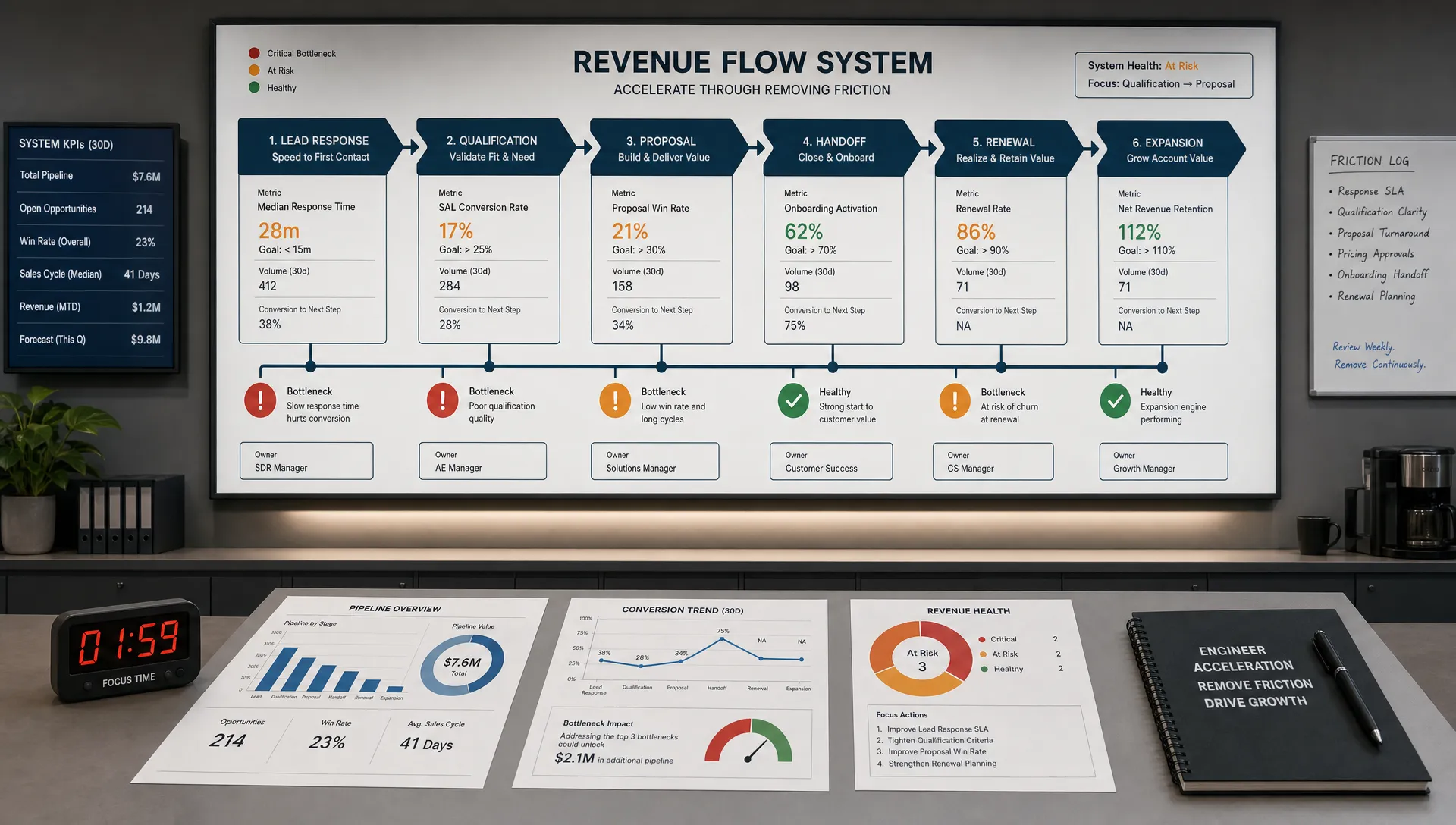
An acceleration business does not work because leaders demand more speed. It works because the company removes the friction that slows revenue, decision-making, and value creation.
For PE firms, VC investors, family offices, and management teams, that distinction matters. Anyone can push for more calls, more campaigns, more markets, and more dashboards. But activity is not acceleration. In many portfolio companies, “go faster” simply exposes weak positioning, unclear ownership, messy data, inconsistent sales execution, and a technology stack that adds cost without improving conversion.
A true acceleration business is built around a commercial system that can identify growth levers, prioritize the highest-return moves, execute with discipline, and prove progress through measurable revenue outcomes. It is not a motivational slogan. It is an operating model.
What an acceleration business really means
An acceleration business is designed to compress the time between strategic intent and measurable commercial impact. That can mean faster revenue growth, faster market entry, faster sales cycle improvement, faster margin expansion, or faster exit readiness.
The word “business” is important. Acceleration cannot depend on one charismatic founder, one high-performing salesperson, or one short-term campaign. It must become part of how the company operates. The system needs to survive board scrutiny, leadership changes, new geographies, product shifts, and investor timelines.
In a PE-backed company, acceleration is usually tied to a value creation plan. The sponsor has a thesis about where growth will come from, but the portfolio company still needs the commercial architecture to execute it. That is where many firms struggle. The deal thesis may be sound, but the revenue engine is not yet strong enough to deliver against it.
If portfolio acceleration is the goal, the starting point is rarely “more pressure.” It is usually better revenue design, meaning the connection between market focus, sales motion, operating rhythm, data, and leadership accountability.
Why acceleration fails when it is treated as speed alone
Most failed acceleration efforts have the same pattern: the company increases motion before fixing the mechanism.
The team launches into new segments before clarifying the ideal customer profile. It hires salespeople before defining the sales process. It adds automation before cleaning up data. It expands geographically before proving channel fit. It pushes pipeline targets without improving qualification quality.
The result is predictable. Activity rises, meetings increase, CRM fields multiply, and the leadership team feels busy. But win rates do not improve. Sales cycles stay long. Forecast confidence remains low. Customer acquisition cost creeps upward. The board sees effort, but not enough evidence of enterprise value creation.
An acceleration business works only when the company can separate real growth from noise. The commercial system must answer a few uncomfortable questions:
- Where is revenue actually leaking?
- Which segments produce the highest-quality growth?
- Which sales behaviors correlate with conversion?
- Which tools are essential, underused, or creating drag?
- Which initiatives should be stopped so the team can focus?
That last question is often the hardest. Acceleration is not just about doing more of the right things. It is also about removing low-value work that absorbs management attention.
The core components of a working acceleration business
There is no universal template, but successful acceleration models tend to share the same foundations. These components apply whether the company is founder-led, PE-backed, venture-backed, or preparing for a strategic exit.
| Component | What it does | What breaks when it is missing |
|---|---|---|
| Clear value creation thesis | Defines where growth should come from | Teams chase too many disconnected initiatives |
| Revenue architecture | Connects strategy, sales motion, data, and accountability | Growth depends on individual heroics |
| Focused ICP and segmentation | Prioritizes customers with the strongest fit and economics | Pipeline looks large but converts poorly |
| Sales execution discipline | Improves conversion, cycle speed, and forecast reliability | Revenue leaks remain hidden |
| Operating cadence | Forces decisions, ownership, and follow-through | Problems are discussed repeatedly but not solved |
| Technology leverage | Supports the workflow without bloating cost | Tools become expensive reporting layers |
| Talent and leadership alignment | Ensures people, incentives, and roles match the plan | Teams optimize for conflicting goals |
These components are not theoretical. They are the practical conditions that allow acceleration to become repeatable.
Start with the value creation thesis
Every acceleration business needs a sharp answer to a simple question: what kind of growth are we trying to create?
Not all revenue is equal. A company can grow by discounting aggressively, selling to poor-fit customers, overloading delivery teams, or expanding into markets where it has no durable advantage. That may produce short-term momentum, but it can weaken margins, damage customer experience, and reduce exit quality.
A strong value creation thesis defines the specific growth levers that matter most. For example, the priority might be improving enterprise conversion, increasing account expansion, entering the US market, reducing sales cycle length, professionalizing channel partnerships, or improving pricing discipline.
Without this clarity, acceleration becomes a collection of disconnected projects. Marketing pushes one direction, sales pushes another, customer success protects legacy accounts, and the board receives updates that are difficult to compare. With a clear thesis, leadership can sequence resources toward the moves most likely to improve valuation.
Build revenue architecture before scaling activity
Revenue architecture is the structure underneath growth. It includes the market focus, commercial roles, sales stages, qualification rules, pipeline governance, handoffs, metrics, and management cadence that make revenue predictable.
This is where acceleration becomes operational rather than aspirational. If the company cannot define how demand becomes qualified pipeline, how pipeline becomes revenue, and how revenue becomes retained or expanded value, then speed will only magnify confusion.
A working acceleration model defines the commercial journey from first signal to closed revenue and beyond. It makes ownership visible. It clarifies what “qualified” means. It distinguishes between leading indicators, such as response times and stage progression, and lagging indicators, such as bookings and retention.
This matters especially in investor-owned businesses. Sponsors need more than optimistic forecasts. They need a commercial system that can withstand diligence, explain performance, and show where additional capital or leadership attention will produce returns.
Fix revenue leaks before chasing new growth
One of the fastest ways to improve performance is to stop losing revenue that should already be converting.
Revenue leaks often hide in ordinary places: slow lead follow-up, weak discovery, inconsistent qualification, poor handoffs, discounting without control, bloated proposals, unclear next steps, or sales managers who inspect pipeline too late. These issues rarely look dramatic in isolation, but together they can materially reduce growth.
For many companies, the highest-return acceleration move is not a new market or new campaign. It is sales optimisation that fixes revenue leaks fast. When conversion improves inside the existing engine, the company can scale from a stronger base.
The discipline is straightforward, but not always easy. Leaders need to inspect where deals slow down, where opportunities disappear, which customer types convert, and which sales behaviors separate top performers from the rest. Then they need to turn those insights into process, coaching, and accountability.

Treat technology as leverage, not the strategy
Technology can accelerate a business, but only if it supports a clear operating model. Too often, companies buy tools to compensate for unclear process. The result is a crowded stack, fragmented data, and higher recurring spend without better commercial outcomes.
A practical acceleration business asks what the technology must enable. Does it improve speed to lead? Does it make pipeline quality more visible? Does it reduce manual work near revenue? Does it improve renewal planning, account expansion, or pricing governance? If not, it may be an expensive distraction.
This is particularly important with CRM and revenue operations platforms. Many teams treat the system as a reporting destination rather than a selling environment. Licenses accumulate. Fields multiply. Adoption varies by team. Then renewal season arrives, and the company realizes it has limited visibility into actual usage and commercial value. For organizations running Salesforce, a structured Salesforce contract and SKU review can help identify shelfware, renewal risk, and negotiation leverage before spend becomes locked in again.
The point is not to cut technology blindly. The point is to make tools earn their place in the acceleration system.
Use AI where it is closest to revenue impact
AI can make an acceleration business more effective, but only when it targets bottlenecks close to cash. The mistake is to deploy AI broadly without defining the revenue problem it is supposed to solve.
The most useful AI applications tend to reduce friction in high-frequency commercial workflows. Examples include account research, lead routing, sales call analysis, proposal support, renewal risk identification, customer segmentation, and workflow automation around follow-up. These are not flashy experiments. They are practical ways to reduce manual work, improve consistency, and help teams act faster.
For PE-backed companies, this matters because leadership bandwidth is limited. AI should help the company make better commercial decisions faster, not create another layer of dashboards that no one trusts. If the goal is measurable impact, start where AI-powered automation creates revenue fastest, then expand once the workflow is proven.
Align incentives with the acceleration plan
Even the best commercial system will fail if incentives pull people in different directions.
A company may say it wants higher-quality revenue, while compensating sales teams only on gross bookings. It may want account expansion, while customer success is measured mainly on support tickets. It may want enterprise growth, while marketing is rewarded for lead volume rather than qualified pipeline. These misalignments create predictable behavior.
Acceleration requires incentive clarity. Leaders need to decide which outcomes matter and ensure teams are measured accordingly. That does not mean every metric should be financial. It means the company must avoid rewarding activity that undermines the value creation thesis.
In practice, this often requires hard trade-offs. The company may accept fewer leads if they are better qualified. It may reduce discounting even if short-term close rates dip. It may slow hiring until the sales process is documented. These choices can feel counterintuitive, but they protect the quality of growth.
Install an operating cadence that forces decisions
An acceleration business works because it has a rhythm for identifying problems, making decisions, and following through.
The cadence does not need to be complicated. It should create a clear line of sight from board-level priorities to weekly commercial execution. The leadership team should review the same critical metrics, debate the same constraints, and assign clear ownership for the next move.
A strong cadence usually includes three layers. The first is strategic, where leadership reviews whether the value creation thesis still holds. The second is operational, where teams inspect pipeline, conversion, capacity, and customer signals. The third is tactical, where managers coach behaviors and remove blockers.
Without cadence, acceleration becomes episodic. A workshop creates enthusiasm, a new dashboard creates temporary visibility, and a short-term push creates movement. Then the company returns to old habits. With cadence, acceleration becomes part of management discipline.
Measure whether acceleration is actually working
The right metrics depend on the company’s model, but the principle is consistent. Measure the things that prove speed, quality, and repeatability.
Bookings alone are not enough. A company can hit a revenue number while weakening future performance. A healthier measurement system balances growth rate with conversion quality, margin, customer fit, retention, and forecast reliability.
| Measurement area | Useful question | Strong signal |
|---|---|---|
| Market focus | Are we winning in the segments we chose? | Higher conversion in priority ICPs |
| Pipeline quality | Is pipeline real, qualified, and advancing? | Better stage progression and fewer stalled deals |
| Sales velocity | Are deals moving faster without excessive discounting? | Shorter cycles with maintained margin discipline |
| Revenue quality | Are customers profitable, retained, and expandable? | Stronger retention and expansion indicators |
| Operating reliability | Can leaders explain performance clearly? | Forecasts become more accurate over time |
| Exit readiness | Can the growth story withstand diligence? | Repeatable process, clean data, and clear ownership |
The goal is not to create metric overload. The goal is to build confidence. Investors and executives should be able to see what is improving, what is stuck, and what decision is required next.
The first 90 days matter most
In an acceleration engagement, the first 90 days should not be spent on abstract strategy alone. They should establish commercial truth.
That means diagnosing the current revenue engine, identifying the highest-impact constraints, validating the value creation thesis, and choosing the first few moves that can create evidence quickly. The goal is not to solve everything at once. It is to prove where acceleration is possible and build momentum around the right priorities.
For a PE-backed or investor-owned company, this period often reveals whether the business needs sharper positioning, better sales management, stronger revenue operations, a more disciplined expansion strategy, or leadership support such as a fractional CRO model. It can also reveal whether the existing team is capable of executing the plan without additional support.
The best first 90 days create a shared commercial language between sponsor, board, CEO, and revenue leaders. That alignment is often the difference between a plan that sounds convincing and a plan that actually changes performance.
What makes it work in the real world
An acceleration business works when speed is engineered into the company’s commercial system. It requires focus, sequencing, data, leadership discipline, and a willingness to remove friction before adding more motion.
The companies that succeed do not treat acceleration as a campaign. They treat it as infrastructure. They know where growth should come from, how revenue is created, which metrics matter, where execution is leaking, and how technology supports the operating model.
That is what separates durable acceleration from temporary intensity.
Frequently Asked Questions
What is an acceleration business? An acceleration business is a company designed to shorten the time between strategy and measurable commercial results. In a PE or portfolio context, it usually means improving revenue growth, sales execution, market expansion, operating discipline, and exit readiness.
How is business acceleration different from ordinary growth? Ordinary growth may come from more activity, more hiring, or favorable market conditions. Business acceleration is more deliberate. It improves the system behind growth so performance becomes faster, more repeatable, and easier to measure.
Why do acceleration efforts fail? They often fail because companies try to scale before fixing the revenue engine. Weak ICP discipline, poor sales process, messy data, unclear ownership, and misaligned incentives can all turn acceleration into expensive activity.
Does AI automatically make a company accelerate faster? No. AI helps when it is applied to specific commercial bottlenecks, especially workflows close to revenue. If the process is unclear or the data is unreliable, AI can simply make bad execution happen faster.
What should PE firms look for when assessing acceleration potential? PE firms should look for clear growth levers, revenue quality, pipeline reliability, management discipline, sales process maturity, customer retention signals, and evidence that the company can scale without depending on individual heroics.
Turn acceleration into a commercial operating system
If your firm is evaluating how to accelerate revenue across a portfolio company, the question is not simply how to grow faster. The better question is what commercial infrastructure must be installed so growth becomes repeatable, measurable, and exit-ready.
Phil Pelucha Consulting supports PE firms, VC investors, family offices, and portfolio companies with revenue acceleration consulting, commercial diagnostics, fractional CRO support, market expansion, sponsor advisory, and AI-enabled commercial systems. If acceleration needs to move from ambition to execution, start with the revenue system behind the number.