

Why Portco Companies Need Better Commercial Cadence
In private equity, growth problems are often diagnosed too late. A portfolio company misses a quarter, pipeline coverage looks thin, customer churn appears higher than expected, or sales activity increases without translating into predictable revenue. By the time the issue reaches the board pack, the business has already lost weeks or months of value creation time.
That is why portco companies need better commercial cadence.
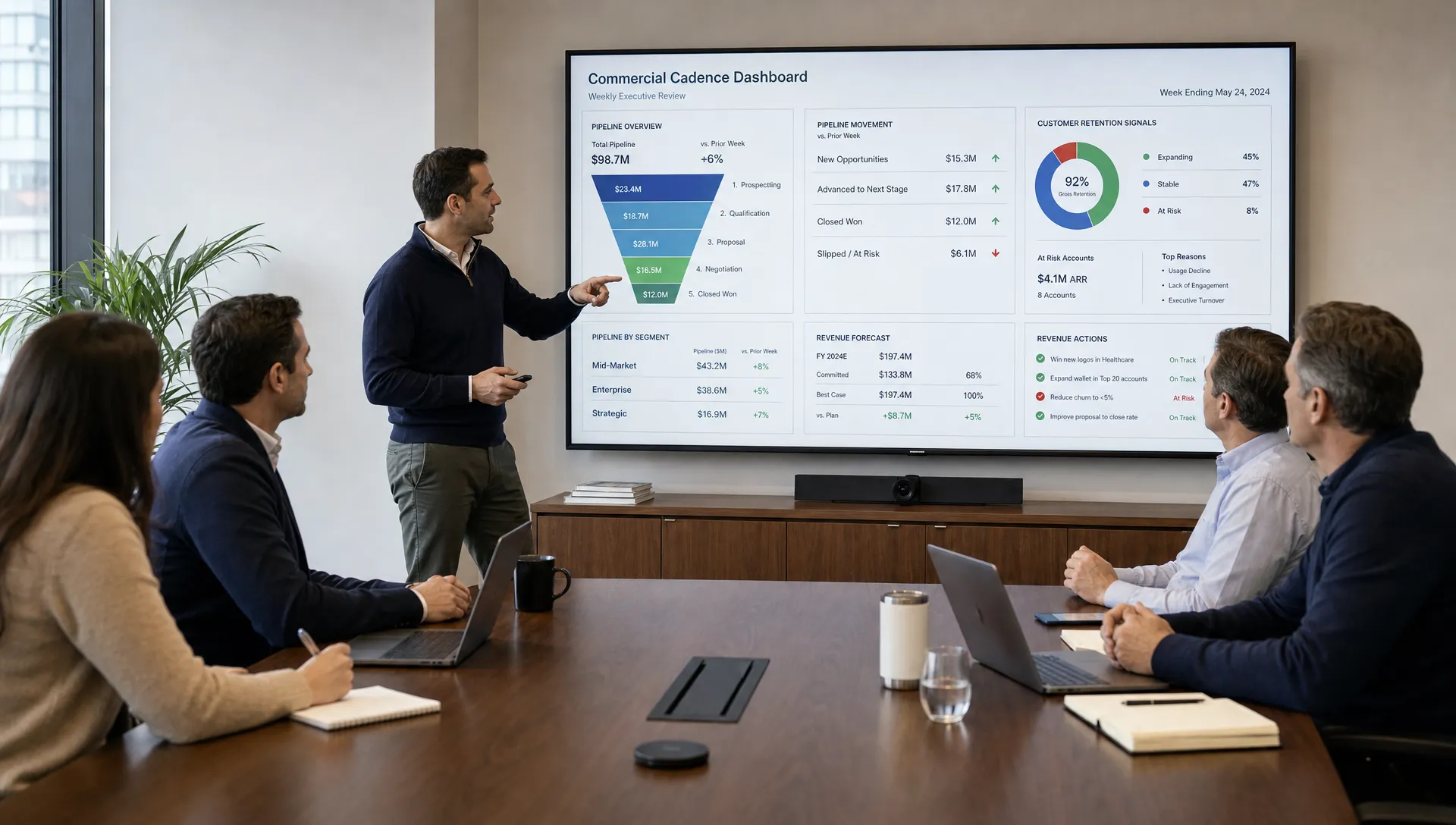
Commercial cadence is not just a meeting calendar. It is the rhythm by which a company reviews market signals, inspects pipeline, makes revenue decisions, assigns ownership, and follows through. It connects the value creation plan to what actually happens in sales, marketing, customer success, pricing, operations, and leadership communication.
For sponsors and management teams, cadence is the difference between hoping the growth plan works and knowing, early enough, whether it is working.
Commercial cadence is the operating rhythm behind revenue execution
Most portco companies already have activity. They have sales calls, CRM updates, leadership meetings, board reporting, marketing campaigns, and monthly performance reviews. The problem is that activity does not automatically create commercial control.
A better commercial cadence answers four questions every week or month, depending on the operating layer:
- What changed in the market, pipeline, customer base, or buying process?
- What does the data tell us about the quality of revenue, not just the quantity?
- What decision needs to be made now?
- Who owns the next action, by when, and how will it be inspected?
Without that rhythm, commercial teams can look busy while the company drifts away from the investment thesis. Deals sit in late-stage pipeline without movement. Forecasts become opinion-based. Marketing celebrates lead volume without knowing whether the right accounts are converting. Customer feedback stays trapped in support tickets. Sponsors get polished reporting, but not enough operational truth.
A strong cadence turns commercial execution into a system. It gives management and investors a repeatable way to spot friction, prioritize constraints, and course-correct before revenue risk becomes valuation risk.
Why weak cadence damages value creation
Private equity ownership changes the commercial standard. A founder-led business may have grown through relationships, market timing, or the judgment of a few key people. Under PE ownership, that is rarely enough. The company needs revenue that is repeatable, inspectable, and transferable.
Weak cadence damages that objective in several ways.
First, it slows learning. If a new segment, channel, pricing motion, or sales process is not reviewed frequently with the right leading indicators, the company may spend a full quarter learning what it should have learned in three weeks.
Second, it hides accountability gaps. When commercial reviews focus only on lagging outcomes, every function can explain why the number moved, but no one owns the operating behavior that should change next.
Third, it weakens forecast confidence. A forecast is only as reliable as the inspection rhythm behind it. If deal stages, next steps, buyer engagement, procurement risk, discounting, and close plans are not reviewed consistently, the forecast becomes a collection of hopeful estimates.
Fourth, it disconnects revenue from customer experience. Retention, expansion, onboarding friction, implementation delays, and support quality all affect commercial performance. When support volume, onboarding friction, or service quality influence retention, portcos may also need outside CX capacity. A partner focused on managed customer service teams and CX consulting can help close the loop between customer experience data and commercial cadence rather than leaving those signals buried in tickets.
Finally, weak cadence makes risk harder for sponsors to see. If you want to understand how those issues surface before they hit EBITDA or exit value, the same logic applies to how a PE sponsor can spot commercial risk early by looking beyond headline revenue.
What better commercial cadence looks like inside a portco
Good cadence is not about adding more meetings. In many cases, the first improvement is removing meetings that do not lead to decisions. The goal is to design an operating rhythm where each review has a clear purpose, a defined data set, an owner, and a decision path.
| Cadence layer | Core question | Typical frequency | Primary output |
|---|---|---|---|
| Demand generation | Are we creating the right opportunities from the right markets? | Weekly or biweekly | Channel decisions, campaign adjustments, ICP refinement |
| Pipeline inspection | Is pipeline quality improving or just pipeline volume? | Weekly | Stage discipline, next actions, disqualification decisions |
| Deal review | What must happen to move priority deals forward? | Weekly | Mutual action plans, executive involvement, pricing strategy |
| Forecast review | What revenue can we defend with evidence? | Weekly or monthly | Forecast confidence, risk flags, commit discipline |
| Customer revenue review | Where are retention, expansion, and satisfaction signals changing? | Monthly | Save plans, expansion plays, service fixes |
| GTM leadership review | What constraints are slowing growth across functions? | Monthly | Cross-functional decisions, resource allocation, KPI changes |
| Sponsor review | Are we progressing against the value creation thesis? | Monthly or quarterly | Board-level actions, investment priorities, intervention points |
The frequency matters less than the integrity of the rhythm. A weekly pipeline meeting that accepts vague updates is weaker than a biweekly review that forces evidence, decisions, and follow-up. Similarly, a monthly sponsor review that explains the past without changing the future is not cadence. It is reporting.
Better cadence creates compression. It compresses the time between signal and decision. It compresses the distance between sales reality and board understanding. It compresses the gap between the value creation plan and field execution.
The common cadence gaps in portco companies
Most cadence failures are not caused by laziness or lack of talent. They are design problems. The commercial system was never built for the level of inspection and speed PE ownership requires.
One common gap is the absence of a shared definition of quality pipeline. Sales may count every opportunity in CRM, marketing may count every form fill, and leadership may assume coverage is healthy. But if those opportunities do not match the ideal customer profile, buying trigger, budget reality, and timeline required by the plan, the pipeline is inflated.
Another gap is reviewing lagging indicators too heavily. Revenue, EBITDA, bookings, and churn are important, but they tell management what already happened. A cadence that only reviews lagging metrics will always be late. Portcos need leading indicators such as qualified meetings, stage conversion, sales cycle movement, renewal risk, executive engagement, and expansion signals.
A third gap is anecdotal selling. In many founder-led or relationship-led businesses, sales reviews revolve around stories. The best salespeople explain their deals well, and weaker salespeople hide behind optimism. Better cadence replaces charisma with evidence. What problem is the buyer solving? Who is the economic buyer? What is the next confirmed step? What risk has changed since last review?
A fourth gap is poor cross-functional flow. Marketing, sales, customer success, finance, and operations may each have their own meetings, but no shared revenue rhythm. This is especially damaging in companies trying to move upmarket, enter a new geography, shift pricing, or expand through existing accounts.
The final gap is over-reliance on the CEO. Many portcos still use the CEO as the connective tissue between functions. That works for a short period, but it does not scale. A commercial cadence should reduce the CEO bottleneck by clarifying where decisions happen and who owns execution.
How to install better commercial cadence without creating bureaucracy
The best cadence is simple, visible, and decision-oriented. It should make the business faster, not heavier. Start by treating cadence as part of revenue architecture, not as an administrative layer. If the company is already rebuilding its growth model, this is closely connected to creating portfolio company value through revenue systems rather than relying on isolated sales effort.
A practical installation path looks like this:
- Start with the investment thesis: Identify the revenue assumptions that must become true for the deal to work. These may include new logo growth, pricing uplift, expansion revenue, channel productivity, enterprise penetration, lower churn, or U.S. market entry.
- Translate outcomes into leading indicators: For each thesis assumption, define the weekly or monthly behaviors that prove progress. If the plan depends on enterprise growth, track senior buyer engagement, multi-threading, deal stage aging, security review risk, and average contract value movement.
- Define the minimum data set: Avoid dashboard sprawl. Choose the few metrics each cadence needs to make decisions. If a metric does not change behavior, it is probably not needed in that review.
- Set decision rules: Decide in advance what happens when metrics move outside tolerance. For example, if stage two to stage three conversion falls for three weeks, the team reviews qualification criteria, call quality, and source mix before increasing spend.
- Assign owners and follow-up: Every cadence should end with named actions. The next meeting should begin with whether those actions happened and what changed as a result.
This approach protects the organization from meeting inflation. The point is not to talk about revenue more often. The point is to make better commercial decisions sooner.
Cadence should evolve across the hold period
A newly acquired portco does not need the same commercial cadence as a company preparing for exit. Cadence should mature as the value creation agenda moves from diagnosis to acceleration to buyer readiness.
| Hold period stage | Cadence priority | What leadership should inspect |
|---|---|---|
| First 100 days | Diagnose commercial reality | Revenue quality, pipeline truth, pricing discipline, customer concentration, sales process gaps |
| Early value creation | Stabilize and standardize | ICP clarity, qualification, CRM hygiene, weekly sales discipline, customer feedback loops |
| Growth acceleration | Scale what works | Channel ROI, segment performance, sales capacity, hiring productivity, expansion motions |
| Pre-exit | Prove repeatability | Forecast accuracy, cohort performance, retention quality, management depth, transferable revenue systems |
This is where many portcos get sequencing wrong. They try to scale before the commercial rhythm is stable. They hire more reps, add markets, increase marketing spend, or launch partnerships while the existing system cannot yet explain which revenue is high quality and repeatable.
Before scaling, a company should know who it serves best, why those buyers convert, what sales motion wins, which metrics predict success, and what operating rhythm keeps the team aligned. That foundation is central to what every portfolio company needs before scaling.
The metrics that make cadence useful
Metrics should not be chosen because they are easy to report. They should be chosen because they improve judgment. In a portco environment, the best commercial cadence blends leading indicators, conversion data, quality signals, and financial outcomes.
| Metric category | Examples | Why it matters |
|---|---|---|
| Demand quality | ICP-fit leads, qualified meetings, source conversion | Shows whether growth effort is aimed at the right market |
| Pipeline movement | Stage conversion, stage aging, next-step compliance | Reveals whether opportunities are progressing or stalling |
| Deal quality | Average contract value, discounting, multi-threading, buyer seniority | Separates attractive revenue from fragile revenue |
| Forecast integrity | Commit accuracy, slippage rate, close-date movement | Improves board confidence and cash planning |
| Customer health | Renewal risk, onboarding completion, support trends, expansion signals | Connects customer experience to future revenue |
| Commercial productivity | Ramp time, quota attainment, win rate by segment | Shows whether scaling adds efficiency or complexity |
The important point is not to track everything. It is to track the few things that expose commercial truth. If the management team cannot explain what decision a metric supports, that metric belongs in a dashboard, not necessarily in the cadence.
What sponsors should expect from better cadence
For sponsors, better commercial cadence improves visibility without requiring micromanagement. The board does not need to inspect every deal or run the sales team. It does need confidence that management has a disciplined rhythm for identifying constraints, making decisions, and acting quickly.
A stronger cadence should change the quality of sponsor conversations. Instead of asking, why did revenue miss, the discussion becomes, which leading indicator deteriorated first, what did we do about it, and what have we learned? Instead of debating whether pipeline is big enough, the team can discuss whether pipeline is qualified enough. Instead of accepting generic growth commentary, the sponsor can see how each commercial initiative maps back to the investment thesis.
This also strengthens exit readiness. Buyers want more than historical growth. They want evidence that growth can continue under new ownership. A clean commercial cadence helps demonstrate that the company has management depth, revenue visibility, repeatable GTM execution, and operational control.
Frequently Asked Questions
What is commercial cadence in a portco company? Commercial cadence is the recurring operating rhythm used to review revenue signals, inspect pipeline, make decisions, assign ownership, and follow up. It connects the value creation plan to day-to-day commercial execution.
Why do portco companies need a different cadence after acquisition? PE ownership introduces tighter timelines, higher scrutiny, and a stronger focus on repeatable revenue. A cadence that worked in a founder-led phase may not provide the visibility or accountability required during the hold period.
Is commercial cadence just another name for sales meetings? No. Sales meetings are one component. Commercial cadence includes demand generation, pipeline, forecasting, customer retention, expansion, pricing, GTM decisions, and sponsor-level reporting.
How often should a portfolio company review commercial performance? The right frequency depends on the operating layer. Pipeline and priority deals often need weekly inspection, while customer revenue and GTM performance may be reviewed monthly. Sponsor-level reviews are usually monthly or quarterly, but should be tied to clear decisions.
Build a cadence that turns revenue activity into value creation
Portco companies do not need more noise. They need a clearer rhythm for seeing the truth, making decisions, and improving execution before small issues become missed targets.
Phil Pelucha Consulting helps PE firms, VC funds, family offices, and portfolio companies diagnose commercial bottlenecks, strengthen revenue systems, and install the operating cadence needed for acceleration and exit readiness. If your portfolio company has revenue ambition but lacks commercial control, Phil Pelucha Consulting can help turn the growth plan into an executable system.